SALFORD STAR CALL FOR PATHFINDER PUBLIC INQUIRY PART 5
To get the background please read…
Part 1 here
Part 2 here
Part 3 here
Part 4 here
"I think Broughton Green is going to turn out to be a success actually in the end" John Merry Leader Salford City Council
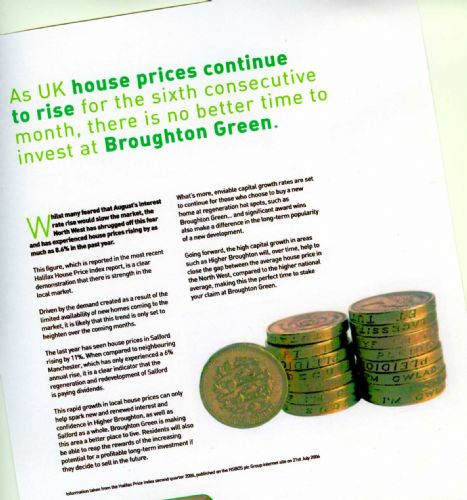
The Audit Commission report into the Manchester Salford Pathfinder doesn't say too much about Higher Broughton as `there wasn't time'. So we thought we'd help them with some information…
Of the many houses that were knocked down in the Top and Bottom Streets of Higher Broughton, just 19 new `affordable houses' were set aside for the existing population in the early phase, back in 2006.
In Salford Council's official evaluation report (which we had to get via the Freedom of Information Act) of those 19 houses in Vincent Street some figures were produced from which we can get some idea of what the hell was going on…
Of the 19 houses, seven were three bedroom – costing £135,000 each, and 12 were two bedroom costing £110,000 each. The report states that "The properties were sold by the Partnership* to qualifying residents on the basis of construction cost plus an 'allowable' 10% profit".
Some might well question whether a two bedroom house up there actually cost £100,000 to construct in the first place. But here, the point is that from the 19 `affordable' houses the developers (Higher Broughton Partnership) walked away with £226,500 profit. And the residents who'd had their houses knocked down? Well they got, according to the evaluation report, "a substantial funding gap between the value of the compensation residents were offered for their existing house and the value of the new property".
That "gap" was an average of around £70,000. The residents got around £40,000 for their old house and had to pay £110-135,000 for a new one.
To help residents buy one of these new `affordable' houses, Salford Council provided a `relocation grant' of £25,000 (to be paid back if they sell up within 10 years) plus an equity loan of between £40-£50,000. Which basically meant that whereas before the regeneration, residents owned 100% of their houses, after regeneration they owned around half a house.
In the evaluation report, only 50% of the 15 respondents were happy with how they were sold the financial package – almost 30% were dissatisfied. "The possible explanation of this" the report understated "may relate to the complexity of the model used and the fact that some found it difficult to understand the possible implications of using the assistance."
The `implication' was that, before, they owned 100% of a house, and now they don't, while the developers walk away with over £200,000 profit. This is just one tiny snapshot, where figures are available, of the whole Pathfinder mess.
These 19 houses were only built after Salford Council was slated by an earlier Audit Commission report which stated that there was "no housing for existing residents affected by clearance…It would seem very obvious that the first phase should provide homes for people being relocated".
The Salford Star went into great detail about this Audit Commission report and the whole Higher Broughton regeneration back in Issue 4 (click here for details).
Meanwhile, at the moment three existing residents of the Top Streets have a High Court injunction on Salford Council to stop it demolishing their homes in the Top Streets (see here), while another is taking the Council to the Land Tribunal for the umpteenth time, trying to get a proper value for his house.
Elsewhere in Higher Broughton, houses that were built for sale haven't sold.
And so more Government money has been thrown at the development to bale it out…
Contour Housing got a grant of £1.766million to convert `shared ownership' houses that didn't sell in Devonshire Square to social rent. Contour also got a further grant of £1.714 for 35 properties converted from private sales into affordable rent and `intermediate housing'. Orthodox Jewish housing association, Agudas Israel, took over dozens of properties that didn't sell in the `award winning' Broughton Green complex, including 12 houses for social rent, backed by a whopping Government grant of £2.2million, or £183,000 per house.
At one point, the Higher Broughton Partnership, of which Salford City Council is a partner, owed its creditors £12.375million, including a bank loan of £10.75million from the Royal Bank of Scotland. On the last set of accounts that we've seen, the Higher Broughton partnership had liabilities of £5.681million, of which Salford Council shared 19%, and was directly liable for £1.079million.
This month, the whole Higher Broughton Partnership has been restructured and a new company formed "to safeguard against potential future claims".
We asked Salford City Council what the hell this was all about to which Council Leader John Merry replied… "Higher Broughton General Partner Ltd will take overall responsibility for the development scheme, including dealing with any potential claims that could come in from individuals who object to the work that the partnership is doing – although at this stage no claims have been received. This is standard practice for a group like this and avoids claims being passed between agencies."
That's confidence for you!
Altogether, four different Higher Broughton Partnership companies have been used throughout the regeneration making transparency and public accountability almost impossible.
Between 2003 and 2006 alone Higher Broughton had £13million of Pathfinder money pumped into it, the highest in Salford at that time, only for the Audit Commission report at that time to question "how its development will contribute to the future sustainability of the whole Higher Broughton area".
Part of the answer comes in the latest and final Audit Commission report analysing the regeneration up to December 2010, where Higher Broughton is cited as having an empty properties problem. Despite all the demolitions in the Top and Bottom Streets, long term voids (properties empty for over six months) in the area are actually higher than in 2006. This, the report notes, shows "a potential lack of demand".
Five years after the Audit Commission asked how the re-development of Higher Broughton will help lift the area, it's obvious to anyone au fait with the area that it hasn't. Yet £38,548,879 of public money has been pumped into the area, together with £24,800,000 of private funds.
The Audit Commissions report also notes that Higher Broughton is one of those areas where "there are significant areas of vacant land where a future programme will be required to address current dereliction and complete the transformation of the neighbourhoods".
The report adds that "unless this happens some neighbourhoods could start to regress again and the cost of this decline could be significant to the public purse…"
The Audit Commission even quotes a `cautionary tale' from Higher Broughton residents about what happened the last time Salford Council's attempt at regeneration went wrong – a rise in anti-social behaviour and crime.
Now Salford Council and its Higher Broughton Partnership is going back to the government asking for more cash – it's one of 16 schemes bidding for £85million of Regional Growth Fund money to "regain momentum" for its new homes schemes. Which is surely admitting that, so far, the regeneration of Higher Broughton, even on its own terms, has been a flop and a failure.
The `regeneration' of Higher Broughton needs a public enquiry of its own, never mind the whole Pathfinder programme.
Higher Broughton: £63,348,879 spent.
Demolitions: 625
News Builds: 248
* THE HIGHER BROUGHTON PARTNERSHIP consisted originally of Salford City Council, Royal Bank of Scotland, InPartnership and City Spirit
SALFORD COUNCIL LEADER JOHN MERRY RESPONDS…
Back in December 2010 Salford Star editor, Stephen Kingston, interviewed Salford Council Leader John Merry about the regeneration of Higher Broughton, in particular the new houses at Broughton Green which were for sale at prices up to £480,000. Here's the very slightly edited highlights…
John Merry (JM): I think Broughton Green is going to turn out to be a success actually in the end. And we're talking about further phases and how that's going to work.
Stephen Kingston (SK): According to the last accounts we've seen, Salford Council has a £1.09million liability – that doesn't look like a success. There's also loads of unsold properties.
JM: Some of those units have since come off our hands
SK: But they've gone to social rent which wasn't the idea. The idea was to stop renting.
JM: I disagree I think the idea was to have a mixture of properties
SK: Not according to Pathfinder.
JM: I'm telling you how I envisage it happening. Yes there were issues about the private sector but there was also the fact that we wanted the mix of houses. The market did collapse in terms of housing
SK: This was before the housing crash in 2009
JM: I'm not quite clear what you are trying to say. I'm saying to you that those properties have been taken off our hands by Agudas Israel, that is perfectly true. I don't regard that as a bad result, I regard that as an opportunity in the area to actually rent those properties out and to bring new families into the area
SK: That wasn't the idea. The idea was to sell them.
JM: That was the idea as far as I'm concerned, right from the very beginning
SK: I know you don't like talking about ghettos but the houses were built after consultation with the orthodox Jewish community.
JM: Hang on, don't let's talk about ghettos. I actually live in that particular area and I'm not Jewish so… I do admit there is a large proportion of Jewish families and I don't think that's a bad thing, I mean any families are welcome to come.
SK: The point is that the consultation was done with the orthodox Jewish community asking `What do you want?' and they said `Oh we'd like seven bedroom houses please and five bedroom houses' - but you never asked if they could afford them
JM: You're not criticising us for consulting the community that's in the area, what you're saying is that's what they wanted which is perfectly true and in some cases they didn't buy them which is also perfectly true.
SK: Fancy building houses that no bugger can afford. You go round and ask people what they want and they'll say – `I'd like a mansion please'
JM: We want a mixture of houses. The fact remains that some of those houses have gone, some of them went incredibly quickly. Now the question of whether we got the pricing right or not is a different matter. The fact remains that I'm confident that those houses will eventually be sold.
SK: You say you've had a return from them?
JM: I'm saying that we're getting things like the community hub which is basically being paid for from the return the Council got.
SK: Where's that written down? Can I see it? The profit or the return?
JM: The accounts have been published.
SK: No they haven't .
JM: We'll get the information for you. There aren't super profits there, no. What I'm saying is that we've got a return in terms off the money invested and that is going into the hub which is currently being built as we speak.
SK: Yes we've been told the Manchester Housing office is going in there
JM: Is there anything else bananas you've been told?
SK: Partners in the Higher Broughton Partnership have pulled out haven't they?
JM: I think we can get you the details because there has been some restructuring, that's perfectly true. And one of the situations is that money was borrowed from the Bank of Scotland and of course they've had a very difficult period and they are looking for a return on their money as well. So we've got to make sure everyone's happy. We'll get you the details.
That was in December. It's now nearing the end of March – and only this week have we had any kind of an answer (see above) which is still not satisfactory. We've asked to see all the Higher Broughton Partnerships accounts, only to be told they are available at Companies House. But they're not. Watch this space for further details…
READ THE CONCLUSION PART 6 HERE
WHAT IS HOUSING MARKET RENEWAL OR THE MANCHESTER SALFORD PATHFINDER?
In Salford, the Pathfinder covered the whole of Central Salford within a few miles radius of Manchester – Broughton, Kersal, Ordsall, Langworthy, Seedley and the area defined as Irwell Riverside.
Pathfinder was a Government project started in 2003 with a vision to "create a mixed housing offer with a range of types, values and tenures that will meet the aspirations of both new and existing residents". In other words, the vision was to bulldoze loads of existing, affordable houses, and build new expensive ones for Manchester commuters without pissing off the people already living in those areas.
The Pathfinder financed schemes include Countryside Properties `New Broughton'; Broughton Green in Higher Broughton; the Urban Splash `upside down houses' in Chimney Pot Park; LPC Living in Ordsall, and Miller Homes' Unity Quarter in Kersal.




.jpg)


.jpg)
.jpg)
(3).jpeg)
.png)
(1).JPG)
