READ PART 1 HERE
READ PART 2 HERE
READ PART 3 HERE
PART 4
COMMUNITY ABUSE!
"This was supposed to make everything better…But we didn't get what was promised."
Recently, the Audit Commission produced a report on the Manchester and Salford Pathfinder, the £354million housing programme which has aimed to regenerate Central Salford by pulling existing houses down and replacing them with `nicer' ones.
In Part 2 of the Salford Star call for a public inquiry into Pathfinder, we looked at how the programme was merely a free for all for developers' profits. In Part 3 we looked at the hopeless economic impact of Pathfinder spending in Lower Broughton, and in Part 4 we follow the Audit Commission's case study of Lower Broughton where it researched to what "extent local people influence spending priorities, and engage in decision making"…
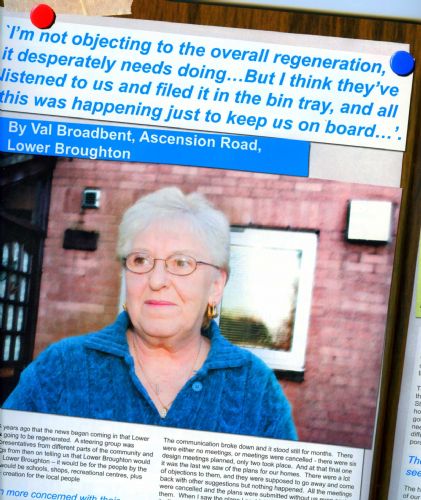
Val Broadbent was a former resident of Lower Broughton and moved to `New Broughton' almost four years ago, in Phase 1 of the area's regeneration.
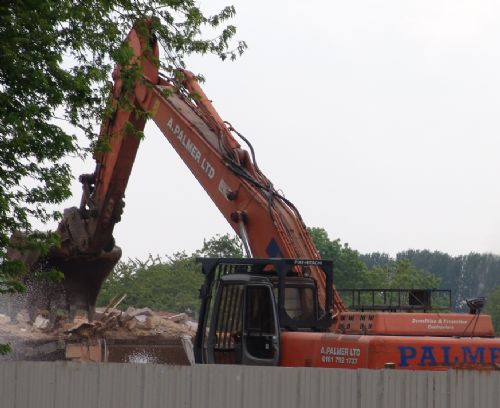
Val lived in Ascension Road, in a Salford University designed eco-house that was only 22 years old. But it was taken off her and demolished as part of the `regeneration'.
When Val read parts of the Audit Commission report she is absolutely horrified, particularly the paragraph on the whole premise of the Pathfinder programme
Audit Commission report Page 15: Point 37… The pathfinder area is historically characterised by low levels of owner occupation compared with the national, regional and subregional averages. MSP set out to change the balance of the housing market, by demolishing unpopular and obsolete private and social rented housing, and providing a broader mix of tenures and house types.
"They didn't demolish any unpopular and obsolete properties in Lower Broughton" says Val "All the houses were modern and fully tenanted. There were no void, vandalised or derelict properties. All they did was exchange our homes for substandard poor quality boxes."
Val has been involved at every stage of the community engagement in Lower Broughton and can barely conceal her anger when she reads the Audit Commission's Case Study 3 on `Resident engagement in regeneration plans' and its conclusion which states `the HMR programme takes account of the views of local people in determining the shape of their neighbourhoods'.
"It might look that way on paper but it just wasn't like that" says Val. She picks out particular statements from the Case Study…
`The creation of a formal steering group, the Lower Broughton Regeneration Partnership with representation from across the area, has further strengthened community involvement…'
"This is way out of date and stopped working pre 2007 when the steering group fell apart" says Val "This was the theory but in practice it never worked."
`A series of themed planning workshops involved all local stakeholders, allowing the exploration of detailed design issues…'
"This never happened for Phase 1" adds Val "The workshops were cancelled and we never saw the plans until after they had been submitted."
Indeed, residents have catalogued every consultation meeting that was supposed to have taken place since 2005 but didn't, complete with missing minutes for those that did; plus five years of complaints about the regeneration from people in both private and social housing.
The Audit Commission report Page 22. Point 53 states: `Residents, for example, have expressed high levels of satisfaction with the way that their transfer to a new build scheme was handled in New Broughton.'
Residents were so delighted with the transfer that the New Broughton Residents Association carried out its own survey into `satisfaction' with Phase 1 of the scheme. A sample of 61 occupiers of new properties took part in the survey, 49 in social housing and 12 in private housing.
62% of its sample thought that they were `Worse off from where they moved from'. Only 4 people, or 6.5% of the sample, thought they were `Better off'.
When asked whether they were better or worse off `from what you understood things would be like from the New Broughton plans', 62% thought they were worse off, 6.5% thought they were `Better off' and 15% hadn't even seen the plans!
This survey, presented to a special meeting of the Lower Broughton Regeneration Partnership in November 2010 wasn't mentioned in the Audit Commission's report praising the `high levels of satisfaction' of residents affected by the New Broughton transfer.
"It's obvious that the figures they quote are just copied from 'paper reports' as though everything is black or white" says Val "For example, yes it's true they did demolish my house and give me a new one but nothing in the report reflects the 'human' side of that.
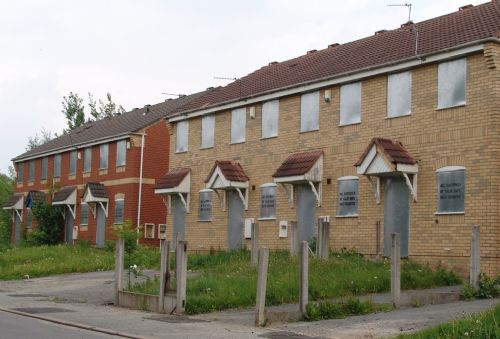
"I still to this day can't understand why they took that house off me and gave me this rubbish" she adds "We all had perfectly good houses but when you read what they put down, we all came from derelict properties. In fact we complained at the time that we were treated like slum clearance. They all thought we had a coal fire, a tin bath on the wall and an outside loo or something. But the house I had was only 22 years old and it was twenty times better than this new one. There was nothing wrong with any of the houses but they've replaced them with matchboxes."
Val takes particular offence to the whole patronising tone of the Pathfinder programme which seems to see `problem communities' but not the reasons for the problems.
"The area was a mess because of Salford Council pulling two schools down, the car wash, the nursery, the CAB…everything was taken away, demolished and left to rot with nothing put in its place" she explains "It was never cleaned up, it was just left like bomb sites. Everything was taken away from around us and then it was blamed on us for what the area looked like. All that's left now is the church but we can't even get there because they've blocked off all the access from here.
"This was supposed to make everything better" she says "But we didn't get what was promised."
The Audit Commissions reports that `New shops on Broughton Lane are serving local consumer demand, with space becoming available to hold even more new traders…'
The reality is two shops – a Costcutter and a chemist.
"Even these shops have taken three years to emerge" says Val "Costcutter has only just started to get a few morning papers and you can't do your weekly shop, although you can do your lottery in there. Meanwhile, we've been blocked off from Mocha Parade for over three years. It used to be a five minute walk there, now it's a 25 minute walk. You can see it from the bottom of my street but you have to walk all around the place to get there."
Pathfinder uses a lot of gobbledegook about rebuilding sustainable communities. The experience of Val in New Broughton is the complete opposite. It's destroying community.
"The new people who have moved in don't give much to the community" she says "A lot are students or Chinese people. The houses were bought by landlords and let to students – which we were told wouldn't happen. It's not people like you and me and my son who are buying houses to live here. It's a moving population and that's why there's no community because it's not stable. One lot of students come in and after a few months they're gone and another lot come in. They don't want to socialise with you. They don't want to sit in their gardens and talk to you."
Indeed, driving through New Broughton all looks shiny and new. But behind the gloss the community spirit has all but died.
"We are lonely and isolated and it isn't for want of going to courses or joining in, it's the daily life" Val explains "We had driveways at the other house and you met your neighbours on a daily basis – they were cleaning their cars, sat out reading the paper, doing bits of gardening…you'd go in the back hanging your washing out and see them, or sit at the back when it was sunny and speak to your neighbours over the fence. But here I'm surrounded by a 6ft fence – the only time I see next door is if I meet her on the street going shopping.
"There's no contact with your neighbours other than going and sitting in their houses which we don't really want to do all the time" she adds "You never see a soul unless you go out."
A Salford City Council report on New Broughton stated back in July 2005 that "The aim of the scheme is to demonstrate best practice in urban regeneration".
Six years later, with over £100million invested, only 685 new houses built, no community facilities completed and bleak prospects for further public investment, Val doesn't think the regeneration of Lower Broughton will ever be finished…
"Certainly not in my lifetime" she says and repeats "I didn't get what was promised – it was supposed to make everything better…"
We asked Roy Irwin, the Audit Commission's Director of Housing, what he would say to people in Lower Broughton who believe that the community engagement was a sham…who believe that Pathfinder decisions were not taken in the interests of the community… who believe that the houses are of poor quality… and who now feel that their community has all but died.
Remarkably, he replies that he wouldn't disagree with those people.
"This area has been in decline for a long time, and I'm sure that decline hasn't been completely turned around at all" he says "So if the people and individuals are not happy with what's happened so far I accept that and their views because they live there. We're just reporting on the overall progress or lack of it in some circumstances that's been made in Manchester and Salford.
"We did pick out Broughton as one of the neighbourhoods where there had been activity but I don't think we say that everything's been solved, and I'm sure there will be people with different views and opinions about what's been achieved. But what's been achieved or not been achieved is a matter for the Pathfinder. So I'm not disagreeing, I'm just saying that we've reported on the information we've had and no doubt there will be people with contrary views."
The information they've had? From whom? From Pathfinder? From Salford Council? Was there any information from independent sources? This is one of the reasons why the Salford Star is calling for a public inquiry into Pathfinder, which seemed to be its own unaccountable, untransparent judge and jury throughout its bulldozing lifetime.
READ PART 5 HERE
READ PART 6 CONCLUSION HERE
See also In Supurbia : Click Here
See Salford Housing Goes back 50 Years: Click Here
See Salford Regeneration Failing (2009): Click Here
See Lower Broughton's Eco Houses: Click Here
Photos by Jemma Cooper


.JPG)


.jpg)


.jpg)
.jpg)
(3).jpeg)
.png)
(1).JPG)
