Back in March*, Prime Minister Theresa May promised to end what she called the "abuse of the 'viability assessment' process", and now the Government has published new guidance for local councils which "supports accountability for communities by enabling them to understand the key inputs to and outcomes of viability assessment".
Viability assessment is a process of assessing whether a scheme is 'financially viable', by determining the costs associated with a development. The 'costs' include everything from the price of actually building the thing, to land value, 'landowner premium', marketing, loan costs and, even more controversially, developer profits which can be as high as 20%.
The Salford Star has shown that a developer can make as much as £24million profit – and still the scheme would be deemed 'unviable'. For years, developers have got their violins out, aided and abetted by a whole industry of agencies that specialise in such matters (including Gary Neville's Zerum), arguing that their profits just wouldn't be high enough if they had to pay Section 106 contributions (for things like roads, parks, education places etc) or provide affordable housing in their developments.
The Salford Star estimates that these viability assessments (plus Salford Council's own developer-friendly SPD policy) has led to around £50million being lost to the city and over one thousand affordable houses.
At almost every planning meeting at Salford Council these 'viability assessments' are dragged out, and planning officers nod them through, without the public being able to view them to make sure developers aren't pulling a fast one.
Salford Council has vigorously defended the privacy of these assessments, firstly refusing to publish them at all, even under the Freedom of Information Act, and lately, when forced to, by redacting everything of any meaning (see photo).
The Government has now published new guidance which hopefully will force Salford Council to finally engage in transparency (albeit too late for the majority of developments)…
"Any viability assessment should follow the government's recommended approach to assessing viability as set out in this National Planning Guidance and be proportionate, simple, transparent and publicly available" the guidance states "Improving transparency of data associated with viability assessment will, over time, improve the data available for future assessment as well as provide more accountability regarding how viability informs decision making...
"Any viability assessment should be prepared on the basis that it will be made publicly available other than in exceptional circumstances" it adds "Even in those circumstances an executive summary should be made publicly available...In circumstances where it is deemed that specific details of an assessment are commercially sensitive, the information should be aggregated in published viability assessments and executive summaries, and included as part of total costs figures.
"As a minimum, the government recommends that the executive summary sets out the gross development value, benchmark land value including landowner premium, costs, as set out in this guidance where applicable, and return to developer" it states "Where a viability assessment is submitted to accompany a planning application, the executive summary should refer back to the viability assessment that informed the plan and summarise what has changed since then. It should also set out the proposed developer contributions and how this compares with policy requirements."
This latter point is really important because it is something the Council stopped doing as soon as the Salford Star exposed it ie what developers should be paying, and what they actually pay. It might not stop developers, 'abusing the viability assessment process' but at least everyone will know how they have avoided paying and the size of their profits.
Unfortunately the Government stopped short of imposing its other proposal which was "'non-negotiable' developer contributions set nationally". This could be rectified locally by Greater Manchester Mayor, Andy Burnham, introducing a set non-negotiable Community Infrastructure Levy for the whole of Greater Manchester. Whether it will happen is something else.
Meanwhile, Salford Council's torturously slow 'consultation' on its own SPD (Supplementary Planning Document) policies which allows developers to pay nothing and provide no affordable housing in certain areas of the city, drags on...and developers are laughing all the way to the bank...
This week, Manchester City Council has launched a consultation around improving transparency in the planning process...
"We want the people of Manchester to have faith in the planning process so they know the decisions being made have been fully scrutinised and where possible, section 106 is being negotiated working with developers on larger developments" says Councillor Angeliki Stogia, Manchester City Council's Executive Member for Environment, Planning and Transport.
"This consultation signals a new approach for developer contributions so that everyone who has an interest in the planning process is clear whether affordable housing contributions will underpin new development in the city" she adds "The move towards publication of viability assessments and affordable housing statements mark the first step in making the process more open and transparent bolstering our clear commitment to affordable housing through the planning process."
In Salford, there's not a word from Salford City Council or Mayor Paul Dennett...
For a full background see previous Salford Star articles...
* Government Admits Abuse of Planning Policies that Have Blighted Salford - click here
Developers Avoid £5million Payments in 2017-18 – click here
Section 106 Delivers Only 16 Affordable Homes in Salford in 2017-18 – click here
Salford Housing Crisis – The Causes – click here
£42million Planning Scandal as Salford Mayor Asks What's Going On – click here
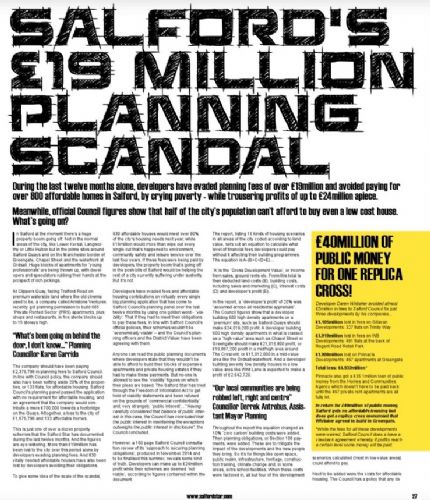
See also the electronic version of Salford Star print issue 10 – the £19million (as it was then) Planning Scandal – click here


.jpg)


.jpg)


.jpg)
.jpg)
(3).jpeg)
.png)
(1).JPG)
