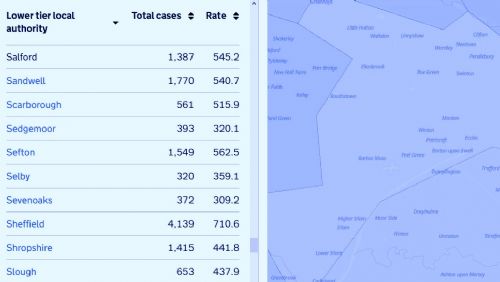
After a few days of a relatively large number of new confirmed cases of coronavirus in Salford, latest figures show just one new case, bringing the cumulative total to 1,387.
Elsewhere in Greater Manchester, Manchester now has a total of 3,068 (up from 3,059), followed by Wigan with 2,151 (up from 2,150), Oldham 1,961 (up from 1,939), Bolton 1,924 (up from 1,922), Rochdale 1,783 (up from 1,775), Stockport 1,665 (down from 1,667), Tameside 1,556 (up from 1,552), Bury 1,310 (up from 1,308), and Trafford 1,317 (up from 1,302).
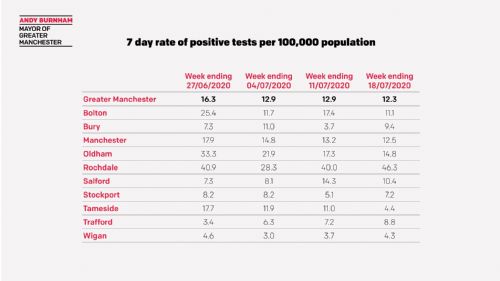
New statistics revealed by Greater Manchester Mayor, Andy Burnham, show that in the week ending 18th July, Salford had a rate of 10.4 positive test cases per 100,000 population, down from 14.3 the previous week, the fifth highest (or lowest) in Greater Manchester – Rochdale (46.3), Oldham (14.8), Manchester (12.5) and Bolton (11.1) all had higher rates. Lowest were Wigan (4.3) and Tameside (4.4).(see graphic)
There have been no new virus-related deaths at Salford Royal Hospital.
Meanwhile, more new information presented on Public Health England's map of coronavirus positive cases by Middle Super Output Area for the week ending 19th July shows the four areas of Salford with three cases or more...
These are Ellenbrook and Boothstown (three cases), Walkden North West (four cases), Swinton West (three cases) and Ordsall and Salford Quays (four cases). To see the map – click here.
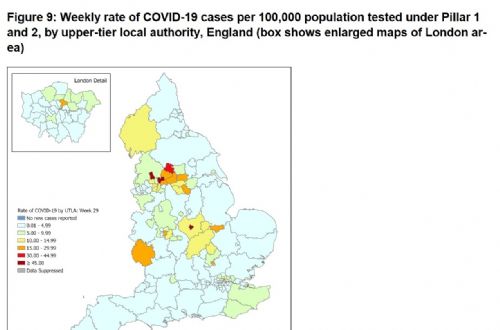
To add to the barrage of information, Public Health England has also produced its weekly virus surveillance bulletin which maps cases over the whole of England for the same week ending 19th July.
It shows just how prevalent the virus is in the North compared to most other parts of the country, with Salford coloured yellow (10-14.99 cases per 100,000 population), at the base of the epicentre in Lancashire and Yorkshire. Most of the rest of the country is coloured light blue (under five cases). (see maps)
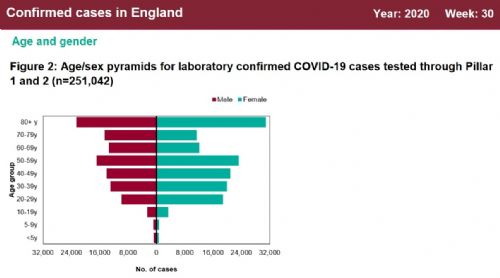
The Public Health England bulletin also shows national cases by age and sex for the week ending 19th July, with positive cases for women aged between 50 and 59 the most prevalent after the over 80 year olds, followed by women aged between 40 and 49. (see graphic)
Today, 24th July, sees face coverings become compulsory in all shops and other indoor spaces in England. The full list of spaces where this applies, according to Government advice, is the following...
Public transport; indoor transport hubs (airports, rail and tram stations and terminals, maritime ports and terminals, bus and coach stations and terminals); shops and supermarkets (places which are open to the public and that wholly or mainly offer goods or services for retail sale or hire); indoor shopping centres; banks, building societies, and post offices (including credit unions, short-term loan providers, savings clubs and money service businesses).
Face coverings are also needed in NHS settings, including hospitals and primary or community care settings, such as GP surgeries. They are advised to be worn in care homes.
The law does not require face coverings to be worn in hospitality settings, including restaurants with table service, bars, and pubs. They are also not required in entertainment venues (such as cinemas or casinos), visitor attractions (such as heritage sites or museums), exercise and sports venues (such as gyms). Where a shop is within another premises which does not require a face covering (such as a museum or other visitor attraction) they are required in the shop only.
It is not compulsory for shop or supermarket staff or transport workers to wear face coverings, nor for children under the age of 11, those with physical or mental illness or impairment, or disability, or who would suffer 'severe distress' by wearing one.
Other scenarios include if you are travelling with or providing assistance to someone who relies on lip reading to communicate; to avoid harm or injury, or the risk of harm or injury, to yourself or others; to eat or drink if reasonably necessary; in order to take medication or if a police officer or other official requests you remove your face covering.
There is no law stating that those who don't wear face coverings should carry an exemption card... "Those who have an age, health or disability reason for not wearing a face covering should not be routinely asked to give any written evidence of this" states the Government advice. For the full Government details on face coverings – click here.
A while back, the Salford Star showed how to make a free face mask out of an old t-shirt without any need for sewing – click here for details. For a video on how to make a mask - see also here. Meanwhile there are plenty of face masks for sale with profits going to good causes – click here and click here for some ideas


.jpg)
.jpg)


.jpg)


.jpg)
.jpg)
(3).jpeg)
.png)
(1).JPG)
