Over the last week, the Salford Star has been inundated with requests from worried, angry residents living in the city's social housing tower blocks wanting to know if they are safe.
As far as we can, we have been investigating, materials used and questioned the results with housing associations and manufacturers of the cladding. We have also been trying to get the results of Pendleton Together's independent survey by Trident on safety of its blocks, with no success.
Salford City Council has information about every single cladding scheme in the city, as every single developer and housing association would have to submit its schemes, complete with technical information, and have them passed by either the Council's planning officers or the planning panel of councillors. Salford City Council has not made this information available to residents.
However, research by Salford Star reveals the following...
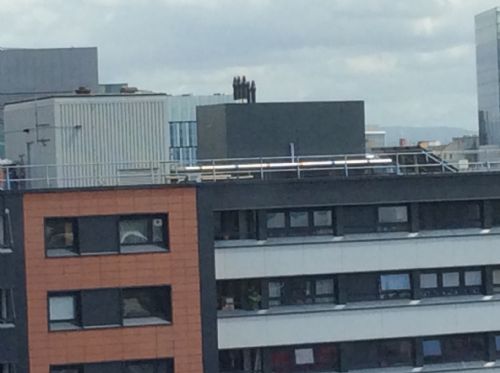
Canon Hussey and Arthur Millwood Court – an application passed in March 2013 shows that in the new external cladding, the 'corner features' are "Aluminium Cladding - Reynobond Solid A 7116S". Reynobond is the manufacturer of the cladding used in Grenfell Tower. On the roof of these blocks is a gas powered tank and 'eco pod system'.
Magnolia Court, Sycamore Court and Mulberry Court - insulation cladding used in these blocks has Expanded Polystyrene (EPS) - Grey EPS and White EPS.
In the Insulated Render and Cladding Association's guides it notes that EPS is 'cost effective' but 'classed as combustible'. The company that refurbished these blocks was Alumasc with Salix Homes and Seddon Construction.
In Alumasc's own Safety Data Sheet for 'Grey Expanded Insulation', under Fire Fighting Measures, it states...
"Special hazards arising from the substance or mixture...should be considered toxic, will include Carbon Monoxide and Carbon Dioxide, may contain hydrogen bromide and trace amounts of styrene monomer".
Under 'Conditions to Avoid' it states "temperatures above 200°C/Exposed heat, flames and/or sparks..."
The Probyn-Miers article on Fire Risks From External Cladding Panels - A Perspective From The UK', referenced by the Salford Star and other national media, alleges that EPS is the worst possible material to use...
"EPS will initially soften and shrink away from a small flame, but will then melt and burn. The voids created by melting admit oxygen, which intensifies the fire. Molten flaming droplets can spread the fire. All the material between the metal facings is likely to be consumed, leading to loss of structural stability. At the outset of the fire, development is fairly slow and contained. In a well-established fire, the material will contribute to the fire development. Delamination and collapse may be sudden. EPS was recognised as the worst of the plastic foams in fire conditions."
The Salford Star contacted Alumasc, Salix Homes, Seddon and Salford Council with this information. We asked:
1) Why was EPS fitted as part of the cladding to these three blocks and not others that Alumasc has supplied in Salford, which have what appear to be safer materials like the mineral wool system? Was cost a factor in this?
2) Can Alumasc/Seddon/Salix Homes/Salford Council guarantee that the materials used in this cladding is totally fire retardant?
2) Did the buildings have cavity barriers or fire stops installed – if so, which?
Alumasc didn't answer the questions. Instead the company sent a general statement...
"In the immediate aftermath of the events at Grenfell Tower in London, we understand from the press coverage that one line of investigation is likely to consider the recently-applied cladding system. In response to a number of requests, we would like to reassure our clients and designers that all Alumasc cladding system specifications that are issued for 'high rise' buildings (i.e. buildings greater than 18m in height ("Alumasc specifications")) have been tested and approved specifically for use above 18m. As such, the Alumasc specifications:
a) have British Board of Agrément approval;
b) comply with Building Regulations for use above 18m throughout the UK; and
c) have a rating of A1 or A2 to 'BS 13501-1 Fire Classification of Construction Products and Building Elements' or have been tested and approved to 'BR135 Fire Performance of External Thermal Insulation for walls of Multi-storey Buildings', including the full-scale fire testing regime defined in 'BS8414 Fire Performance of External Cladding Systems' or 'BRE Fire Note 9 Assessing the fire performance of external cladding'.
"In practical terms, this means that the Alumasc specifications will not propagate the spread of flames because they include:
• Rendered and/or brick-faced finishes that are classed as non-combustible;
• A mineral wool, A1 fire rated, inert fire break at each floor level above the first floor, except where full-scale testing has demonstrated the compliance of the system to the relevant standards without such measures;
• A combination of mechanical fixings (including steel 'fire' fixings) and adhesives to ensure that the system will not suffer disproportionate collapse during a fire; and
• Direct-fixed constructions (i.e. without a ventilated cavity).
"The above controls are integral to the approval of the use of the Alumasc specifications, including their reactions in the event of a fire, by independent accredited bodies..."
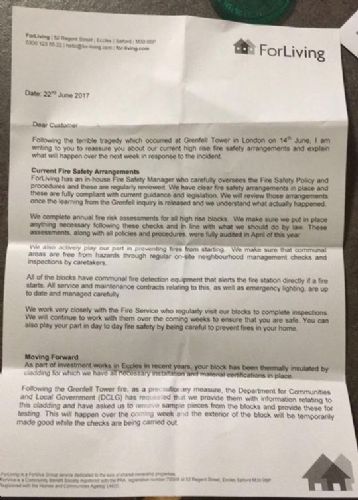
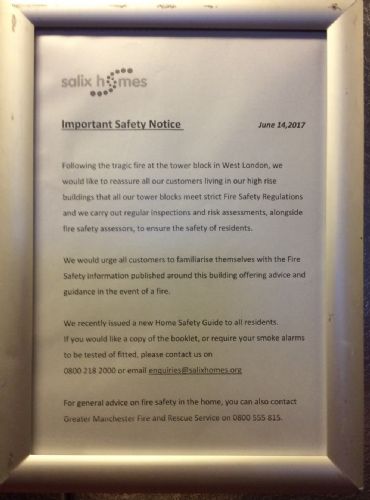
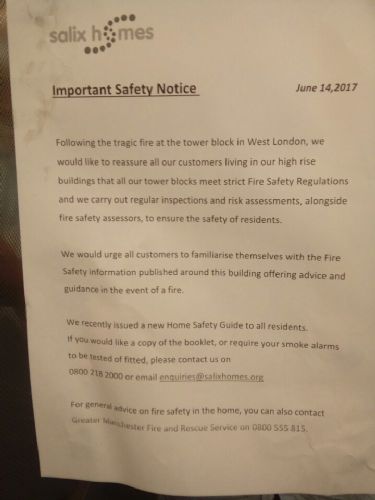
Salix Homes responded: "We would like to reassure all our residents living in our high rise buildings across Salford that all our tower blocks meet strict Fire Safety Regulations and we carry out regular inspections and risk assessments, alongside fire safety assessors, to ensure the safety of our customers.
"All building systems and materials used on our high-rise blocks adhere to the same strict Fire Safety Regulations and following preliminary investigations based on what we know from the tragic events in West London, the systems and materials used are different to those on Grenfell Tower.
"We have a fire safety procedure appropriate for each of our blocks based on advice from Greater Manchester Fire and Rescue Service. This is published in the communal areas of each block and was recently sent to all residents. We would encourage all residents to remind themselves of this for their block.
"The safety of our customers is our utmost priority and we are confident that the safety procedures we have in place will keep our customers safe. However, following the tragic incident in London, we will now be working with Greater Manchester Fire and Rescue Service to look at any lessons that can be learnt."
Alumasc also supplied cladding for Black Friar Court – JWD Architectural Aluminium manufactured and installed the "striking two-tone, orange-to-gold ALUCOBOND® balcony cladding panels...ALUCOBOND® is a three-part composite material, with two layers of aluminium encasing a rigid, fire-resistant, structural interior layer" the company states.
Alucobond composite cladding was also used on Riverbank and Newbank blocks. JWD Architectural Aluminium also worked on City West's blue faced tower blocks in Eccles... "the buildings have been insulated and clad in aluminium on the outside, massively improving thermal efficiency and completely changing the appearance of the structures" the company states.
The Salford Star can find no other information on these blocks, although City West states "City West is fully compliant with all fire safety regulations. Our high rise blocks have been designed to contain and prevent the spread of fire and external refurbishments have been carried out using different systems and materials to those that would appear to have been used at Grenfell Tower."
Elsewhere in Salford, Riverside House, the new student block on Blackfriars Road, had cladding installed by RR Cladding..."We installed ALUCOBOND® composite cladding panels, and a complex substrate complete with window reveals and other bespoke finishing components fabricated by JWD..."
All companies state that their materials comply with building safety regulations. However, last night, Salford and Eccles MP, Rebecca Long-Bailey, issued a long press release stating "Building regulations are not fit for ensuring the safety of residents, and Grenfell Tower is clear evidence of this...
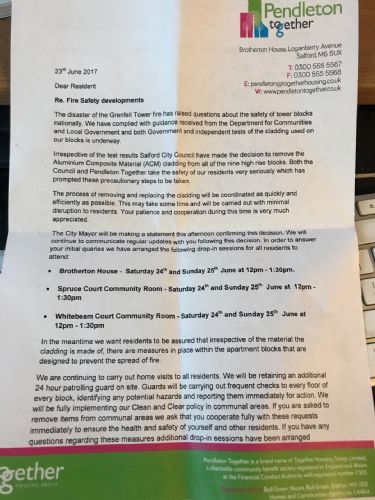
"I am pleased to see that Salford City Council whilst still awaiting the results of Government assessment results have taken urgent action and are removing cladding from its nine high rise blocks in Pendleton where they are aware that cladding panels may be at risk" she added.
"Residents' safety should always come first, and I am calling on all housing providers in Salford to urgently follow the City Council's lead and ensure that all precautions are taken where it is found that similar aluminium polyurethane composite cladding has been installed. I understand that some cladding on tower blocks in Salford may differ slightly from that used at Grenfell, however the safety of tenants is of the utmost importance..."
At yesterday's press conference, Salford City Mayor, Paul Dennett, said "The decision to remove the cladding on the council's nine tower blocks is the right and moral thing to do. There will be no waiting around in Salford whilst there are any questions about the safety of our residents..."
Salford Council has all the technical safety information it needs, via the planning process, but has not released this to residents. Meanwhile Pendleton Together, with the Council, commissioned its own independent survey of the nine tower blocks. Yesterday the Mayor failed to mention this at all, only saying that "it is already clear that the aluminium composite cladding on our blocks must be removed..."
If Salford Council has its own results confirming that panelling in the Pendleton Together blocks is not safe, why isn't it sharing those results?
The manufacturer of some phenolic insulation that was used on some of the tower blocks, Kingspan, in line with other manufacturers, is adamant that its materials are safe... "Fire performance was also a central design focus for the towers and fire barriers are being installed within the rainscreen at floor level on each storey" it states.
Salford's independent fire assessment of the Pendleton Together blocks was commissioned from Trident a week ago, yet the Government is stating that it can get results of sample testing back way quicker than this.
If it is a matter of days before the Trident and Government results are known, why did the Salford Mayor announce that the panels were to be removed? This massive work cannot start for a few days anyway. So does the Council know something it's not telling residents?
These are the sort of questions that the Salford Star would have put to the Mayor at yesterday's press conference – except that the Salford Star, being the only press actually based in Salford, was not invited.
Meanwhile, the onus is now on Salford City Council to make public everything it knows about all cladding in the city...
*See also related Salford Star articles...
Cladding Removed From Nine Pendleton Together Tower Blocks – click here
Cladding used in Pendleton Tower Blocks 'Contributes To Fire Growth' state experts – click here
Recent Pendleton High Rise Fire Highlights Inadequacies – click here
Salford Tower Block Fire Risks Ignored By Salix Homes For Five Years – click here
Pendleton Together States It Will Learn Lessons from Fire safety Inquiry – click here
UPDATE: 25th June - It could be months before cladding is removed in Salford - click here
Update: 25th June 2pm - Salix Homes to Strip Cladding from its tower blocks - click here
Main Photo by Séamus Martin


.jpg)
(1).JPG)


.jpg)


.jpg)
.jpg)
(3).jpeg)
.png)
(1).JPG)
