While there has been no official word on what caused the horrific blaze at Grenfell Tower in London this week, experts seem to be agreeing that the cladding certainly contributed to the speed in which the fire spread, with tragic results.
In Salford, the majority of tower blocks have been re-clad, with the most visible example being the high rises along the Crecent, including Thorn Court, Spruce Court, Whitebeam Court and Malthus Court.
Here, all the hype surrounding the refurbishments has been about appearance rather than tenant safety…
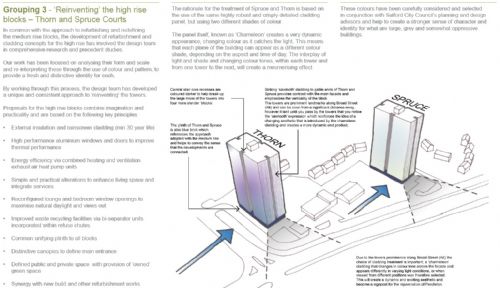
"The design has been developed to provide colour and interest at key focal points" stated Pendleton Together "...The rationale for the treatment of Spruce and Thorn is based on the use of the same highly robust and crisply detailed cladding panel, but using two different shades of colour.
"The panel itself, known as 'Chameleon' creates a very dynamic appearance, changing colour as it catches the light" the company slathered "This means that each plane of the building can appear as a different colour shade, depending on the aspect and time of day. The interplay of light and shade and changing colour tones, within each tower and from one tower to the next, will create a mesmerising effect.
"These colours have been carefully considered and selected in conjunction with Salford City Council's planning and design advisors and help to create a stronger sense of character and identity for what are large, grey and somewhat oppressive
buildings" it added "...As the buildings sit adjacent to a major highway they are seen by the public when on the move..."
The appearance hype goes on and on and on – but there is almost nothing written about safety in the blocks. The original 'hybrid' planning proposal for the whole of Pendleton contains little about such issues. And the actual 'outline' application considered by Salford Council, and passed in August 2012, has disappeared from the Council's website completely.
The only clue to the detail of the cladding comes in 2013, amongst dozens of documents in a 'request for confirmation of conditions' from Urban Vision to contractor, Keepmoat, which has two lines giving details of the materials to be used...
"Aluminium Composite Material (ACM) cladding Panels; Composite panels Aluminum Face Sheets; Thickness: 0.020"; Standard Polyurethane core (PE); 4mm thick; panel weight: RB 160 = 1.12 ilbs/sft."
The rest is all about which colours Pendleton Together should be using... "Spruce & Thorn Court shall be predominately in 'Chameleon' finish" etc...*
The letter adds that "Prior to the commencement of development of each phase, samples of the following materials shall be submitted to and approved in writing by the Local Planning Authority… Bricks; Tiles/slates; Mortar; Structural metal work; Timber work; UPVC; and Cladding."
Salford Council approved the materials, including the 'Standard Polyurethane core', which, it must be stressed, didn't break fire and safety regulations at the time. However, there were numerous warnings about the materials used in the cladding which would take anyone with Google two minutes to find.
An article in the Winter 2016 newsletter of architectural experts, Probyn Miers, goes into huge detail (with sources) of the Fire Risks From External Cladding Panels (see here). It examines fires that have happened all over the world where cladding has been a factor, and highlights polyurethane, or PUR, as one of the materials which poses a risk…
"Polymeric core materials such as EPS [polystyrene] and PUR will burn at temperatures well below that of a fully developed fire and thus contribute to fire spread" it states
"PUR is combustible" it adds "However, it forms a char layer which tends to inhibit further combustion. The char layer is relatively fragile. It may break off to expose fresh combustible foam. PUR also contributes to fire growth in a fully-developed fire, giving off black smoke and toxic fumes, including hydrogen cyanide above 850oC."
Other variants used in cladding are Polyisocyanurate, or PIR, which, the article states "is difficult to ignite and exhibits a pronounced charring which enables it to withstand fire for longer, but is ultimately combustible"; Phenolic foam, which "is difficult to ignite" and Rockwool mineral fibre, which is "non-combustible".
The article concludes that "In the UK, influence from insurers and technical development within the composite panel industry has led to cores of polymer-cored external cladding panels changing from PUR to PIR to phenolic foam, decreasing the fire hazard."
From the materials stated in the Salford Council report, this, apparently, didn't happen. And questions need to be asked about whether cost was a factor in this…or even appearance, god forbid.
The Salford Star has tried to contact Pendleton Together (again) and Salford City Council Lead Member for Housing, Paul Longshaw about legitimate resident concerns. Neither Pendleton Together nor Paul Longshaw returned calls.
This afternoon, Paul Longshaw did put out a press statement…
"The council has been working closely with our key housing partners that have blocks of a similar age to Grenfell Towers to seek assurances their fire safety policies and procedures are in place and have been followed. We have been advised that for current requirements those policies and procedures are in place.
"When the London fire investigation is complete we will analyse the response to the disaster and exactly what happened to see if there are any lessons we can learn in Salford. This will be completed in partnership with local landlords and the Greater Manchester Fire and Rescue Service.
"Greater Manchester Fire and Rescue Service (GMFRS) works closely with the local authority and housing providers to ensure all buildings in this city are as safe from fire as possible.
"Understandably residents who live in tower blocks in our city at this moment may feel concerned and vulnerable. To reassure people, landlords are writing letters to those in high rise flats, issuing statements and putting messages on social media.
"We expect there will be much reflection and investigation into the cause of the fire in London. We will continue to work with our partners to modify procedures and building safety measures should this be found necessary. Your landlord representative is there to work with you on this should you need to contact them."
This is Part 1 of a two part article... Part Two – Salford City Council and Housing Association Arrogance and Unaccountability: coming soon...
See also previous Salford Star article: Recent Pendleton High Rise Fire Highlights Inadequacies in Salford – click here
Update: 16th June 2017:
Pendleton Together promises independent review of Salford tower block fire safety - click here
Update: 26th June
The Salford Star has been asked to point out that, while the planning letter stated 'Chameleon', this is a product manufactured by Rockpanel. While this product was considered for use, the actual material that was used in the end was a product called Alucobond Spectra, which is an ACM with a similar appearance to Chameleon. The Salford Star is trying to ascertain whether price was an issue in the switch


.jpg)


.jpg)


.jpg)
.jpg)
(3).jpeg)
.png)
(1).JPG)
