Over the years, Salford residents have faced a barrage of 'pledges', 'promises', 'strategies', 'plans', 'masterplans', demolitions and more which they were told would improve the lot of the community – well, for those who were still here; with many having been compulsorily kicked out of their homes, only for new unaffordable properties to be built on top of their previous houses.
Salford saw MediaCityUK arrive, plus zillions of unaffordable apartments and houses which developers assured the Council would lead to more yuppies and "an overall improvement in the health of the residential population of the area"(Countryside Properties on 'New Broughton')...
Meanwhile the Council itself insisted that demolitions in Pendleton would "lead to a dilution in the current concentration of economically inactive households" by "young professionals and individuals who wish to live in Pendleton" (Salford Council business case for PFI).
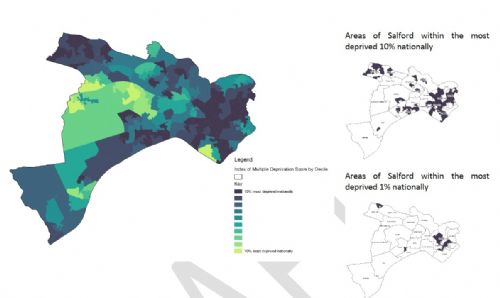
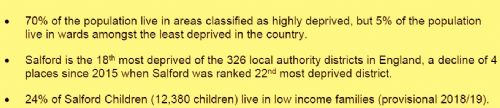
The ongoing 'redevelopment' of the city was supposed to make Salford into a 'Beautiful vibrant prosperous city' (Salford URC). Yet, since 2015, the city has gone from being the 22nd most deprived local authority area in the country, to the 18th most deprived...
It's a fact noted in the Intro to this year's Council accounts, which also adds that 70% of Salford's population 'live in areas classed a highly deprived', and that 24% of Salford children, or 12,380, live in low income families...
Next week, Salford Council's Health and Wellbeing Board will discuss a new Salford Locality Plan 2020-25, in which a Foreword by Councillor Gina Reynolds and Dr Tom Tasker admits that, since the last Locality Plan in 2016, "We have not made sufficient progress in closing health inequalities that may appear intractable and deeply ingrained..."
What follows in the draft Plan is a catalogue of failure..."While life expectancy has been improving in the last few decades, the rate of improvement has started to slow down" it states, adding that "Salford residents spend a higher proportion of their lives in poor health than average for England, and this typically affects the more deprived parts of the city to a greater extent"...
The report gives an update on the targets from 2016...
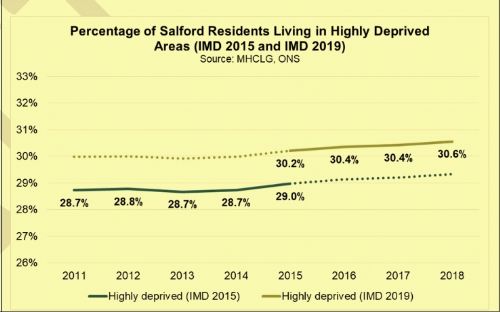
In 2015 there were 29% of Salford residents living in highly deprived areas…In 2018 there were 30.6% of Salford residents living in highly deprived areas... "The overall position is little changed in the last few years" the Plan states.
On halving child poverty, it adds that it "is not on track" but suggests it could be at 19.2% by 2021 compared to 21.1% in 2016...yet the Intro to the Council's accounts insists that, currently "24% of Salford children live in low income families" (see above)...
In 2016 the Plan noted that "Our success rates at GCSEs are amongst the lowest in England"...In 2020 the Plan notes that "This remains the case. We have the 3rd lowest average Attainment 8 score and 3rd lowest average Progress 8 score out of 150 LAs in England (2019)"...
In 2016 the Plan noted that "People living in poorer areas live up to 11 years fewer than those living in our richer areas"...In 2020 it states "The inequalities gap in life expectancy (between the most deprived 10% and most affluent 10%) has narrowed to 7.2 years for women and remains unchanged at 11.2 years for men (2015-17), though the gap is still too wide and unjustifiable".
In 2016 the Plan aimed for 7,500 fewer smokers in the city...In 2020 it notes that there were 200 more smokers in 2018 "due to population increase"...In 2016 the aim was for 400 'fewer overweight 11 year olds' from a figure of 985 children...In 2019, the Plan notes, there were 1,039 overweight 11 year olds...
And so it goes on and on – premature deaths from cancer - rising; preventable liver disease - rising; premature deaths from respiratory diseases – rising. In 2016, the Plan noted that "The number of people who are checked for the early signs of cancer will increase by 30%"...Now, the new Plan notes that "There has been an annual increase of around 2.1% in the numbers screened for cancer", and that the 'most ambitious projection by 2022 would be an increase by 17% from the 2017 value.
The 2016 Plan also envisaged that "Emergency admissions to hospital will be reduced by 20%"...The 2020 Plan notes that "The most ambitious achievable reduction in next five years would be 11%...The trend over recent years has been an annual increase of around 1.3%"...
...Meanwhile, the flu vaccination targets for over 65s from 2016 were "an ambitious projection", the Plan notes; and its 92% target that 'people will wait no longer than 18 weeks for treatment after a GP referral' was missed by 14,350 patients.
Virtually all the targets from the 2016 Plan were missed. Successes were few, perhaps on mental health spending, although the Plan adds that "Comparable figures in health and social care in mental health are difficult to source"; and, although the 2016 Plan targeted a 90% increase in the number of people diagnosed with early dementia, the current implied 84.8% is the eighth highest in England. Other targets have become irrelevant, given the unforeseen COVID-19 crisis.
The new 2020-25 Locality Plan contains chapters with similar optimistic headings, targets and promises...'Children in Salford will have the Best Early Start'...'Children and Young People Will Develop Well in Salford'...'People will value being and feeling well in Salford'... 'People in Salford will live independent and fulfilled lives into Active Older Age' etc etc...
And then, at the end of the Plan document, is a little chapter titled 'How we will measure progress' – which seeks to "address the locality's financial challenge"... £72million of cuts, or 'interventions' by 2023/24...a Children's Redesign, Adult Transformation, Best Value Schemes, and Efficiencies and Reform.
The 'savings' depend on 'efficiencies', 'alternative models of care' and on 'reducing demand' – but based on the past four years, there's no chance of this happening, as things have actually got worse. And even if, by some miracle, these 'interventions' are successful, there will still be a funding gap of £21million.
The Health and Wellbeing Board is asking Salford residents to pledge to take more exercise, drink less, to stop smoking and go for more health checks – oh, and to use Salford Council's obscenely expensively produced 'My City Salford' website "to find local services, events, advice and support in Salford"...except that the site has been derelict for months and has now been taken down completely...
Many would argue that Conservative Government cuts have been to blame for running down services, and, of course, they would be right...but many would also argue that Salford Council has spent £multi-millions during the last five years on prestige projects, office blocks, a garden in Worsley, the AJ Bell Stadium and more, for which the borrowing costs come out of the budget for front line services.
Many might also argue that the wholesale gentrification of the city for the more wealthy has been a massive failure for the indigenous community's health and wellbeing...
To read the Final Draft of the Salford Locality Plan 2020-25 - click here
Main photo shows The Toilet of Broken Promises - an installation at the Salford Star exhibition in Salford Precinct from 2018


.jpg)
.jpg)
.JPG)
.jpg)
.jpg)
(3).JPG)
.JPG)
.JPG)
.jpg)


.jpg)


.jpg)
.jpg)
(3).jpeg)
.png)
(1).JPG)
