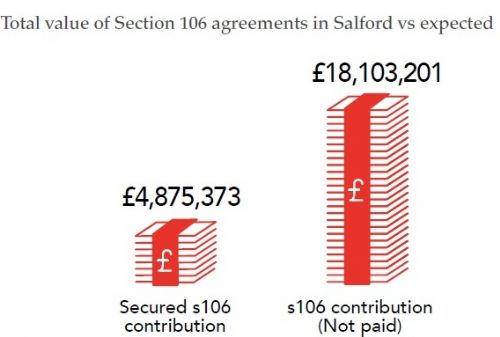
New research by Dr Jonathan Silver at Sheffield University has shown that £18,103,201 has been avoided by developers over 26 sites studied in Salford, and that Salford City Council's developer friendly policies has also led to the loss of 2,194 affordable properties.
This echoes and supports Salford Star research over the last few years that shows, over all sites in Salford, around £50million has been lost to the city through planning fee avoidance, plus thousands of affordable properties.*
Silver's report, titled From Homes to Assets: Housing financialisation in Greater Manchester, looks at the overall context of development in the area, and how housing is now treated as a 'commodity for accumulating wealth' by both global and local developers.
He writes about a "developer-friendly approach" that "has involved allowing planning permission for most new buildings overriding concerns about heritage, neighbourhood impact, affordable housing, design and other gentrification"...a "supportive context for housing developers" that is "most noticeable through reducing financial contributions from developers through Section 106 contributions and affordable housing requirements."
The Salford sites investigated include Middlewoood Locks, the ECf's Stanley Street and Slate Yard, Adelphi Street, loads of developments on the Quays, and Fred Done's Blackfriars blocks.
While £18,103,201 was avoided by developers "through manipulating 'viability assessments'", only £4,875,373 was collected in Salford. And, while an estimated 2,194 affordable housing units were lost via the same process, across the sites studied, only five affordable properties were provided.
Manchester fared even worse, with only £834,000 collected in contributions and no affordable housing gained across the 53 sites studied.
The report also looks at how state aid from the likes of the Government, Greater Manchester Combined Authority and Salford City Council has directly subsidised many of these private developments. It's been done by either allocating and providing public land, or through cheap loans totalling £265million, with average financial support at £29,719 per unit, "none of which are designated for affordable or social housing".
Middlewood Locks, for instance, is cited in the report, with £35million in subsidy, while Fred Done's Blackfriars development had £17million, although the Star showed how this figure was subsequently increased to £22.5million (see here).
Across the Salford sites studied, the report shows how 86% are being marketed abroad, as the developments become part of a huge network of worldwide investment, "including large institutional investors involved in development finance, companies based in 'secrecy jurisdictions' and smaller investors purchasing one or two units, as part of savings and pension schemes for the growing, global middle class...
"...It means new housing units being built in Greater Manchester are already sold
'off-plan' before they even become available for local residents" the report shows. However, it adds, with the average cost of an apartment in one of the Salford sites £167,046, on top of other housing related bills a local person would have to be earning £3,000 a month to be able to afford one.
As well as the financial exclusion involved in actual buying one of the properties, renting one is also out of reach of the local community, with rent increases averaging 22.4% in Greater Manchester between 2014 and 2015.
Particularly galling is the growth of the Private Rental Sector, or PRS – "This sector can be understood as housing developments that are built for rental purposes by institutional investors" the report explains...
"This can include developers holding onto the housing units or selling them on to various financial institutions and actors, aimed at the rental sector and importantly as tradable assets that can be sold on to other institutional investors" it adds "This new financial 'product' is the key means through which housing financialisation has taken place and allows institutional investors to purchase apartments, often at scale (so for instance a whole building or urban development site), creating both ongoing rental income and a traceable asset.
"Encouraged by new national guidance and favourable fiscal conditions, thousands of PRS apartments are in development, intended to capitalise on the rising rents in the housing market" it states "The opportunities to profit from the PRS have therefore differed considerably from the past because it is now straight-forward for large financial actors to invest in housing in Greater Manchester."
While international investors and local developers are cashing in, where does this leave the community?
As Salford City Council might argue, and the report estimates, in the very long term, as much as £13million per year in Council Tax from the new properties might be collected. But increased population leads to strains on services like schools, doctors, refuse collection, transport and more, which haven't been addressed because of the huge losses on Section 106 fee collection.
Other impacts include "important parts of the historic built environment being destroyed in the name of developer profit and the privatisation of public space" (as can be seen in Chapel Street and Salford Quays), the report concludes.
It also concludes that "Local Authorities are failing to create balanced communities. The result is that there is increasing economic segregation within Greater Manchester city-regional centre and surrounding areas, creating ghettos of rich and poor".
The report begins with the truism that "Amongst the cranes and construction workers, new towers and luxury accommodation, the numbers of homeless both hidden and on the streets continues to grow. It has become perhaps the city-region's most pressing political and social issue as hundreds of rough sleepers struggle for survival everyday in Manchester and Salford."
This most pressing and shameful political and social issue is nowhere near to being resolved...
From Homes to Assets: Housing financialisation in Greater Manchester
The Salford Star recommends that readers check out either the full report or its 'executive summary' – click here for the link on Greater Manchester Housing Action website with an intro by Jonathan Silver
*See also previous related Salford Star articles...
Salford Housing Crisis – The Causes – click here
£42million Planning Scandal Mushrooms as Salford Mayor Asks What's Going On – click here
Only Two Affordable Properties For Over 4,000 Flats and Houses Built in Greengate and Chapel Street - click here
Salford In UK Top 10 Greedy Property Speculator Hotspots - click here
9 Year Waiting List For One Bed Affordable Flat in Salford - click here
Salford Star print issue 10 has a huge article detailing the background and ruses behind the planning scandal – click here for electronic version




.jpg)


.jpg)
.jpg)
(3).jpeg)
.png)
(1).JPG)
