Salford City Council is a one-party regime, led by the Labour Party which has a forty seat majority, and almost no opposition from nine Tory councillors and one Independent. While that is democracy and reflects the will of Salford people, who is actually holding the City Mayor and his Cabinet to account?
A new report by the House of Commons cross party Communities and Local Government Committee, chaired by Clive Betts MP, reviewed "the ability of committees to hold decision-makers to account, the impact of party politics on scrutiny, resourcing of committees and the ability of council scrutiny committees to have oversight of services delivered by external organisations".
It noted that "Senior councillors from both the administration and the opposition, and senior council officers, have a responsibility to set the tone and create an environment that welcomes constructive challenge and democratic accountability".
Does this happen in Salford? Here, the Council has five scrutiny committees - Children's, Community and Neighbourhoods, Growth and Prosperity, Health and Adults, and the main one that the House of Commons Committee was generally looking at, the Overview and Scrutiny Board.
The last publicly available minutes of this Board in Salford show officers largely reporting on subjects, with councillors asking a few questions afterwards with virtually no answers recorded.
For example, the minutes note members' 'Concerns in regard to the significant budget pressures on Children's Services'. What were these 'concerns'? How did officers respond? We'll never know.
Matters Arising from the same meeting show that information requested by councillors from as far back as August and September had still not been provided (see here).
Meanwhile, community concerns, such as the £90,000 NDC 'legacy money' handed to the Inspiring Communities Together group never got near any scrutiny committee, despite being asked.
Nor do many of the other controversial Salford Council decisions and practices get discussed by scrutiny. The system just isn't working, and this observation locally has been largely backed up by the findings of the House of Commons Committee which took evidence from all over the country.
The Salford Star has been told by one councillor that the scrutiny committees are "useless...a waste of time".
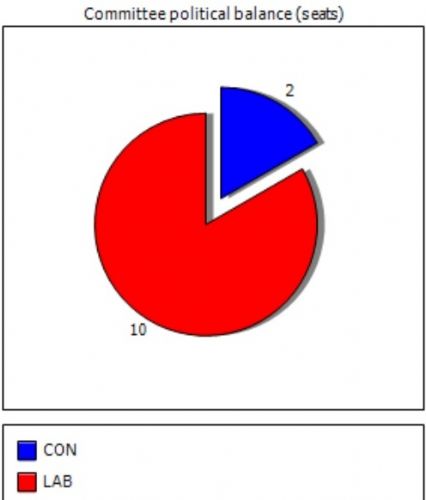
One of the main concerns of the Committee was the role of party politics in scrutiny. Here in Salford, because of the make-up of the Council, all the scrutiny committees are totally dominated by Labour Party councillors, effectively holding their own party to account. Are they going to rock the boat and expose any scandals?
"...Local councillors will always be aware of party politics, but sometimes this can have too great an influence and act as a barrier to effective scrutiny" states the House of Commons Committee "Jacqui McKinlay from the CfPS [Centre for Public Scrutiny] told us that 'We often say that local government scrutiny is a perfect system until you add politics to it. In our last survey, 75% of people say that party politics affects scrutiny'..."
The Committee recommended, as a solution, "That overview and scrutiny committees should report to an authority's Full Council meeting rather than to the executive, mirroring the relationship between Select Committees and Parliament..."
Would this work, given that full council meetings in Salford are just opportunities for ruling councillors to showboat, with stage managed questions and stage managed answers?
At the end of each council meeting reports are presented from 'outside bodies' that the Council is involved with, such as Salix Homes, the Salfordian hotel, City West etc – and these are never discussed, with councillors nodding them through with one eye on the clock.
More interesting is the Committee's recommendation "That members of the public and service users have a fundamental role in the scrutiny process and that their participation should be encouraged and facilitated by councils".
It gives an example of effective public scrutiny from the London Borough of Hackney monitoring services for disabled children...
"Rather than only using the testimony of the council officers delivering the service, a major part of the evidence base for this review was the views of parents and carers of disabled children, as well as disabled children and young people themselves about the services they receive and the barriers they face in accessing current services...
"We commend such examples of committees engaging with service users when forming their understanding of a given subject, and encourage scrutiny committees across the country to consider how the information they receive from officers can be complemented and contrasted by the views and experiences of service users."
This method would have been really useful when the Salford Mayor, Paul Dennett, made the decision to close The Grange, the city's only residential care home for disabled children, or during the current proposal to charge parents of disabled children for transport to college and nursery.
Other recommendations by the Committee included "That scrutiny committees and the executive must be distinct and that executive councillors should not participate in scrutiny other than as witnesses, even if external partners are being scrutinised"...
"...That scrutiny committees should be supported by officers that are able to operate with independence and offer impartial advice to committees. There should be a greater parity of esteem between scrutiny and the executive, and committees should have the same access to the expertise and time of senior officers and the chief executive as their cabinet counterparts..."
..."That councillors working on scrutiny committees should have access to financial and performance data held by an authority, and that this access should not be restricted for reasons of commercial sensitivity"...
The Committee also found "that there can sometimes be a conflict between commercial and democratic interests, with commercial providers not always recognising that they have entered into a contract with a democratic organisation with a necessity for public oversight".
This a huge one in Salford, with too many public services now 'outsourced' to private unaccountable organisations, like Salix Homes, Pendleton Together, loads of care services and financial consultants.
"We believe that scrutiny's powers in this area need to be strengthened to at least match the powers it has to scrutinise local health bodies" states the Committee, which also called for more scrutiny of procurement.
Huge contracts in Salford are currently being rubber stamped by just three senior councillors – John Merry, Bill Hinds and Paula Boshell - and the City Mayor... "It is imperative that council executives involve scrutiny at a time when contracts are still being developed, so that all parties understand that the service will still have democratic oversight despite being delivered by a commercial entity" states the Committee.
Will Salford City Council put any of these recommendations into practice? In your dreams!
Meanwhile the House of Commons Committee also looked at the scrutiny of the 'metro mayor' authorities, such as the Greater Manchester Combined Authority (GMCA), now led by GM Mayor Andy Burnham; and concluded that scrutiny "performance is currently hindered by limited resources. We therefore call on the Government to ensure that funding is available for this purpose..."
The committee also looked into oversight of the un-elected Local Economic Partnerships, or LEPs, stuffed with vested business interests. The Greater Manchester LEP helps control budgets of hundreds of millions of pounds via things like the Northern Powerhouse Investment Fund (£400million); the GM Investment Fund (business loans of up to £5million) and City Verve (£10million)...
The House of Commons Committee recorded "significant concerns that public scrutiny of LEPs seems to be the exception rather than rule"...
The Committee's report and findings has now been lodged with the Government. Will the Tories do anything with it? Will Salford Council even read the thing, never mind act on it? Unfortunately, it seems that the long grass is awaiting another delivery...
Read the full Effectiveness of local authority overview and scrutiny committees report – click here
See also previous Salford Star article on the Communities and Local Government Committee – Is Democracy In Salford Failing? click here




.jpg)


.jpg)
.jpg)
(3).jpeg)
.png)
(1).JPG)
