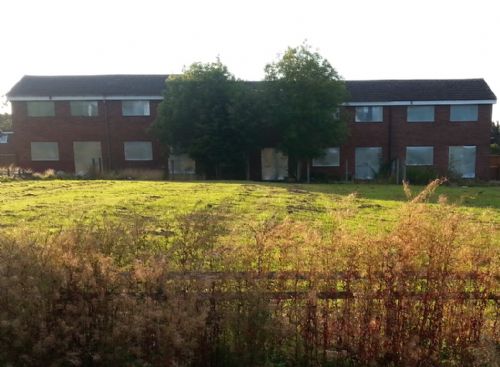
The Charlestown area, which stretches from Whit Lane, through Douglas Green to the front of Littleton Road, has proved to be the most glaring regeneration catastrophe in Salford over the last decade.
After the spectacularly, embarrassingly failed New Deal for Communities – the £53million ten year project which left the area looking like it needed £53million spending on it – came masterplan after masterplan, consultation after consultation, with zero at the end...bar the local kids labelling it `The Forgotten Estate'.
Academic, Dr Andrew Wallace*, a senior lecturer at the University of Lincoln, even wrote a thesis on how Charlestown and Lower Kersal faced a "legacy of injustice ...through inaction", leaving a "decimated landscape" and a "casual disregard for residents and the limbo they have been forced to endure". Salford Council, he wrote, was "a menace bogged down in incompetence and failure"...
...And Dr Wallace was being polite, compared to statements from the community living in the fifteen year mess...
That the area needed something doing with it goes without question. But the reward for those who have lived in The Forgotten Estate is no social rent houses, a loss of open space, potentially overcrowded schools and a developer set to make a bucket load of cash from Salford City Council's limp wristed housing policies.
Keepmoat – the company which managed to piss off almost everybody living in Pendleton's towerblocks with its cack-handed refurbishments (see here and see here) – is Salford Council's `preferred partner' for the regeneration of Charlestown.
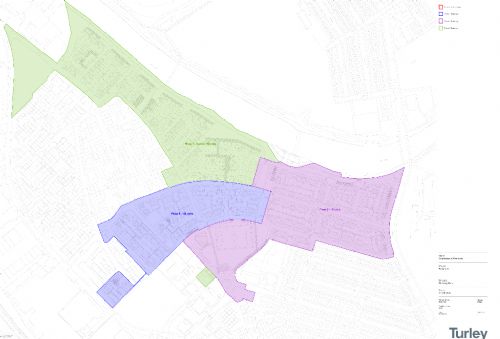
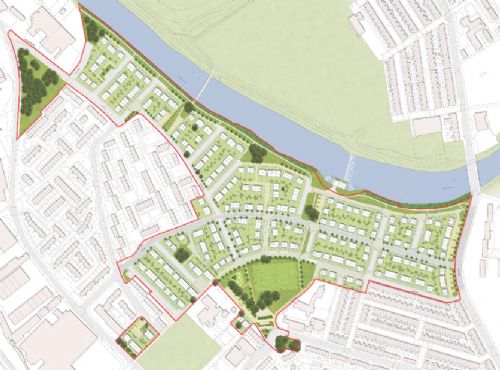
The company has submitted a planning application for a total of 430 houses, to be built in three phases, starting in May 2016 and ending in 2024. Of the total number of properties, 86, or 20%, are stated to be affordable – but these will be made of up `shared ownership' and `affordable rent' houses via Great Places. `Affordable rent' is not `social rent'. It is around 80% of market rent, and hardly `affordable' for those on low incomes who most need social housing.
Meanwhile, the first phase of building, which contains half of the `affordable houses', is situated nowhere near the riverside. The main riverside houses are saved until Phase 3, with some house prices set at almost £200,000. Apart from the `affordable houses', prices tend to be around £147,000 and £164,000...
While the plans propose 3.54hectares of open space, including `an improved sports pitch and improved children's play facilities...within the public park bounded by Whit Lane and Douglas Green', a `riverside green space' and a `Local Area for Play', 2.88hectares of open space will be lost within the development. Keepmoat states in its application "This was accepted by SCC [Salford City Council] in terms of the extant planning permission for the site."
Salford Council's own SPD policy states that Keepmoat should be paying £1,439 per bed space for the `provision and improvement of open space', which totals £2.356million but the value of the public space improvements the developer is intending to make comes to just £711,668 – a loss of £1.644million to the city.
And the company states in its application that it has no intention of making up the difference. .."Keepmoat proposes to make no open space contribution for the Charlestown Riverside development, above and beyond the proposed qualitative improvements to open space provision to be delivered as an integral part of the development."
Similarly, Salford Council is due payments towards education, to mitigate against the increased demand for local primary schools in the area. The total payment is calculated in the application to be £816,197 – but, again, the company states "Keepmoat proposes to make no education contribution for the Charlestown Riverside development".
Keepmoat's get-out is that it will be supplying 20%** `affordable housing', worth £3,047,886, which it doesn't have to provide, leaving a net gain for the city of £587,714.
The company is actually correct because, although it had to supply 20% affordable housing, plus the open space and education payments, when it first tendered for the redevelopment contract, Salford City Council has since caved into developers and changed its planning policy (Planning Obligations SPD, adopted June 2015). Now, housing schemes in `low value' areas (which includes Charlestown) don't have to provide any affordable housing at all, in what can be seen as an official `social cleansing' policy.
Salford Council states that the reason developers don't have to supply affordable housing in `low value' areas is because it would make schemes `unviable' – the magic word that developers all over the city have used to avoid over £19million of planning obligation fees.
Unusually, within Keepmoat's application the full set of financial figures have been included, and posted publicly. These show the staggering profits that Keepmoat will be allowed to make from its Charlestown Riverside scheme.
Bearing in mind that all the previous and current demolitions in the area, and the clearance of the former community, have been paid for from public money (Pathfinder, NDC etc), the land is valued at just £8,850 per plot, presumably the price Keepmoat is paying the Council for houses that will be sold for up to £199,012.
The planning application figures show a gross profit for Keepmoat of 22.63%, or £12,388,105; a `blended' profit (every single expense deducted) of 12%, or £6,568,343; and a return of 18% - which is the 12% `blended' profit plus `overheads' of £3,542,400 that the Council has allowed.
The planning application states: "The developer's financial return for the scheme as submitted by Keepmoat as part of its tender response and accepted by Salford City Council is a 12% profit margin on net sales revenues. In addition, an overhead allowance of £8,200 per dwelling has been approved. This is equivalent to an overall level of return of approximately 18% of net sales revenues."
This would bring a `return' to Keepmoat of over £10million. The company is generously paying a `community investment fee' of £10,000 per phase, or £30,000 in total...
The Keepmoat application will go before Salford Council's planning panel in the near future for approval.
* To read more of Dr Wallace's work on Whit Lane and the NDC see previous Salford Star article - click here and his research paper click here
**The 2009 masterplan for Charlestown stipulated there should be 25% affordable housing
For a full background on the change to Salford Council's planning policy see The £19million Planning Scandal in the print issue of Salford Star. Also in this issue is a background to the Keepmoat Pendleton mess, plus Graham Cooper, a youth worker at Oliver's Youth Club, writing about Whit Lane's Forgotten Estate – "There is a real issue about the word `regeneration'; it should be de-generation" he states, adding "A part of what's going on here is about driving people out"
To read the electronic print copy - click here
See also previous Salford Star articles on The Forgotten Estate...
Cannabis Factory Dumped on Whit Lane - click here
Peter Kay shoots drama in £53million Comedy of Errors - click here and Peter Kay Fly Tipping Horror - click here
Eight Year Whit Lane Regeneration Mess - click here
Salford's £53million NDC Disgrace - click here
The £53million Down the Drain Award - click here


(1).jpg)
(1).jpg)
(1).jpg)
.jpg)
(1).JPG)
.JPG)
.JPG)


.jpg)


.jpg)
.jpg)
(3).jpeg)
.png)
(1).JPG)
