Latest figures from Salford City Council show that the city's housing crisis is getting worse, with half of all families not being able to afford even a low cost house and one third not being able to afford private rents.
To get anywhere near solving the problem, the Council reckons it needs an extra 887 affordable properties a year – and this at a time when developers are using `viability' loopholes to avoid contributing to the shortage.
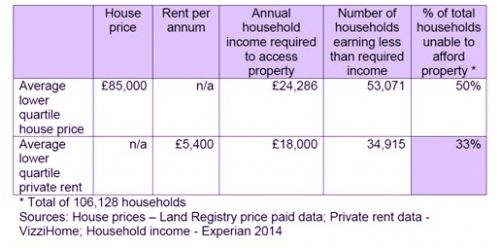
The Council's housing affordability report shows that the average `lower quartile' house price during the first six months of 2014 was £85,000, and to be able to afford one of these low cost houses a household would need to have an income of £24,286, using the standard house price to income ratio of 3.5.
According to Experian household income data for Salford, out of a total 106,128 households in the city 53,071 of them earn less than £24,286. Which means that half of all Salford families cannot afford to buy even a low cost house.
Meanwhile, based on Shelter and Joseph Rowntree Foundation estimates that no more than a third of income should be spent on rent, and that the average `lower quartile' private rent in Salford is £495 per month, to be able to afford this households would have to be bringing in £18,000 a year...
... According to 2014 Experian income data, there are 34,915 households in Salford with an income of less than £18,000, which is 33% of the total 106,128. So one third of all Salford households cannot afford to rent privately – and half of all Salford households cannot afford to buy. Which only leaves social housing to sort the problem. And there's fewer and fewer of these properties available.
Over the past nine years, the Salford Star has investigated the loss of affordable housing, particularly in Central Salford, where whole estates full of affordable housing in Broughton, Langworthy, Pendleton, Lower Kersal and Charlestown have been bulldozed to be replaced with largely unaffordable `market' housing.
The latest example is Countryside Properties planning application for houses near The Meadows which will have no affordable housing (see here). Like Countryside, other property developers and speculators that are building huge blocks of apartments and houses for `young professionals' are also avoiding social housing obligations using `viability' clauses – ie that if their profits aren't high enough they don't have to bother with social housing or obligatory `Section 106' payments. Even the Assistant Mayor for Planning called it a `public scandal of immense proportions' (see here).
The Council report states that it "will need to ensure that it seeks to maximise the affordable contribution secured through planning obligations, whilst still having regard to the impact such requirements will have on scheme viability."
A mere 77 affordable homes are being built from Section 106 agreements, while the Council is currently sitting on a `commuted sum' of £310,357 which might be used for affordable homes in the future. On top of this, there's Government funding for 857 affordable homes through to 2017 but it's nowhere near enough to fill the need in the city. Council calculations based on all directions of demand produce a figure of 887 affordable homes needed every year.
Just 16 social rent properties were built and completed last year (2013-14). The current trend is to provide the very misleading `affordable rent' properties – which are 80% of market rent, compared to 40-60% in social rent (see here). There were 128 of these `affordable rent' properties completed last year, and 25 `intermediate' houses. Even if these latter properties are classed as affordable houses, the total of 169 is well short of the 887 needed.
Meanwhile, the numbers of Salford households on the housing waiting list rose from 10,251 in 2013 to 11,498 in 2014. And latest figures show that there were an average of 27 bids for every affordable flat that became available in Salford and 38 bids for every affordable house.
* See also previous Salford Star article: Salford Council attacks Housing Waiting List Allocations Policy - click here




.jpg)


.jpg)
.jpg)
(3).jpeg)
.png)
(1).JPG)
