In Part 1, the Salford Star looked at how Salford Council stated that it couldn't refurbish 23 houses in the Top Streets of Higher Broughton, as it was not `economically viable'. A figure of `up to £130,000 per property' was quoted in letters to residents. Following a High Court ruling, six large houses on Devonshire Street were saved – the cost of refurbishing? Not £130,000 but an average of £58,333 each. See Part 1 – click here
PART TWO: THE HIGHER BROUGHTON HOUSE PRICE HORROR STORY!
Four years ago, in Issue 7 of the printed Salford Star, we interviewed John Merry, the now former Leader of Salford City Council, about the prices the Council was offering people whose homes were being taken off them as part of the `regeneration'.
In Seedley, at the time, the Council was making offers of around £52,000 for houses it wanted to demolish, when similar houses across the road that were staying up were selling for between £90,000 and £100,000. The Audit Commission had also just produced a report that showed, nationally, councils were offering people £35,000 less than the market value of their homes.
"If that's the case and people are not getting the proper price I'd be extremely concerned" said John Merry "because by law we are supposed to offer what is the market value of the property…"
Now for the first time, Salford Star statisticians have compared the house prices people actually received from Salford Council in the Top Streets of Higher Broughton and what the market value of those houses should have been. The difference is vast – in one case over £40,000.
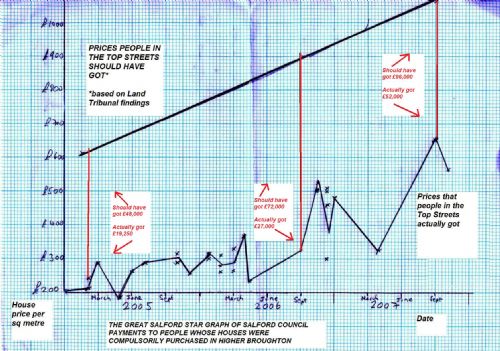
We've even produced, at great expense, a professional looking graph so Salford people can chart for themselves the huge differences.
The bottom graph line shows the real amounts people were paid for their houses in the Top Streets between 2005-7. While Salford Council is reluctant to reveal the prices it's paid, these figures have been taken from popular house price websites and what people who lived there have actually told us. We've got the sale price and converted it into price per square metres, as that's how valuers like to work.
The top line shows what the market value should have been, based on Land Tribunal rulings on 2005 and 2007 prices, when the Council was found to have undervalued properties*
We then took three examples (shown in red) and converted them back into full prices, rather than price per square metre. The first is from February 2005, where, based on our figures, a Top Streets house owner actually received £19,250 from the Council, when the true worth was around £48,000. The second case is from September 2006, when the house owner received £27,000 when the true worth was around £72,000. And the third case is from September 2007 when the house owner received £56,000, when the true worth was around £96,000 – a whopping £44,000 difference.
We can only work out these figures for Higher Broughton because these are the only two cases that we know of where people have taken the Council to a Land Tribunal as part of a Compulsory Purchase programme. If our figures are accurate – and we're pretty sure they are – home owners in the Top Streets who had their houses forcibly take off them by Salford Council lost out sums of between £25,000 and £44,000.
Yet, by law, Salford Council has to pay market value. So why didn't it? Is the Council going to compensate homeowners who lost out? And is Mr Ian Stewart Mayor going to hold a Public Inquiry? We won't hold our breath…
See also previous Salford Star articles on the Top Streets of Higher Broughton...
* The Assassination of a Community - click here
* Insane Salford Council Demolition Disgrace - click here
* Based on two rulings (case numbers ACQ352/2008 and ACQ409/2009) when it was found that houses being bought by the Council for demolition should have had the same value as retained houses (see here).
After the case (ACQ352/2008) concerning 2005, houses in the Top Streets should have been valued at £613 per sq metre, whereas actual figures we've seen from that time show that the Council was paying around £300 per sq metre.
In his summing up of the second case (ACQ409/2009), the judge PR Francis said that, in 2006-7, prices regularly exceeded £100,000 and averaged about £125,000, or roughly £1200 per sq metre. The peak of the housing market was September 2007.


(1).JPG)
.jpg)


.jpg)


.jpg)
.jpg)
(3).jpeg)
.png)
(1).JPG)
