THE GREAT AFFORDABLE HOUSING GIVEAWAY
Developers building in the poorest areas of Salford will no longer have to provide affordable housing as part of their schemes under new proposals from Salford City Council.
In future plans for housing in the City until 2028, developers won't have to provide any affordable housing in areas of so-called `low sales value', which include Higher and Lower Broughton, Charlestown and Lower Kersal, Pendleton, Weaste, Seedley and Langworthy and Little Hulton.
Developers in areas of `mid-to-low sales value' – including Trinity, Ordsall, Claremont, Eccles and Peel Green, Irlam and Cadishead, Swinton, Pendlebury, Agecroft and North Walkden - will have to provide just 10% affordable housing.
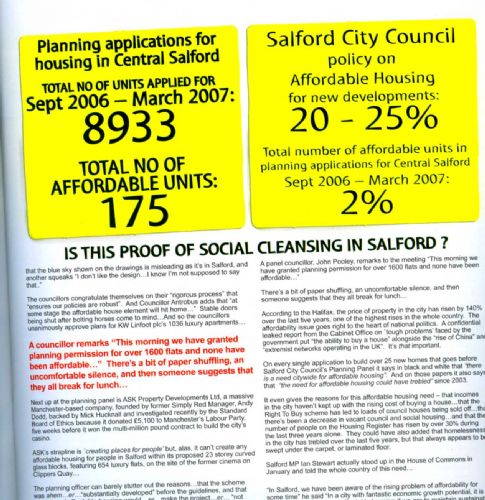
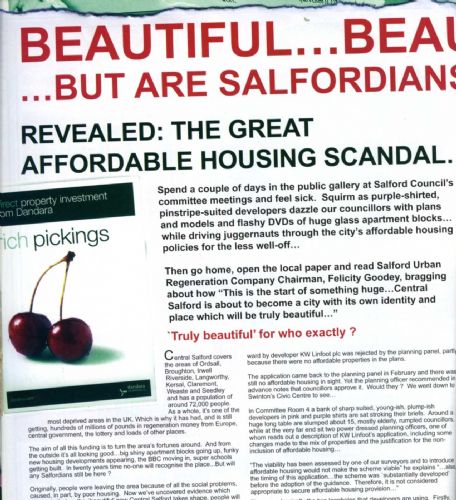
Up to now, every housing development in the city over 25 homes had to include 20% of affordable housing. Even though many housing schemes got round this obligation (see Salford Star print issue 4 – The Great Affordable Homes Scandal), now Salford Council is to officially rip up the obligation.
So-called `mid sales value' areas – including Broughton Park, Chapel Street, The Crescent, Exchange Quay, Ellesmere Park and Monton, Boothstown, Ellenbrook and South Walkden – will still have to include 20% affordable housing, as will `high sales value' areas like Salford Quays and the `Regional Centre'.
`Mid-to-high sales value' areas – Worsley, South Swinton and Chat Moss – will have to provide 25% affordable housing. Except that few housing schemes come up in Worsley and Chat Moss, while the obligation for affordable housing at MediaCityUK was ripped up years ago.
The proposals are staggering considering that the Salford Council housing waiting list has grown by around 2,000 – to almost 16,500 by the end of 2011 (see here).
The Salford Council proposals come as part of its Core Strategy, which informs its housing policy until 2028. Helpfully, Salford Council officer, Chris Findley, has been giving presentations on it all to Community Committees around the city. But at the East Salford Community Committee presentation on 22nd March he failed to include the ripping up of the affordability obligations in East Salford…
…Also, the Council's consultation on the proposals ends today, 2nd April – see here for more details.
Details of the great affordable housing giveaway are contained in Salford Council's horribly complicated Affordable Housing Economic Viability Assessment (see here), based on all sorts of black art assumptions about land values, house prices and, most controversially, developers' profits.
At the moment, any housing scheme in Salford above one hectare in size or 25 housing units must have 20% affordable housing. But the current policy also recognises that "a lower proportion of affordable housing may be appropriate where the financial impact of the provision of affordable housing, combined with other planning obligations as set out in the Planning Obligations SPD, would affect scheme viability…".
Since this policy was introduced in 2006, the `economic viability' argument has allowed developers to ride a coach and horses through it, cashing in all the way. Now Salford Council has re-visited the policy and decided that all schemes in `low sales value' areas are not `economically viable' and have ripped up the clause for provision of affordable housing…
…However, a housing scheme becomes `not economically viable' after developers have taken a 20% profit. Which, according to Salford Council's tables for typical developments in `low value' areas means that even if developers hit profits of over £2million, £3million and £4million the scheme is still deemed to be `economically unviable' - because the profits, plus the affordable housing cost and other payments, would push the project into deficit.
Whether a housing scheme is in surplus or deficit is worked out with an equation of A – (B+C+D+E).
`A' is the final sales or rent value, and the costs subtracted from this are the Land Costs (B), Development Costs (C), Financing Costs (D) and Developer Profit (E).
On the proposed 20% developer profits virtually all schemes in low and mid-low areas would be in deficit, according to Salford Council figures. The Council `Viability' report states… "It can be seen that in the low value sales areas the provision of affordable housing as part of schemes would not appear to be viable, even with only a relatively small requirement for social rented dwellings as part of the overall mix…On this basis…it is not considered appropriate to set any affordable requirement in the low value area."
The repercussions of this could be staggering, given that most new housing developments are in `low value' areas. Does this mean there is to be no affordable housing in Countryside Properties proposed development for Whit Lane and Lower Kersal? Does this mean there will be no affordable housing in the new Pendleton PFI scheme?
Before the new policy has even been approved, Countryside Properties' proposals for eighty new huge houses in the Top Streets of Higher Broughton were passed without any need for affordable housing – using the `not economically viable' argument (see here).
Now developers might get a gold card to build unaffordable houses in areas that need them most – while loads of available affordable housing has been tinned up and demolished, and the waiting lists for affordable housing grow and grow…
* Any objections to the proposals must be lodged today – see the full consultation report and all the documents – click here
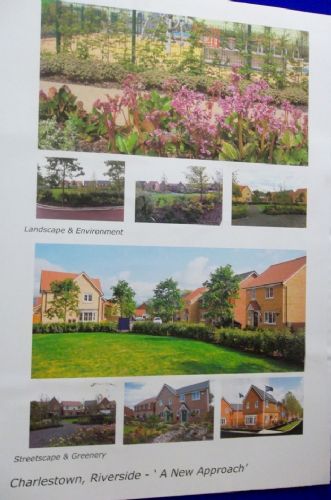
** Main photo shows new houses for Whit Lane in Charlestown - but will any be affordable for people who actually live there under these proposals?


.JPG)
.JPG)
.JPG)


.jpg)


.jpg)
.jpg)
(3).jpeg)
.png)
(1).JPG)
