Salford City Council has very clear rules when it comes to new housing schemes. Any development of more than 25 dwellings must have at least 20% affordable housing, in accordance with policy HOU3 of its own Housing Planning Guidance document.
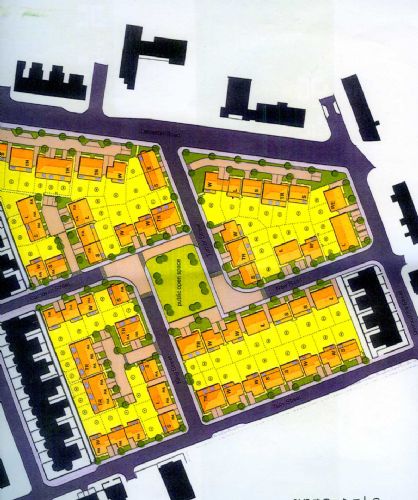
So when a planning application for eighty new houses in the Top Streets of Higher Broughton was submitted by Countryside Properties and the Higher Broughton Partnership - of which Salford Council is a partner, along with the Royal Bank of Scotland and Sigma Inpartnership – people might have expected an element of affordable housing.
However, when the plans came up before Salford Council's Planning Panel on March 15th, the 20% affordable housing obligation was waived.
The planning papers even stated that "Due to the size of the site and amount of units proposed there is a requirement for the scheme to provide an element of affordable housing…equating to a total of 16 units. The applicant is not providing any affordable housing across this scheme".
First, the `applicant' tried to dodge the requirement by arguing that this scheme was nothing but an extension of "existing schemes in the nearby vicinity whereby the 20% provision has therefore been met". But even Council planning officers wouldn't swallow that one – it's not even the same developer.
Then `the applicant' submitted a "viability appraisal of the development to demonstrate that should affordable housing be provided then the scheme would be unviable". This was reviewed by Salford Council's surveyors who agreed that any affordable housing would make the scheme "unviable".
Planning papers state that "whilst the provision of affordable housing is important, to meet the housing needs in this area of the City…the benefits of bringing this scheme forward outweigh the need for 16 affordable units and as such the development is considered acceptable in this regard."
Elsewhere in the application, under the heading `Provision of Public Open Space and Landscaping' there was a requirement for the scheme to meet something called Code Level 3 which would have cost £272,000…
…But `the applicant' stated that this "further burden could result in the scheme not coming forward", so it was waived again, with a mere note on the planning permission stating that "The Panel requested that liaison take place with the Lead Member for Housing, other appropriate Lead Members and the developer to review the overall provision of public open space in the wider area".
The `applicant' did, however, generously agree to pay a £16,000 climate change charge. Meanwhile, the `applicant' would normally also have to pay for a Section 106 Agreement, to cover off site improvements, however this wasn't required either, because it was providing such things under a `developer agreement' with Salford Council.
In the end, the `applicant' was required to pay a mere £1,500 per house for public realm and stuff, plus £150 per house for construction training, and £200 per house for climate change. Given that these are all three, four and six bedroom houses this is absolute peanuts. The total cost to the `applicant' for eighty houses is £148,000, probably less than the cost of one house.
Salford Council's Planning Panel passed the application as it stood, with no affordable housing requirement, no Section 106 payment and hardly any of the normal infrastructure payments.
This is all nothing new for Salford Council which has been generous in the extreme to developers in the city (see The Great Affordable Homes Scandal in print issue 4 of the Salford Star)...But what is different about this particular application is that the `applicant' is officially Countryside Properties and Higher Broughton Partnership – of which Salford Council is, er, a partner…
• In a further twist, the planning decision might yet be ruled unlawful as one of the objectors to the scheme was not informed of the Planning Panel meeting – a clear breach of the rules.
* In an even further twist, after the planning permission was given, it was announced that Jewish housing association, Agudas Israel, would be taking 25 of the houses, presumably making them affordable. So why wasn't this a condition of the planning approval?
See also previous Salford Star articles on the troubled Top Streets of Higher Broughton – click here for There Goes The Neighbourhood


.JPG)
.JPG)


.jpg)


.jpg)
.jpg)
(3).jpeg)
.png)
(1).JPG)
