As you enter the A-Z of Lost Salford Streets exhibition your attention is automatically drawn to the huge brick walls plastered in real signs from long gone and recently demolished streets. It's a sad, awesome sight…
…And one that might just make you miss the white rectangular box that's standing by the entrance door with a pair of ear phones hanging out the top of it. Put these on and you can hear the voices of the Salford people who used to live in these streets, bringing the street signs to life. And yes, one woman does say "You could leave your door open"…
These are happy voices, with happy memories of a disappeared Salford that's disappearing more every day as the relentless march of the bulldozers destroy the last vestiges of old Salford.
This very week, the red brick Seedley Primary School has been trashed (see here), Wiltshire Street in Higher Broughton has been razed (see here), while Lower Broughton continues to be erased from the map. The A-Z of Lost Salford Streets isn't some mausoleum of bygone days, it's living history that's still being made tomorrow. And some of the street signs being displayed are fresh from the wrecking sites.
Today is present throughout this exhibition as its creators have gone out of their way to involve Salford's young people in their heritage. Paper plates drawn and coloured by kids from all over the city commemorate the lost streets while textile banners depict old Ordsall and the Docks.
They will not let this city die in the face of MediaCityUK, Countryside Properties, Peel Holdings and the rest of the developers and speculators determined to make Salford into some poor man's Milton Keynes.
And to emphasise the cleansing, there's a poignant display of the District Six Museum in South Africa which has been the inspiration for this Salford project since day one. In District Six, the indigenous poor black community was expelled for the expansion of Cape Town, with the area's supervisor instructed to chuck the street signs into the sea to wipe out the memory of the place. Instead, he kept the signs and they are now displayed in the museum so people never forget the injustice. The comparisons are glaring.
Here, Lost Salford Streets artist and co-ordinator, Lawrence Cassidy (himself a `lost person' of Lower Broughton), has slapped huge photos of Salford people onto cargo cases and packing drums to emphasise the point. And in one corner of the exhibition are loads of old maps, with people encouraged to put a coloured dot where their former house stood and to write a little memory.
People can also meet the Re-tracing Salford team and bring in photos, stories and street signs every Saturday (1-4pm) throughout the exhibition's run.
Meanwhile, to underline how precious the very recent past can be, some street signs not on the museum's walls are displayed in glass cases with the family snaps of those who lived life there before the bulldozers arrived.
This exhibition is alive with the living, breathing soul and spirit of Salford. Never mind Jeremy Clarkson, the A-Z of Lost Streets should be the first stop for BBC people on their way to the media island on the Quays.
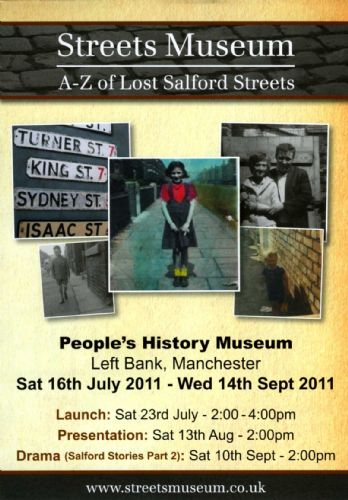
STREETS MUSEUM
A-Z of Lost Salford Streets
Until 14th September 2011
People's History Museum
Left Bank, Manchester
(Near the Mark Addy pub, ten yards over the border into Manc)
• Every Saturday 1-4pm – Meet The Re-tracing Salford Team
Bring in old photos, street signs and your stories of Salford.
• Sat 13th August 2pm: Streets Museum Presentation
• Sat 10th September 2pm: Salford Stories Part 2 (drama)
Further details of the exhibition and the work of the Re-tracing Salford Team see www.streetsmuseum.co.uk
Photos by Anya K
Words: Stephen Kingston


.JPG)
.JPG)
.JPG)
.JPG)
.JPG)
.JPG)
.JPG)
.JPG)
.JPG)
.JPG)


.jpg)


.jpg)
.jpg)
(3).jpeg)
.png)
(1).JPG)
