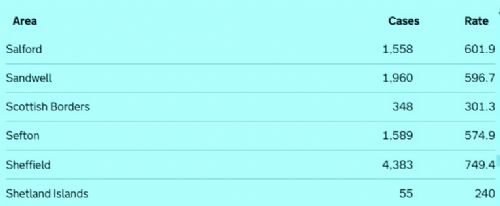
Salford has five new confirmed cases of coronavirus, bringing the total to 1,558, up from the previous day's 1,553.
Elsewhere in Greater Manchester the latest case numbers show Manchester with a total of 3,550 (up from 3,516), followed by Oldham with 2,389 (up from 2,359), Wigan 2,215 (up from 2,212), Bolton 2,091 (up from 2,083), Rochdale 1,988 (up from 1,971), Stockport 1,852 (up from 1,847), Tameside 1,724 (up from 1,722), Trafford 1,504 (up from 1,497) and Bury 1,410 (up from 1,407).
There were no new virus-related deaths at Salford Royal Hospital.
Meanwhile a new map of virus cases in the week ending 6th August for the city's Middle Super Output Areas shows Kersal Dale, Little Hulton South and Cromwell Road and Broad Street with new infections. The highest number of cases were in Cromwell Road and Broad Street, Ordsall and Salford Quays, and Salford Central and University with eight cases.
The full list of cases for that week is...
Cromwell Road and Broad Street 8 cases
Ordsall and Salford Quays 8
Salford Central and University 8
Higher Broughton 6
Little Hulton South 4
Patricroft 3
Kersal Dale 3
Worsley 3
Walkden South 3
To view the map – click here and enter a postcode
Following yesterday's press conference*, in which Greater Manchester Mayor, Andy Burnham, produced statistics showing that the national NHS Test and Trace system didn't reach 47% of contacts of those who tested positive for the virus, the Government has announced the integration of the system with local councils...
"NHS Test and Trace will provide local authorities with a dedicated team of contact tracers for local areas" the Government states "Local and national teams will work as one to ensure that as many people as possible are reached by contact tracing...
"This new way of working will give local areas dedicated ring-fenced teams from the national service" it explains "These dedicated teams of NHS Test and Trace contact tracers will focus their work on specific areas, alongside the relevant local public health officials to provide a more tailored service.
"If the dedicated national team cannot make contact with a resident within a set period of time, the local public health officials can use the data provided by NHS Test and Trace to follow up, which in some pilot areas has involved local authority teams and voluntary partners visiting people at home" it adds.
The move, which is totally logical, was welcomed by both the Local Government Association and Andy Burnham who said: "To get NHS Test and Trace working properly, I called on the Government to make three major changes: first, to provide more data to local councils; second, to provide resources build local contact-tracing teams; and third, to provide financial support for people in low-paid jobs to self-isolate when asked to do so.
"With this announcement from the Government, two out of the three appear to have been delivered and whilst we await the full detail I very much welcome the fact that they are clearly listening" he added "But they need to go further ahead of the re-opening of schools in September.
"NHS Test and Trace will not work properly until all employees are supported to follow its requests to self-isolate" he explained "There is growing evidence that people in the lowest-paid jobs are not cooperating with the system because of the fear of falling into debt. This is why we have launched the Time Out to Help Out campaign - a call on the Government to give all employees the ability to self-isolate without losing pay.
"Only by ending the pay penalty will we see the NHS Test and Trace get anywhere close to being the 'world-beating' service we were promised" he concluded "Failure to do so will leave our poorest communities exposed to real risk of harm this winter..."
* For full details of the Time Out to Help Out campaign and yesterday's press conference see the previous Salford Star article – click here


.jpg)


.jpg)


.jpg)
.jpg)
(3).jpeg)
.png)
(1).JPG)
