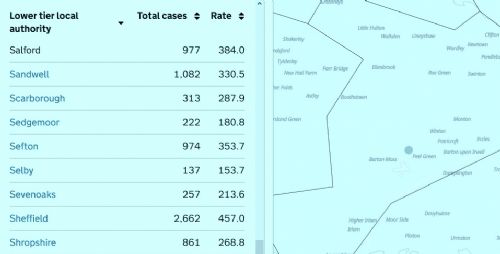
Salford has recorded no new confirmed cases of coronavirus as the total stays at 977 after the previous day's five new cases.
Elsewhere, virus cases in Manchester now total 1,720 (up from 1,714), followed by Wigan with 1,231 (same), Oldham 1,152 (up from 1,151), Stockport 1,085 (up from 1,084), Bolton 1,055 (up from 1,054), Trafford 881 (same), Rochdale 882 (up from 881), Tameside 863 (same), and Bury 815 (same).
Salford Royal Hospital recorded no new virus-related deaths but there was one sad virus-related death in a Salford care home in the week of 12th June and registered up to 20th June announced yesterday by the Office For National Statistics.
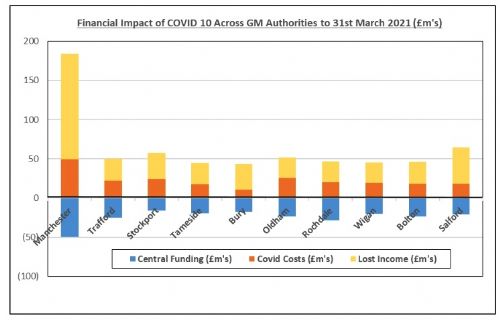
Meanwhile, the Greater Manchester Combined Authority (GMCA) reports the total cost to local authorities of the pandemic by the end of the financial year as £732million, with a net deficit of £368million.
Last week*, Salford City Mayor, Paul Dennett, announced an expected £58million shortfall in the Council's finances as a result of the virus crisis, which left him "deeply, deeply concerned".
With a Government grant of £16million to date, this left £42million for which the Council is using £4million reserves to bring it down to a £38million projected overspend.
The costs included £4.3million for adult social care, £4.8million for children's social care, £13million lost from business rates, £10.7million lost from Council Tax, £5.1million in lost income and £10million lost in dividends and interest on loan payments from Manchester Airport...
The new GMCA report lays the figures down starkly for the whole of Greater Manchester... "Analysis undertaken by the 10 GM local authorities and the Combined Authority indicate that based on current assumptions the cost of the impact of the virus and the associated actions taken to manage the pandemic will be in the region of £732m by the end of 2020/21 alone" it states.
"This is made up of additional costs faced in delivering the GM response to the crisis of £236m together with lost revenues of £496m" it adds "Whilst there are a number of assumptions that have to be made in forecasting what the financial impact of the virus will be, it is important to note that this is not a worst-case scenario. Rather it is an estimate of the most likely impact based on current rates of infection and expectations around Lockdown."
The GMCA figures show the total financial gap in the ten local authorities after the use of reserves and Government grants to be £298million, the gap for GMCA to be £38million and the gap for the Metrolink to be £32million. The deficits do not assume that there will be a second wave of infections or an increased 'R' number.
A table in the report shows that, on top of general Government grants of £16million, Salford has also been allocated £1.98million for Track and Trace, £1.94million for Infection Control and £3.58million in hardship grants, bringing a total of £23.55million from the Government.
Meanwhile, Salford is forecasting the second worst financial impact of COVID-19 across Greater Manchester after Manchester itself (see main graph), but is also putting in the joint lowest use of reserves (along with Trafford) to alleviate the impact, with £4million from general and earmarked reserves (see photo above).
Across the GM region, the virus crisis will cost an extra £2million in waste disposal, £1.9million in sorting homelessness, £2million for the Fire and Rescue Service, £2,8million in procuring PPE and £1.5million extra costs for Transport for Greater Manchester after Government grants, with a further £30million reduced net revenue predicted between August 2020 and March 2021.
"This Paper focuses on the financial impact of COVID 19 in 2020/21" states the GMCA report "It is clear however that there will be a significant ongoing financial impact both in terms of continued higher costs and an ongoing continued suppression of income.
"Whilst it is too early to present estimates of the ongoing impact and there are currently too many unknown variables, the impact is likely to be felt in the following areas...Reduced council tax base and lower levels of growth; Reduced business rates base and lower future growth; Suppressed levels of income from a variety of sources; Increased demands on social care, public health and other council budgets; Increased cost of ensuring financially stable social care market; Shift back to private vehicle use reducing income across public transport; Impact of social distancing on efficiency and capacity of council services...
"This is by no means an exhaustive list and will add up to significant ongoing costs" the report concludes "Any move towards reductions in government funding such as a reduced revenue support grant would have a compounding impact on these issues..."
The GMCA is calling on the Government to support an array of measures to help alleviate the financial catastrophe, ranging from covering losses on business rates and Council Tax, a reduction in public borrowing interest rates and flexibility all round in policies and funding streams.
* For a background on the Salford costs of coronavirus see previous Salford Star article - click here


.jpg)


.jpg)


.jpg)
.jpg)
(3).jpeg)
.png)
(1).JPG)
