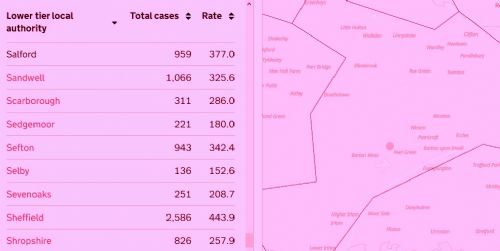
Salford has seen three new confirmed cases of coronavirus, taking the tally to 959, up from 956 the previous day.
Elsewhere in Greater Manchester, the number of confirmed virus cases in Manchester now total 1,643 (up from 1,636), followed by Wigan with 1,223 (up from 1,221), Stockport 1,061 (same), Oldham 1,116 (up from 1,112), Bolton 1,039 (same), Trafford 847 (up from 846), Rochdale 839 (up from 836), Bury 793 (up from 790) and Tameside 789 (down from 790).
There has been one new sad death at Salford Royal Hospital. Better news is that the 'R' rate for the North West is down to 0.8 according to the Centre for Mathematical Modelling of Infectious Diseases, based on data from around two weeks ago.
Meanwhile, following the coronavirus crisis, the TUC is warning of a 'surge' in youth unemployment in the North West as they are four times more likely to work in sectors where jobs are most at risk.
New analysis shows that 21%, or 108,000 workers age 25 and under in the North West work in the greatest risk 'accommodation and food' and 'arts, entertainment and recreation' sectors, compared to 5% for workers older than 25.
The TUC statistics show that 83% of workers in the 'accommodation and food' sector have been furloughed, 74% of these businesses have paused trading and 62% have turnover falling by more than 50%.
In the 'arts, entertainment and recreation' sector, 73% of workers have been furloughed, 75% of these businesses have paused trading and 63% have turnover falling by more than 50%.
This compares to the construction industry where 41% of workers have been furloughed, 19% of these businesses have paused trading and 40% have turnover falling by more than 50%. The average for all industries is 28% of workers furloughed, 18% of businesses have paused trading and 26% have turnover falling by more than 50%.
"In addition to lay-offs, recessions make it much harder for young people seeking to enter the labour market for the first time, as employers are doing much less hiring" the TUC adds "This is part of the reason why youth unemployment following a recession tends to be much higher than for other workers. UK job vacancies have already fallen 25% compared to this time last year. And the sector with the biggest fall is accommodation and food (42%)."
The TUC is calling for a job guarantee scheme to stop those without work becoming long-term unemployed, with early access to the scheme for young workers..."It would resemble the future jobs fund, which was part of the national recovery plan following the recession in 2008 caused by the private banking crisis" the TUC explains "A government evaluation found that two years after starting the programme, participants were 27% more likely to be in unsubsidised work."
The key features of the TUC's proposed jobs guarantee scheme are that it would...
* Support additional jobs that would not otherwise be created by employers
* Enable work that benefits the UK, such as helping to decarbonise the economy
* Offer secure contracts of at least six months
* Pay at least the real Living Wage
* Give training opportunities to help people move into longer-term work
* Provide guaranteed access to trade union representation
The TUC is also calling for the Government to protect as many jobs as possible, including extending the job retention scheme for employers who cannot easily adapt to social distancing. And ministers should form a national recovery council alongside unions and employers, to design and deliver a recovery plan that protects and creates decent jobs.
"We know it's a tough road ahead. But the more people in work, the faster we can work our way out of recession" says TUC Regional Secretary Jay McKenna "Our regional recovery plan must be centred on jobs – both protecting those we have and creating more. We need more good jobs in social care, in the green tech that our future depends on, in UK start-ups and in a revitalised manufacturing sector.
"For those who lose their jobs, the government must set up a job guarantee scheme" he adds "Young people in particular can't be left to the misery of long-term unemployment. And it's the best value option for the Treasury. If we make sure everyone has a decent job on a fair wage, we can recover faster and build back better."




.jpg)


.jpg)
.jpg)
(3).jpeg)
.png)
(1).JPG)
