The independent scientific advisor body, Independent SAGE, has this morning produced its report, Should Schools Reopen? Interim Findings and Concerns, which concludes that it is not safe to reopen schools on 1st June.
"We understand that there is an imperative for children to return to school for their own wellbeing, and that this will also enable some parents to return to work, but it is also vital that an appropriate level of safety for children, staff and the wider community is ensured" the report states.
Amongst the report's findings are that "it was apparent that the public did not feel that they had sufficient scientific, social, and educational information from the government about the impact of schools reopening on their children, teachers and the wider community", and uses its own modelling to try and present the information and answer such questions.
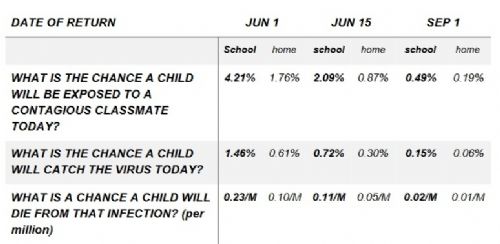
Delaying a school re-opening by two weeks, to 15th June, would halve the risk to children, it insists, while delaying until September would be even less risky.
A pupil going back to school on 1st June would have a 4.2% risk of being exposed to the virus, and a 1.46% chance of catching it. A pupil going back to school on 15th June would have a 2.09% chance of being exposed to the virus, and a 0.72% chance of catching it. By September a pupil going back to school would have a 0.49% chance of being exposed to the virus, and a 0.15% chance of catching it.
While the risk to children is very low, and the report acknowledges the potential mental health problems and the educational disadvantages of pupils from poorer areas caused by home schooling, Independent SAGE believes that decisions on school opening "should be guided by evidence of low levels of COVID-19 infections in the community and the ability to rapidly respond to new infections through a local test, track and isolate strategy...
"There is no clear evidence that these conditions are met" it adds "Until they are it is not safe to open schools on June 1...We strongly recommend that local test, track and isolate programmes are in place and tested before schools re-open."
As far as the effect on the wider community goes, the report is inconclusive..."Where there are ongoing new infections within the community, evidence suggests that re-opening schools could increase the spread of the virus, both in the school and the wider community, perhaps by up to 0.3 on R value" it states "Other evidence from Asia however suggests that school closures have little impact on the rate of transmission.
"There have been recent reports of an upsurge of cases following reopening of schools in France, South Korea and Denmark, leading to re-closing in some instances" it adds "However, this does not necessarily infer transmission within schools but could also be because infections are generally going up in places where lockdowns are eased...
"...the crucial factor allowing school reopening around the world has been the presence of well-functioning local test, trace and isolate protocols - something that is now accepted will not be in place in England by early June" it explains "Each school will vary in terms of layout, ventilation, and numbers of available staff which will determine precisely which infection control procedures are feasible or not...
"We strongly recommend that decisions on school opening be made at local level, involving all stakeholders, to ensure there is support available as schools progress to full function" it concludes.
Commenting after the release of the report, Kevin Courtney, Joint General Secretary of the National Education Union, said: "We have been pressing for publication of the science for many weeks, so we strongly welcome this important intervention from Independent SAGE on the critical issue of school safety during the Coronavirus pandemic.
"We would like to thank them for contributing so much to the public's understanding of the risks involved in a wider opening of schools" he added "Independent SAGE set two crucial conditions for the safe wider opening of schools: low levels of Coronavirus in the community, and a robust track and trace system. Today, Sir David King said in answer to a question from the NEU that the chances of those being met by June 1 are 'virtually nil'.
"The Government must finally relent on its arbitrary target date of June 1, and accept it is simply not yet safe for the wider opening" he insists "Schools and families cannot go on with such uncertainty."
Salford Council has already written to parents and carers stating that it is 'highly unlikely' that all schools in the Government's remit will open on 1st June – see previous Salford Star article for full details – click here




.jpg)


.jpg)
.jpg)
(3).jpeg)
.png)
(1).JPG)
