"These figures show that nowhere outside London and the South East can both boys and girls born today expect to reach their state pension age without a disability..."
The Centre for Ageing Better today reveals what the organisation calls 'unacceptable' inequalities in how long, and how healthily, babies born today in different parts of England can expect to live.
Ageing Better looked at three factors: life expectancy, healthy life expectancy (which estimates the number of years a person will spend in 'very good' or 'good' general health), and disability-free life expectancy, which estimates the number of years spent without a long-lasting physical or mental condition that limits a person's daily activities. And the results, while predictable, are also shocking. Particularly as the Government pushes up the retirement age.
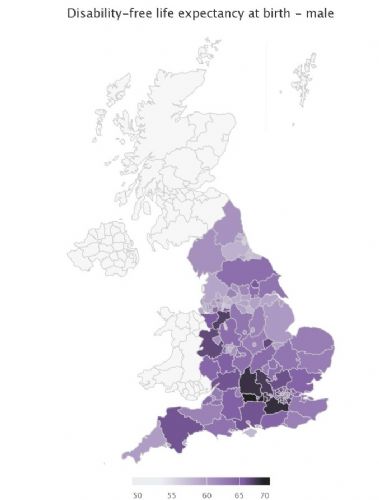
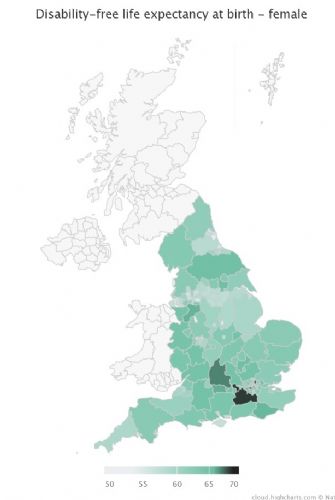
Babies born in Wandsworth can expect to live disability free over ten years longer than babies in Salford, the statistics show, as there are calls for the Government to take action...
A female in Wandsworth can expect to live to 69.1 years of age disability-free, compared to a female in Salford who can expect to live 56.7 years disability-free.
A male in Wandsworth can expect to live to 69.4 years of age disability-free, compared to a male in Salford who can expect to live 58.9 years disability-free.
Wandsworth and the South East* in general have the highest healthy life expectancy in England, with Ageing Better arguing that "the majority of babies born today could be on track for a retirement spent in ill-health and disability".
In only two local areas across England can both boys and girls born today expect to reach 68 – the age at which they are currently set to draw their state pension – without a disability. In only six places can both boys and girls expect to reach that age in good health. If, as expected, the state pension age rises, the numbers could drop further.
"Most of us are set to live many years longer than our parents or grandparents – and these extra years are a wonderful gift" says Anna Dixon, Chief Executive of the Centre for Ageing Better "But the opportunity of longer lives isn't being shared equally, especially when it comes to how healthily we spend our later lives.
"These figures show that nowhere outside London and the South East can both boys and girls born today expect to reach their state pension age without a disability" she adds "We will be letting down today's children if we fail to improve their prospects for a healthy later life.
"The deep inequalities this data reveals are unacceptable and cannot be tolerated" she insists "The government must recommit to the goal of closing the gap in disability-free life expectancy between the richest and poorest by 2035, and take the action needed to make good on that commitment. This doesn't just require more funding for health services but investment in improved housing, better quality work and communities, as well as further regulation on tobacco, alcohol, and unhealthy foods."
Later this month the Government is set to publish its response to the consultation on its prevention green paper, setting out what action it intends to take. Ahead of its publication, the Centre for Ageing Better is calling for the government to recommit to make good on its promise to 'level up' and reduce the gap in disability-free life expectancy between the richest and poorest.
* The lowest disability-free life expectancy at birth for men was in Blackpool with 52.8 years, with Manchester third lowest at 56.2 years.
The lowest disability-free life expectancy at birth for women was also Blackpool with 53 years, with Tameside fifth lowest at 55.3years.
The highest disability-free life expectancy at birth for men was in Wandsworth with 69.4 years, followed by West Berkshire with 69.2 years.
The highest disability-free life expectancy at birth for women was Waltham Forest with 69.5 years followed by Wandsworth with 69.1 years.




.jpg)


.jpg)
.jpg)
(3).jpeg)
.png)
(1).JPG)
