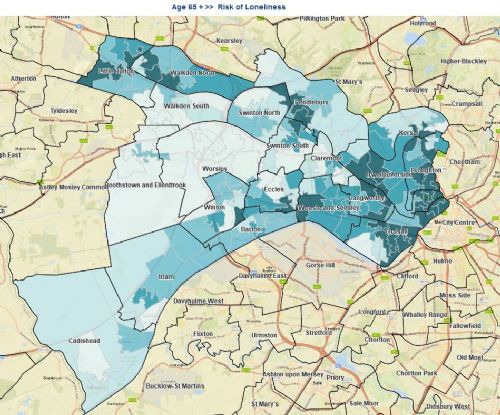
A new report from Salford City Council reveals that there are 35,000 people aged 65 and over currently living in Salford, with the number set to grow. Of the 35,000, however, 16,000, or 44%, are estimated to live in areas at risk of loneliness, (the most deprived national quintiles) as mapped by Age UK.
The Office for National Statistics (ONS) has also placed Salford as the 16th worst local authority out of 326 in terms of risk of older adults being lonely.
"Loneliness can be understood as an individual's personal, subjective sense of lacking desired affection, closeness, and social interaction with others" states Age UK "Loneliness is not the same as social isolation. Although it has a social aspect, loneliness is also defined by an individual's subjective emotional state...
"Loneliness is a negative emotion associated with a perceived gap between the quality and quantity of social relationships that we have and those that we want. It is a subjective experience."
Significant risk factors are said to include marital status, self-reported health status, activities of daily living, age, eye condition and household size, and it matters because "loneliness is also associated with depression, sleep problems, impaired cognitive health, heightened vascular resistance, hypertension, physiological stress and mental health problems."
As well as things like social networks (living alone, contacts with friends and family, social participation etc); health and individual characteristics (age, ethnicity, sexual orientation, low income, retirement etc), 'neighbourhood characteristics' are also a factor, states Age UK, and include the 'structures of buildings and streets, provision of local amenities, territorial boundaries, area reputation, neighbourliness and material deprivation of area of residence'...
In Salford, the Age UK map shows, the wards with the highest risk of loneliness include Weaste and Seedley, Irwell Riverside, Little Hulton, Pendlebury and bits of Ordsall.
Salford Council's 'refreshed' Locality Plan states that the city wants to encourage employers to employ people 'well into their 60s', while it also wants to implement "an inclusive approach to supporting older adults to volunteer, including opportunities for older people to provide mentoring and peer support. There should be a focus on extending opportunities to remain engaged with creative, learning and cultural activities as we age..."
It will also use the Age Friendly Assessment for Salford measures as indicators of inclusion and contribution of older people...
"Public and private partners signed up to being age-friendly; Percentage of people who describe their area as being age-friendly; Employment rate of those aged 50-64 is comparable to national average; Number of those aged 50-64 who are in training or volunteering; The proportion of adult social care users and carers who have as much social contact as they would like; and Rates of over 50 Salford residents who are 'active' or 'fairly active'...
To view the Age UK locality map of Risk of Loneliness – click here
And to see definitions and more details – click here and click here




.jpg)


.jpg)
.jpg)
(3).jpeg)
.png)
(1).JPG)
