"Unfortunately there does not appear to be a formal record or agreement which the Council is able to locate..."
In 2007, residents in Seedley and Langworthy were battling Salford City Council to save their houses from demolition. Some of those residents told the Salford Star at the time that the local community organisation, the Seedley and Langworthy Trust, or SALT, was seen as the 'devil's disciples' as its staff were not supporting shop keepers and home owners who did not agree with the way that the so-called regeneration was being carried out.
The demolition of homes around Nansen Street and the huge amounts of public money being handed to Urban Splash for its upside down houses at Chimney Pot Park certainly riled large sections of the community, with good reason. The upside down houses proved unaffordable for those who used to live in them, and the land on which the demolitions occurred remain empty crofts, although Salford Council put the sites on the open market last year (see here).
At the centre of all this has been SALT and, late last year, Salford Council discovered that thousands and thousands of pounds had been handed to the organisation from shop rents with no apparent paperwork or accountability.
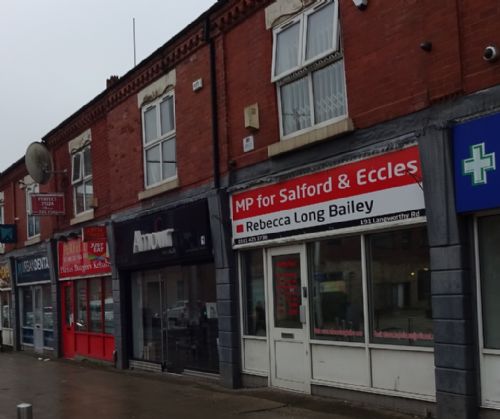
The payments, averaging around £12,600 a year, date from 2007 when the doomed North West Development Agency, or NWDA, paid for shop makeovers on Langworthy Road, for numbers 167, 173 and 191; one of which was subsequently sold, and one of which has now been taken over by Rebecca Long Bailey.
Apparently, according to a Council report, the NWDA approved a request for the shop income "on condition that an annual report was provided each year containing details of the proposed projects and assessment of expenditure and outcomes" ...although no-one can actually find any such agreement, and the NWDA was scrapped in 2010...
"Unfortunately there does not appear to be a formal record or agreement which the Council is able to locate, and despite correspondence between the Council and NWDA, again, there is no record of a formal agreement being entered into" states the Council's legal eagle in the report.
The monies mentioned in the Salford Council report highlighting the issue don't appear to be flagged up in any of SALTs accounts that are publicly available.
Following the report, Councillor Kelly, Lead Member for Housing and Neighbourhoods, formalised the agreement and approved "the payment of the rental income of 167 and 191 Langworthy Road to the Seedley and Langworthy Trust for use in community projects, subject to the implementation of the project approval and governance arrangements.
"...The approval seeks to clarify these arrangements and makes recommendations for strengthening governance arrangements for the approval of expenditure on a value for money basis" she added. In other words, they now have to report how the money will be used and how it benefits the community.
The Salford Star put some questions to Councillor Mike Pevitt, an on-off member of the board of SALT since its inception...
What was the full income that SALT received from the shops? Was it £12,600 per year, and since when?
Councillor Pevitt: "I can confirm that the payment is c£12,500 pa and arises from an agreement with the former NWDA that monies due to it from rents from shops that were refurbished using NWDA grant could be retained in Salford as long as it was utilised for community use in the area but not directly by the Council."
What did the money get spent on, given that most of SALT's projects were funded from ringfenced grants?
Councillor Pevitt: "SALT only received any monies if the properties were let in the year: this amount was also subject to a management fee of 15% and also subject to corporation tax, SALT are required to report annually on how the funds are deployed."
Why was SALT a 'private limited company' rather than a community interest company or something more transparent?
Councillor Pevitt: "As far as a Private Limited Co, I assume this was due to legal advice; I wasn't on the Board when this was set up, I was seconded to SALT by my Employer in May 2004 and had to leave the board, also the original company was set up in 1999. Limited projects the board members financial liabilities."
At the time was SALT too close to Salford Council/NWDA to be an independent Trust with the community's interest at heart?
Councillor Pevitt: "I don't think it was too close to the Council, at times I can remember relationships between the council and SALT were quite stretched. SALT has always had the community's interest at heart, demonstrated by the many years of support that SALT gave to the community, such as managing the massive alleygating scheme in the area and supporting the residents involved in the In Bloom initiative within the area, plus the running of various SRB5 training and Learning projects, which I believe you were heavily involved in the media training."
SALT is currently moving into the housing market, having brought five empty properties back into use via a £458,000 grant from the Empty Homes Communities Grant Programme plus an additional loan of £40,000 from Salford City Council. SALT has also been awarded funding from Homes England to develop a community led housing model working with Inspiring Communities Together.
Gerry Stone is a trustee of Inspiring Communities Together (ICT), while Bernadette Elder is the Chief Executive of ICT. The pair are also the directors of the Seedley and Langworthy Trust.


.jpg)
.jpg)
.JPG)
.JPG)


.jpg)


.jpg)
.jpg)
(3).jpeg)
.png)
(1).JPG)
