Change.org, the world's largest social change platform with 17 million users in the UK alone, has compiled the country's first 'People Powered Index' of MPs, which ranks how, er, rank they are in their relation with constituents.
The Index of all 650 MPs was calculated using ten data sources from the last Parliament, which ran between 2017 and 2019, and measures the following...
* An MP's availability to their constituents. This looks at how an MP is available online (email and social media), offline (holding surgeries in their local area and a caseworker), and whether an MP is distracted by a second (or third) job.
*An MP's participation in Parliament. This looks at an MP's participation record for voting in Parliament, so that their constituency is counted when new laws are passed, and how often an MP raises issues from their constituency in Parliament.
* How an MP listens to the public. An MP's top priority is their constituency, but they also have a responsibility to the wider general public to bring political attention to mass public campaigns and priority issues by discussing them in Parliament.
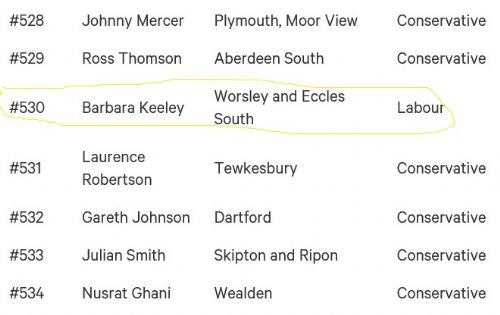
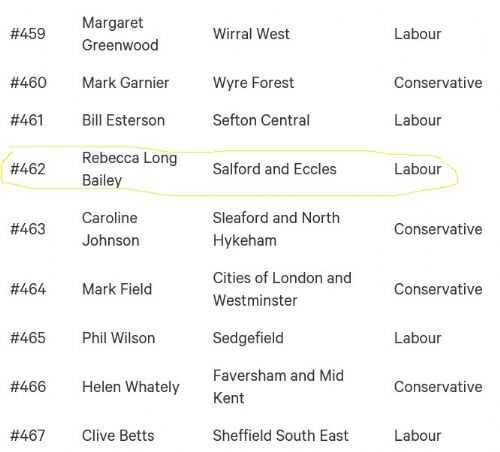
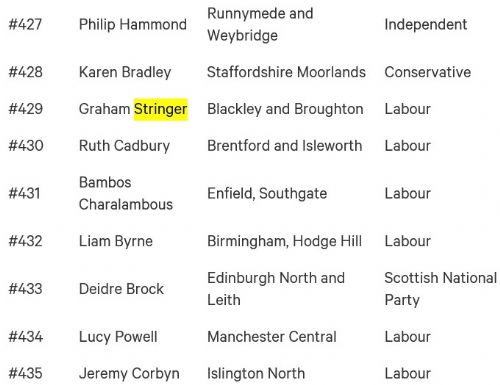
Salford's three MPs unfortunately come out really badly in the Index, lingering in the bottom third. Worst was Barbara Keeley, MP for Worsley and Eccles South, who ranked 530; next worst was Rebecca Long-Bailey, MP for Salford and Eccles who ranked 462; and best of a bad bunch was Graham Stringer, MP for Blackley and Broughton who scraped the cusp of the bottom third with a rank of 429.
National figures didn't rank much better, with Labour Party Leader, Jeremy Corbyn ranked 435 and Tory Leader Boris Johnson 478.
The best MP in the UK was named as Wayne David, Labour MP for Caerphilly, and the worst MP in the country was Geoffrey Clifton-Brown, Conservative Party MP for The Cotswolds. Overall, two-thirds of the top fifty MPs are Labour, and almost three-quarters of the bottom fifty are Conservative MPs.
Despite only holding 32% of seats in Parliament, women account for 36% of the top fifty MPs, while men are ranked lowest, making up 82% bottom fifty MPs.
"Unlike most jobs, there's no job description for being an MP" says Kajal Odedra, UK Executive Director of Change.org "So for the MPs putting themselves forward again, and when we're looking at candidates to see who's best for the job, how are we judging what a 'good' MP looks like? That's why Change.org has created the UK's first People-Power Index.
"From years of working with ordinary people to campaign on issues that matter to the public, a big motivation for starting petitions is that they don't feel heard by those in power" she explains "We've judged that being a 'good' MP is about openness and responsiveness to constituents. Trust in politics is strengthened when it is open, transparent and the public are genuinely listened to.
"We want voters to check how their MP ranks when making their mind up whether to re-elect their last MP or not, and we want the People-Power Index to inspire new MPs to prioritise their relationship with their constituents" she adds.
To see the full list of ranks for MPs in the Change.org index – click here


.JPG)
.JPG)
.JPG)


.jpg)


.jpg)
.jpg)
(3).jpeg)
.png)
(1).JPG)
