Today, the National Audit Office has released its report on fracking in England, and whilst it doesn't make any comments on the Government's policy or approach, it does cover an overview of fracking and the activity to date, the Government's objectives, managing the risks from fracking and the costs to taxpayers...
First thing to note from the report is that that public support for fracking "is low and has fallen over time...The Department [for Business, Energy and Industrial Strategy] public attitudes survey shows the opposition to shale gas has increased from 21% to 40% between 2013 and 2019".
The report adds that "Local authorities we interviewed said the strength of public opposition for shale gas planning applications was unprecedented", with one having received 36,000 responses.
While the councils can claim £250,000 back from the Government to cover costs, the Ministry of Housing, Communities and Local Government estimates that determining a planning application costs around £300,000, excluding challenges and appeals. As an example, Lancashire County Council incurred additional costs of £330,000 for a public inquiry against two planning decisions.
If, as expected, Ineos comes back to try and get planning permission for fracking in Salford, at Barton Moss or elsewhere, the cash-strapped Council could be liable for hundreds of thousands of pounds to deal with it.
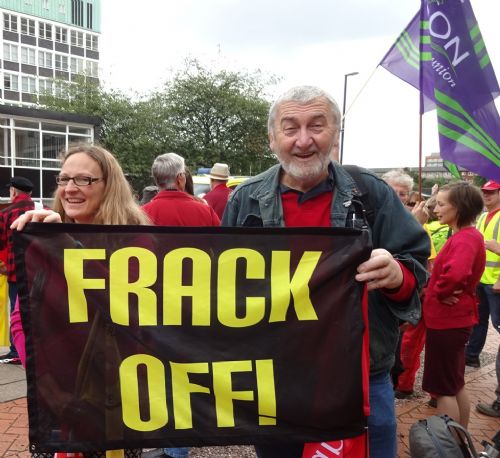
Then there's the cost of policing any protests centred around the fracking site. Barton Moss policing cost £660,000 up to February 2014, with costs estimated at around £1million by the end of the protests (see here)...
"We have identified known costs of at least £32.7million since 2011" states the Audit Office report "This includes £13.4million spent by three local police forces on managing protests around shale gas sites. It does not include the cost of appeals, judicial reviews, or the time and expenses of public servants."
On top of this are the costs of cleaning up and decommissioning a site - estimated at between £195,000 and £1million - should an operator go bust..."The Department was unable to explain who would meet decommissioning costs if the landowners were unable to do so" states the report.
The industry has used arguments of energy security and cheaper gas to justify fracking, but the report questions such assumptions...
"The Department does not include estimates of shale gas production in its annual
assessment of the security of supply because of the uncertainty over how much shale can be commercially extracted" it states, adding that "Irrespective of the size of any future shale gas industry, the Department does not expect it to reduce energy prices because the price of gas is set internationally, and the UK's shale gas output is likely to be small in comparison to international markets. The CCC [Committee on Climate Change] concluded that shale gas production would do little to reduce energy bills."
The 48 page report lists risks to everything from air quality (impact 'substantially higher') to earthquakes ('additional risk') and local water supplies ('likely to be more significant').
One of the report's key findings is that the Department for Business, Energy and Industrial Strategy "believes shale gas can support economic benefits, but it has not analysed the benefits or costs of shale gas development..."
A statement on behalf of national anti-fracking groups concludes that "The lack of Government knowledge and awareness of the impacts of fracking is staggering, as are the claims that the UK has leading regulatory standards. Coupled with the climate crisis humanity is currently facing, a new fossil fuel industry from fracking would be both reckless and nonsensical..."
Steve Mason from Frack Free United, also comments: "What we have here is a truly independent verification of the facts and questions posed by the anti-fracking campaign. This report has exposed the fragilities of the Government's policy on fracking, leaving so many unanswered questions. The Government has no idea how much gas they can extract, what the economic benefits are and they do not have the technologies available to limit emissions if we frack.
"It is highly likely that taxpayers will have to pay for the clean-up costs" he explains "Anyone reading this report must surely be thinking: 'What on earth is going on? How can the Government support this industry that is fast becoming more fantasy than facts?' We advocate an urgent ban on this dirty fossil fuel industry."
Joe Corré, Head of campaign group Talk Fracking, adds: "A report which condemns fracking is at the same time still offering a faint flame of Government support for the rapidly dying shale gas industry. Shale investors are finding it very difficult to give up the ghost. Unfortunately, their friends in government are still keeping it on life support despite all the science and public opinion giving a fatal prognosis for England. Fracking is over."
Gina Dowding MEP also says: "What is clear is that the NAO [National Audit Office] has finally called out the cheap gas prices myth and that energy prices are not expected to fall: that's because the shale gas industry cannot be easily compared to the North American model both because of difficult geology here and how our communities are much more densely populated. Aside from the myriad issues surrounding fracking, to even think of progressing with a new fossil fuel industry during a climate emergency, is nothing short of stupidity."
And the Preston New Road campaign, born from Cuadrilla's site in Lancashire, adds "From the fracking that has taken place to date, some of the dis-benefits such as earthquakes and greenhouse gas emissions have been proven. Shale gas extraction just does not appear to have a sound business case."
Finally, Jamie Peters, fracking campaigner at Friends of the Earth, underlines the sentiments: "This is a quietly critical report that doesn't give the fracking industry any revived sense of hope. The NAO have several concerns including the mark-your-own-homework approach to regulation and the lack of clarity over who should be responsible for clean-up costs if fracking ever got going.
"Nothing has changed: fracking isn't wanted" he adds "It's a failed industry, and the future is renewables and energy saving."
To read the full report – click here




.jpg)


.jpg)
.jpg)
(3).jpeg)
.png)
(1).JPG)
