The contrast is obvious to anyone who drives through the city at the moment...huge housing blocks going up everywhere, posh restaurants and bars opening all over the place...and a scenario in which loads of people who come from Salford can't afford to get near any of it.
Unaffordable apartments going for over £300,000 and rents driven up to the £1,000 a month mark, contrasted with a massive affordable housing shortage and poverty on the increase.
Last week, Salford Council presented its 'Housing Review' to the East Salford Community Committee, recognising the problem but refusing to take any of the responsibility for the 'tale of two cities'.
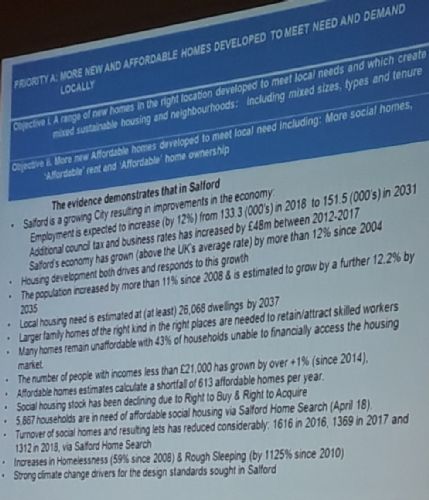
The Council's Priority A was stated as "More new and affordable homes developed to meet need and demand locally", which was accompanied by a slew of figures backing it up...
Despite Salford's economy growing by 12% above the UK average rate since 2004, with a similar growth in employment and population, 43% of the city's households cannot access the housing market either to buy or rent, with average private rents increasing by 29% since 2009. Meanwhile, the number of people with incomes of less than £21,000 has increased by 1% over the last four years.
'Affordable housing' was defined at the Community Committee as people spending no more than a third of their income on rent or mortgage.
"Many homes remain unaffordable" understates the Council Review, calculating a need for 613 'affordable homes' per year, and publishing the number on the housing waiting list as 5,867 as of April 2018. It adds that there's been a 59% increase in homelessness since 2008 and an 1125% increase in rough sleeping since 2010, while 3,879 empty homes "continue to be a blight in the city and are a wasted resource".
Two of the reasons given for the lack of social housing are people buying their social housing properties, via Right To Buy and Right To Acquire and that people are staying longer in social housing, reducing available lets.
However, as the Salford Star has pointed out many times, it's not what Salford Council tells you about the housing problem, it's what they don't tell you...about what many regard as the social cleansing of the city.
Before the 'regeneration of Lower Broughton, 100% of houses were classed as affordable. By the end of the 'regeneration', 64% of the new houses were for market sale or rent ie unaffordable. Lower Broughton developer, Countryside Properties, stated on its relationship with Salford Council that "It was a key aspiration of the Development Agreement to significantly reduce the proportion of affordable housing"...
And in Pendleton 885 affordable properties were down for demolition, to be replaced with only five hundred affordable homes, out of 1,500 to be built. The Salford Council business case to the Government on the scheme noted that its Pendleton Together plans "will lead to a dilution in the current concentration of economically inactive households" by "young professionals and individuals who wish to live in Pendleton".
In other words, it was a deliberate policy by Salford Council to flatten the amount of affordable housing and 'dilute' the number of poor people in the central areas.* Add that together with the Council's planning policy which let developers off with providing social housing in 'low value' areas and beyond, and now the Council has an affordable housing crisis!
Lead Member for Planning, Councillor Derek Antrobus, who was at the East Salford presentation, added that the Council's much lauded 'Derive' housing company is "not going to make all that big a difference"...as the Review was met with anecdotes from community attendees about so-called 'social housing companies' charging almost market rents and landlords buying up properties to convert to houses of multiple occupation, destroying the community and driving up rents.
The Housing Review also has a Priority B, to 'Improve and maintain existing homes', noting that the last time the Council counted, in 2016, 7,259 private dwellings, or 9%, would fail the decent home standard. And 2,746 private homes, or 3.4%, would fail the decent home standard in relation to 'thermal comfort'.
Priority C for the Council is about 'Living and Ageing Well Through Housing Provision', noting that the over 90s age group has increased by 43% between 2008 and 2017, and that there will be a need for up to 1,000 Extra Care Housing spaces by 2030.
The Review also notes that 1,391, or 23%, of those on the current housing register require an adapted or accessible home but that more people who have disabilities should be supported to live in the community. The Council's 'objective' is that "quality supported accommodation will be available for those who need it".
It's all fine words but the reality is somewhat harder to implement...as the tale of two cities intensifies...
* See previous Salford Star article and links – A Tour Through Salford Council Spin On Affordable Housing – click here


.jpg)
.jpg)
.jpg)


.jpg)


.jpg)
.jpg)
(3).jpeg)
.png)
(1).JPG)
