Last year, the Government identified eleven locations in Greater Manchester, including in Salford, where legal limits for nitrogen dioxide, or NO2, would be breached beyond 2020. It followed a court case by Client Earth which forced the Government to act and sort it out by 2021.
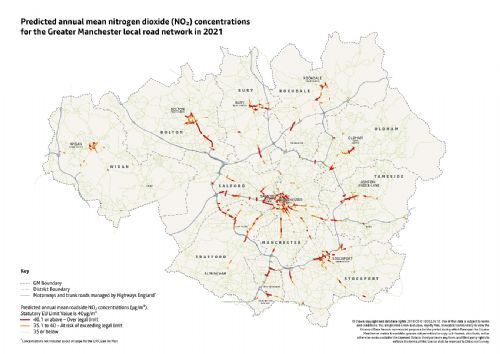
At the time, 48 roads in Salford were identified (but not specifically named) as being in breach of NO2 legal limits (see previous Salford Star article – click here), but today the Greater Manchester Combined Authority (GMCA) has produced an online map showing the exact locations and 14 stretches of roads and areas in Salford that are affected, and predicted to breach limits by 2021, while stating that the problem is now worse than originally thought...
• Wellington Road by the side of the M602
• The area around the B5231, Monton to Patricroft, including Green Lane, Leech Drive, Monton Green and Shackleton Street.
• Parrin Lane, alongside the M602
• Worsley Brow, near the M60
• The East Lancs Road, near the junction of Worsley Road
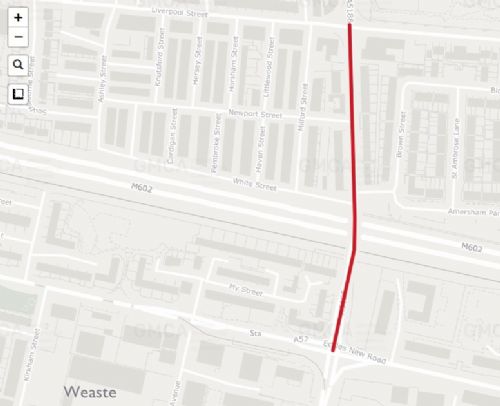
• The B5228 that goes over the M602 from Eccles new Road to Tootal Road
• Langworthy Road, from Eccles New Road to Liverpool Street
• Parts of Cromwell Road, from Gerald Road to the Pendleton roundabout
• Liverpool Road in Barton, neat to the M60
• Regent Road
• Albion Way
• Trinity Way
• The side of the M60 near the Chill Factore
• Broad Street/Crescent and Chapel Street.
Diesel vehicles mainly cause 80% of NO2 emissions at the roadside, and it's now acknowledged that air quality is the largest environmental public health issue facing the UK. Pollutants are linked to a wide range of serious health problems and reduced life expectancy, and contribute to the equivalent of 1,200 deaths a year in Greater Manchester alone.
While the Government is pushing for charge-based Clean Air Zones, the Greater Manchester Combined Authority is working on a Clean Air Plan which avoids any congestion charge but could include, it states, "increasing public transport capacity; upgrading or retrofitting the public transport fleet to run on cleaner engines; increasing the use of electric vehicles through expanding the electric charging point network or financial incentives; better traffic management; encouraging use of alternative fuels; expanding and improving cycling and walking infrastructure; and potentially introducing Clean Air Zones, where the most polluting vehicles may attract a penalty payment if they are driven into certain designated areas".
Councillor Alex Ganotis, GMCA Green City Region Lead, says: "Nitrogen dioxide is an invisible killer, and drivers and their passengers often don't realise that the air inside their car can be dirtier than outside.
"We can all make small changes to help clean up our air" he explains "For example, driving less and walking or cycling more can help reduce your exposure to air pollution and also cut emissions. We're looking at ways to help more people do this.
"But we mustn't lose sight of the fact this is a looming public health crisis which needs urgent national action" he adds "We're calling on Government to give Greater Manchester the tools we need to tackle the problem together – this means a local vehicle scrappage scheme and funding for cleaner engines for buses and taxis.
"In developing our Clean Air Plan, Greater Manchester is following a strictly defined process set out by Government to run feasibility studies on potential NO2air pollution compliance measures" he says "I want to be clear that a congestion charge is not being considered as part of this process. But we do have to consider how we ensure that dirty vehicles are not polluting our air."
Most of the noxious pollution spots are near major motorways and Councillor Ganotis is calling for the Government, which runs the network, to tackle the issues.
Eleanor Roaf, Greater Manchester's lead Director of Public Health for air quality, adds: "It's children, older people and those in poor health who are hit hardest by polluted air. But it's not just them who would benefit from this problem being tackled effectively. Polluted air increases the chance of hospital admissions and trips to A&E. It's harming our health and is linked to increased risk of heart disease and lung cancer. That's why urgent steps need to be taken to ensure this issue is tackled as quickly as possible."
A new Greater Manchester air quality website has been created to raise awareness and keep residents informed on the development of the Greater Manchester Clean Air Plan – www.CleanAirGM.com
To see the map of Salford roads that breach legal limits of NO2 pollutants – click here


.JPG)


.jpg)


.jpg)
.jpg)
(3).jpeg)
.png)
(1).JPG)
