Leeds City Council is currently consulting on Clean Air Zones, to be implemented by 2020, that will cover 55% of the city and will see proposed charges of £50 a day for coaches and HGVs, and £12.50 per day for taxis and private hire vehicles.
Birmingham City Council is consulting on similar plans and charges, that will also see car owners paying between £6 and £10 per day to enter the Clean Air Zone, unless the vehicles are compliant to 'Euro4 emissions standard' ie electric or low emissions. In Birmingham it's reckoned that 200,000 cars a day travel within the proposed Clean Air Zone and that 45% of them would be liable for the charge.
Today, the Planning, Housing and Environment Overview and Scrutiny Committee of Greater Manchester Combined Authority (GMCA) is meeting to discuss plans for Greater Manchester Clean Air Zones.
That Greater Manchester has a major pollution problem isn't in any doubt. Salford itself is the joint worst pollution hotspot in England for PM2.5 particles (see previous Salford Star article - click here), while the city has 48 roads with illegal levels of nitrogen dioxide (N02) mainly caused by vehicle emissions (see here).
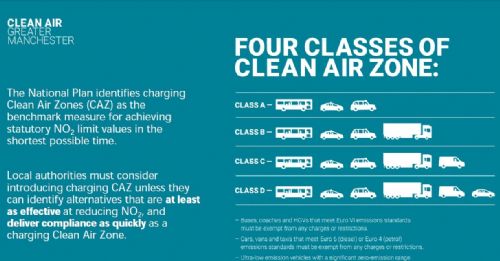
Greater Manchester as a whole has seven local authority areas exceeding EU and World Health Organisation limits of N02, and after a groundbreaking court case brought by Client Earth, the Government is legally bound to sort it out by 2021. It has decided that Clean Air Zones with charges for vehicles with high emissions is the answer...
"Local authorities must subsequently consider charging Clean Air Zones as their benchmark measure for implementation unless they identify alternatives that are at
least as effective at reducing NO2 and deliver compliance as quickly" states the report being discussed by GMCA councillors today.
GMCA and Transport for Greater Manchester have to come up with a plan by 31st December this year, and have produced a shortlist of options to try and avoid Clean Air Zone charging, which will be seen as a congestion charge under a different name.
Options include 'time restrictions' on vehicles entering the Zones; 'Differential parking charges...different charges for times of day, vehicle type, car sharers and could include workplace parking levy'; 'Encouraging alternative travel choices through road space reallocation'; increasing electric vehicle uptake through 'infrastructure or financial incentives'; changing traffic signal timing to reduce congestion; and reducing trips taken by cars by building 'awareness of the options available'.
If these measures don't reduce N02 concentrations 'in the shortest possible time', then the 'quicker option' of charge-based Clean Air Zones would be forced on Greater Manchester residents.
The GMCA is currently undertaking a feasibility study in Oldham, and will publish its 'preferred option' by 31st December, followed by a public consultation.
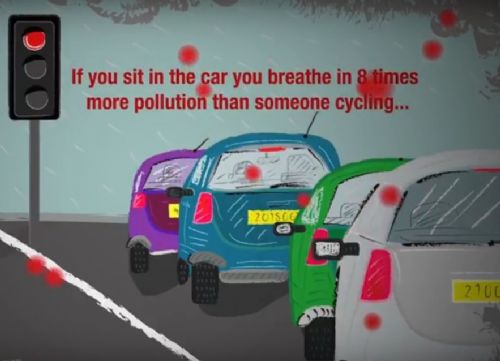
Meanwhile, Manchester Friends of the Earth has produced an excellent short animated video explaining the affects of pollution and why you should leave your car at home - click here to view it




.jpg)


.jpg)
.jpg)
(3).jpeg)
.png)
(1).JPG)
