While those in authority keep telling us how Salford is booming, statistics obtained by the Salford Star on young people aged 16 and 17, and not in employment, education or training (NEET), or simply 'not known' about, paints a different picture of those left behind.
The percentage of 16-17 year old NEETs in Salford has risen from 5.81% in March 2017, to 6.25% in March 2018. This is more than double the national average 2.8%, close to double the Greater Manchester average (3.6%) and even above the average for Salford's 'statistical neighbours' (economically similar places) which have 4.5% NEETs.
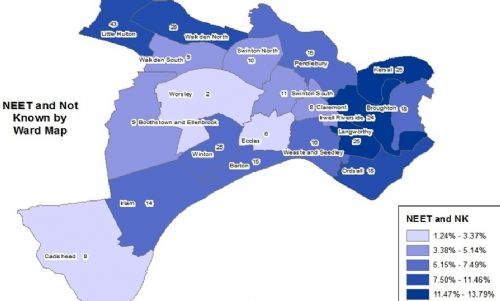
When those who are 'not known' are added to the Salford figures the rate rises to 8.1%, up from 7.3% last year. East Salford has shown the greatest percentage rise, with 10.08% NEET or 'not known', up from 8.47% last year. Within East Salford, in the Irwell Riverside ward, 14.37% of 16 and 17 year olds are within this category, while in Kersal it's 11.65%.
High percentages were also recorded in Walkden North (11.4%), Little Hulton (11.05%), Langworthy (10.4%) and Ordsall (8.97%). Altogether, almost four hundred (380) 16 and 17 year olds in the city are NEET or 'not known'.
Lowest wards for NEETs and 'not known' were Worsley, with just two NEETS, and Eccles with four NEETS and two 'not known'. Salford North and West showed a slight drop, from 6.73% in 2017 to 6.71% in 2018, Salford Central showed a drop from 10.67% to 8.23%, while Salford South increased slightly from 5.18% in 2017 to 5.57%.
Meanwhile, those who are NEET in the city are spending longer periods of time in unemployment – up from 129 days in 2017, to 137 days in 2018; and the number of 16 and 17 year olds in education (from 3,569 to 3,518) and employment (from 486 to 426) has dropped.
Education, employment and training outcomes for teenage mothers (a decrease of 11.7%) and those supervised by the Youth Offending Service (a decrease of 7.14%) have also worsened.
Now Salford City Council has commissioned Salford University to find out what is going on with NEETs in the age group above, 18 to 24, or what it calls 'the city's hidden young people'. The Council is concerned that they 'are being left unsupported' and not claiming benefits to which they are entitled.
"There are several suggested reasons why young people are off the radar – such as the stigma associated with receiving benefits, experience of benefits sanctions, taking part in crime or participating in the informal economy by doing odd jobs or street trading" says Research Fellow Dr Katy Jones, who is leading the project "However, much of this is based on assumption and there is a lack of real evidence which we are now hoping to address."
Her team want to carry out confidential interviews with twenty people aged 18 to 24 who are living in Salford, not in employment, education or training and not claiming benefits they are entitled to, and anyone who participates will get a £10 shopping voucher. Anyone interested should email Katy Jones at k.e.jones@salford.ac.uk




.jpg)


.jpg)
.jpg)
(3).jpeg)
.png)
(1).JPG)
