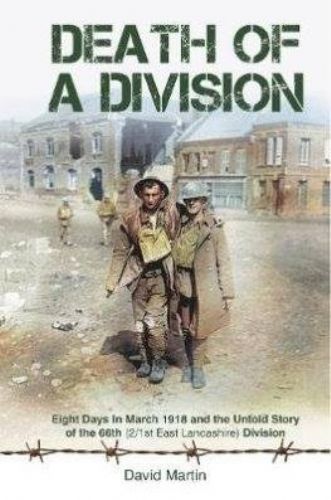
This year see's the 100th Anniversary of the end of the First World War, the war to end all wars as the survivors were told. As can be expected a slew of military books will be published or reprinted to mark this occasion and so I was delighted when a copy of, Death of a Division by David Martin arrived on my doorstep.
David is a noted author, military historian and tour guide to the battlefields of the Great War in France, and this book tells the story of one, momentous week in the Great War, 21st - 28th March 1918, that became known as The March Retreat.
Both British and Germans alike were beginning to feel the full horror of this pointless war, which had seen both countries lose thousands of men, their countries almost starved into submission and brought to the verge of bankruptcy. And for what?
On the morning of 21st March, one million German troops left their trenches and attempted to smash their way through the British Expeditionary Force along a front of fifty miles. It was to be their last effort to land a knockout punch on the Allies and win the war.
Standing in their way stood a dozen British Divisions, including men of the 66th (2/1st East Lancashire) Division, men who who gathered from the mill towns of Burnley, Accrington, Blackburn and Preston; men who prior to the war had worked in local cotton mills or on the land.
This incredibly detailed and researched book complete with photographs and period photographs tells their story. Tales of heroism, cowardice, incredible bravery and sacrifice and, it has to be said, incompetence by several high ranking generals in the British Army are told here.
Letters sent home to loved ones give amazing insights to the day to day horrors the men faced. Lance Corporal William Sharpe tells of four young men aged just 18 who first experience of enemy shellfire saw them screaming and crying for their mothers; these boys would be blown to smithereens.
An army doctor, Captain Dobson, had to amputate both legs off a young officer, and when he visited him after the operation to see how he was coping, was told, "I'm sorry to have been so much trouble". What can you say to that?
24 year old, Private George Herbert Columbine took command of a machine gun and continued firing at the advancing Germans from 9am to 1pm, before he was eventually killed by a German shell. For this he was awarded a posthumous Victoria Cross for gallantry.
Stories of retreating British troops blowing up ammuntion dumps and torching farm buildings to avoid giving the advancing German's any spoils of war is lightened when the men discover a cache of wine and attempt to drink the lot!
Casualties exceeded 7,000 men from the Eastern Divison, either killed, wounded or mising in action in their brave attempt to stem the German army.
Told in 220 incredibly researched pages, the book is a must-read for both military historians, or anyone who wishes to learn more about the bravery of these Lancashire men.
Death Of A Division: Eight Days In March 1918 and the Untold Story of the 66th (2/1st East Lancashire) Division is published by Pen & Sword, priced at £19.99.
Sales of The Death of a Division will aid the Royal British Legion and the LMS
Patriot National Memorial Engine.
The book launch will be held at Lancashire Infantry Museum at Fulwood Barracks in Preston from 11am to 3pm on Saturday April 14th, offering the chance to meet and talk to the author.
To book a place contact the author on davidemartin1918@gmail.com. Attendees will need photo ID to gain access to the museum.
Review by Tony Flynn




.jpg)


.jpg)
.jpg)
(3).jpeg)
.png)
(1).JPG)
