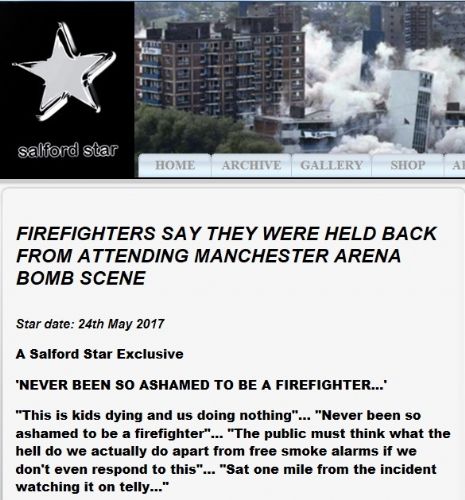
On 24th May last year, two days after the horrific Manchester Arena bomb attack, the Salford Star was sent leaked internal blogs from Manchester firefighters, furious that they were held back from attending the scene...
"This is kids dying and us doing nothing"... "Never been so ashamed to be a firefighter"... "The public must think what the hell do we actually do apart from free smoke alarms if we don't even respond to this"...
"Sat one mile from the incident watching it on telly..."... "My heart hurts knowing we have very capable people who could have helped and weren't given the chance..."
The Star was also sent a copy of a letter sent to the Chief Fire Officer by a Manchester firefighter... "I've never seen my colleague so animated, angry and frustrated this morning on returning to his fire station. He's not alone, it's a feeling that is spreading very quickly among your operational staff.
"Greater Manchester Fire and Rescue Service had a chance to help people and make a difference last night but 'We had no answers'.
"The philosophy of risk says that we will take some risks to save saveable lives. NWAS and my colleague's wife took that risk and saved lives, firefighters were not even given that option...Have we lost our way? Firefighters are angry, frustrated and ashamed of our senior managers..."*
In response to the Salford Star article at the time, Greater Manchester Mayor, Andy Burnham, said: "In coming weeks we will have to understand what decisions were made and why".
Les Skarratts, from the North West FBU, added: "We have some of our members genuinely concerned about the amount of time it took firefighters to arrive at the incident and whether it was an operational decision or an error was made. At this present moment an investigation is commencing...and at this point we are putting our trust in the investigation. Let's see if we can get answers to the questions our members are asking..."
Yesterday, those questions were answered with the publication of the Independent Review into the Manchester Arena attack, The Kerslake Report, which devoted over forty pages to the response on the night from the Fire Service.
The report catalogues the absolute failure in communications between various commanders of the fire service and the police, and the complicated procedures that led to an almost Keystone Cops situation in which no-one seemed to know what was happening, or even who was in charge, or where to send the fire engines...
There was a National Inter-Agency Liaison Officer who was 22 miles away from the Arena, trying to co-ordinate the fire service response while driving at top speed with his blue lights flashing, not knowing what was going on, believing there was a Marauding Terrorist Firearms Attack underway (there wasn't), and directing firefighters away from the police rendezvous point which was the Cathedral car park, thinking it wasn't safe (it was).
The report states that the National Inter-Agency Liaison Officer "tried to speak to the Force Duty Officer to clarify details of the incident and obtain a secure forward control point chosen by someone in full knowledge...but could not get through to him on the phone."
On this point the report concludes: "It has been disappointing for the Panel to learn that, in this instance, specialist 'Inter-Agency liaison' appeared to count for nothing other than telephoning the GMP Force Duty Officer and when this failed the whole GMFRS response to the scene was effectively brought to a point of paralysis, which was to last until 00:21hrs when pumps were finally deployed forward."
Another section of the report states that, basically, Manchester Central Fire Station was only put on alert because a member of the public, dialling 999 from the Arena asking for an ambulance, was put through to the Fire Service by mistake...
"This call activated an automated pre-alert to be sent out to Manchester Central Fire Station, where it prompted firefighters, some of whom had heard the sound of the explosion, to prepare for mobilisation" states the report "However, because North West Fire Control were mobilising resources in accordance with the 'BOMB' action plan, these crews were not activated within five minutes and the pre-alert expired..."
...Leaving the firefighters sat in the station getting angry and frustrated. The report goes into huge detail of what happened on the night with regards to the fire service cock ups, and concludes "Greater Manchester Fire and Rescue Service (GMFRS) did not arrive at the scene and therefore played no meaningful role in the response for two hours. That meant a valuable resource was not available to assist on the scene.
"GMFRS must reflect on the poor communication, poor procedures and issues of operational culture which caused its failure to respond properly" it adds "The Fire Service was effectively 'outside the loop', having no presence at the rendezvous point established by the Police, little awareness of what was happening at the Arena and only a very limited and belated presence at Strategic Gold Command.
"There is not one single reason nor one individual that caused this failure" it explains "Rather, it was a combination of poor communication and poor procedures. GMFRS will need to reflect on the wider issues it raises for their operational culture and approach to multi-agency working..."
On a more positive note, the Review praises actions by individuals and organisations on the night which "demonstrated enormous bravery and compassion"; adds that "Good judgement was exercised by was exercised key emergency personnel at critical points during the evening", notes that "The civic response was exceptional" and that "Vital support and comfort was provided by family liaison officers and bereavement nurses"...
Announcing the report, Lord Kerslake said: "The Manchester Arena attack was devastating for many thousands of people. We must think first and always of the families of those who have been bereaved, those injured, and all those affected by this act of terror. We have ensured that their views have been front and centre throughout this process.
"There is a lot to be proud of in the response to the attack, both for the city region of Greater Manchester, and for the emergency services" he added "The benefits of collaborative working and planning for emergencies were demonstrated to the full. And there were hundreds, if not thousands, of individual acts of bravery and selflessness.
"But it's also vital to learn the lessons around things that did not go so well" he said "It matters not just for the people of Greater Manchester and beyond who were caught up in the terrible events of that night, but also for places that might be caught up in such an attack in the future. I would like to thank all of those who contributed to this report. There was honesty, there was soul-searching, and there was a determination that their insight would benefit others in the future."
To read the full Kerslake Report – click here
*To read the original Salford Star article on the firefighters' thoughts two days after the bomb attack – click here


.jpg)


.jpg)


.jpg)
.jpg)
(3).jpeg)
.png)
(1).JPG)
