"On average, there is one fire every month linked to this kind of cladding. Eventually, one will not be put out in time..." Steve Reed MP
It received almost no coverage, but yesterday, nine months on from the Grenfell Tower tragedy, there was a major Westminster debate on fire safety and cladding, where the Government was accused of 'doing nothing' to help people in both social and private blocks.
Opening the debate, Steve Reed, Labour MP for Croydon North, said "These people are stuck in a building that they describe as a deathtrap, unable to move and unable to afford the cost of making their homes safe."
He informed that an estimated 800 blocks across the country - 300 council-owned and 500 privately owned - are affected by flammable cladding and added that, post Grenfell, only a 'worrying' three council-owned blocks had been re-clad.
Reed argued that "it is the Government's responsibility to remove the cladding because their flawed regulatory system is what allowed it to go up in the first place".
While tenants in social rent blocks are not having costs passed onto them, those living in private apartments (leaseholders) are currently battling freeholders (who own the actual buildings), developers, managing agents and insurers to avoid massive bills for both temporary fire-safety measures and the costs of replacing the cladding.
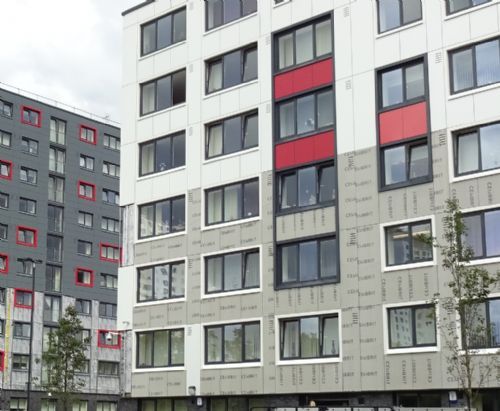
A pre-debate briefing from the House of Commons Library reported that costs of £4,000 a week for fire-safety marshals were being passed onto leaseholders; and singled out the Fresh Apartments in Salford where "The Tribunal in this case found that the costs were recoverable based on the wording in the lease agreements."
The Salford Star understands that this ruling is still being challenged, while the costs for fire wardens alone could hit £100,000. The website, Political Scrapbook, recently reported that multi-millionaire, James Tuttiett, who owns the Fresh apartment building via his company E and J Estates, donated £10,000 from his other company Ashcorn Estates Limited to the Tory Party.
"The Government say they are clear that "private sector landlords follow the lead of the social sector and not pass on the costs of essential fire safety works" states Political Scrapbook "So why do the Tories keep taking their money?"
None of Salford's three MPs – Rebecca Long-Bailey, Graham Stringer and Barbara Keeley – spoke in the debate but Manchester Central MP, Lucy Powell, highlighted the Chips building in Ancoats and the Little Alex block...
"The cladding on the Chips building has been deemed non-fire-retardant" she said "That was known at the time, but it was still signed off, and leaseholders are now being charged well over £5,000 each to put it right.
"The cladding on the Little Alex block was within regulations at the time, but following an inspection it has now been deemed to fall outside them" she added "A prohibition notice has been issued; again, it falls on leaseholders to meet the costs, which will be well in excess of £175,000. That is just unacceptable. It is not the leaseholders' fault, yet they are footing the bill."
Lucy Powell added that it wasn't just about the money but also about leaseholders who have 'no right of recourse'...
"Bodies such as first-tier tribunals are frankly toothless; they do not follow through and are very bureaucratic" she explained "Hundreds of people in Manchester and elsewhere are now stuck between a rock and a hard place".
Yet, she added "this is a failure of governance and of regulation. It is our job in Parliament, and the Government's job, to put that right for the people who are now stuck in unsafe buildings that they are unable to sell."
The Government, said Steve Reed, was merely stating that the freeholders had a 'moral responsibility to replace the cladding' but added that it "is not the same as a legal responsibility...
"It could take years for the courts to resolve this and all that time people would be left living in fear" he added "On average, there is one fire every month linked to this kind of cladding. Eventually, one will not be put out in time. Is the Minister really going to do nothing and risk a second Grenfell Tower fire?"
Responding, the Minister for Housing, Dominic Raab, said remediation work was a 'complex process'... "Planning alone can take up to a year" he explained "It is not just a case of ripping down the cladding then deciding what to do next."
Raab added that "We will also consider financial flexibilities for local authorities to fund essential fire safety works to buildings that they own. We have not yet declined a single request."
Ending the debate, Steve Reed questioned the ethics of the Government..."We bailed out the banks when they broke the banking system. Why can we not bail out leaseholders, who are innocent victims of the Government's failed, flawed fire safety regime?"
Back in Salford, it's a mixed picture on cladding replacement for social tenants. In January, Deputy Mayor, John Merry told a meeting of the full Council, re the nine Pendleton Together highrises, that "there will be a start in March, I'm fairly confident, to actually put the stuff on the tower blocks..." (see here)
A message received by the Salford Star this week from a tenant in one of the blocks screamed... "Just got a letter from Pendleton Together about our windows; don't open them as they are faulty; and the nibe a cable might not have been properly secured when it was put in...Pendleton Together, never mind theses 2 items in our flats GET THIS DANGEROUS CLADDING S*** OFF AROUND OUR HOMES AND START TO MAKE US FEEL SAFE!!!"
Meanwhile, the Salford Star understands that City West, which had mainly decorative cladding, has completed work on two blocks, while all other jobs are anticipated to be completed by August. However, work on Salix Homes blocks seems to have stopped altogether, with the company not releasing any information recently.
To watch the full debate on cladding see the Parliament Channel - click here
Other interesting facts to emerge from the Parliamentary debate, related by Steve Reed MP...
"The Grenfell cladding had the equivalent combustibility to 32,000 litres of petrol over the outside of the building.
"The Building Research Establishment's fire testing system is so weak that manufacturers can design the testing rigs that test their own materials, and can then keep quiet about how many tests their materials fail before they eventually get a result they want. Developers, builders and buyers are never told, because the test results are treated as commercially confidential. Conflicts of interest are everywhere in this system.
"The BRE makes money by running tests on flammable materials...up to £40,000 per test that it conducts for manufacturers. As it also drafts the guidance, as an organisation it has a financial interest in permitting the use of combustible materials that it then tests.
"The fire safety tests after Grenfell were carried out by Kingspan, which manufactured part of the materials on Grenfell in the first place..."
Kingspan insulation was also present on Salford blocks (see here)




.jpg)


.jpg)
.jpg)
(3).jpeg)
.png)
(1).JPG)
