A new State of the Nation report by Government advisory body, the Social Mobility Commission, states quite clearly that "There is a fracture line running deep through our labour and housing markets and our education system. Those on the wrong side of this divide are losing out and falling behind..."
The Commission researched a series of indicators for each of the local authority areas in England and has arrived at a Social Mobility Index for four stages of people's lives...Early Years, Schools, Youth and Working Lives, and then aggregated the score to form an overall ranking.
"The index highlights where people from disadvantaged backgrounds are most and least likely to make social progress" the report explains. Overall, Salford was ranked 213th out of 324 local authority areas. But in the Early Years index was classed as 30th worst in the country.
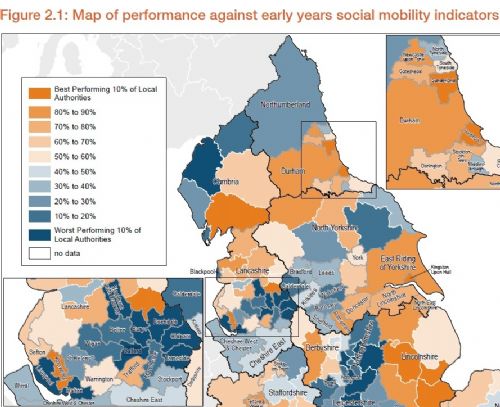
The Early Years section looks at school readiness for disadvantaged five-year-olds, based on 'nursery quality' – the percentage of nursery providers rated 'outstanding' or 'good' by Ofsted; and 'Early years attainment' – the percentage of children eligible for free school meals achieving a 'good level of development' at the end of the Early Years Foundation.
"It is clear what drives positive development outcomes for disadvantaged children in the early years" the report notes "Strong promotion and take-up of the free childcare offer, high-quality preschool settings, effective training and advice for childcare workers, evidence-based support for parents on home learning, and integrated family services.
"Local leaders – across both health and education – require a deeper understanding of disadvantaged children's needs and an integrated strategy for supporting them" it adds "This demands strong leadership and ownership, but a quarter of councils have no one with responsibility for disadvantaged children's outcomes..."
As well as increased accountability to carry this out, the Commission also calls on the Government to increase Early Years funding..."If budget-constrained local authorities reduce funding for early years services, recent progress in early outcomes may reverse and greater challenges may emerge later in school" it states, recommending that "Every local authority should develop an integrated strategy for improving disadvantaged children's outcomes".
Meanwhile, Salford performs around average in the Schools and Youth sections but is below average for the Working Lives indicators, based on wages, house affordability, occupation, living wage and family home ownership.
The Commission states that, for people living in towns and cities, barriers such as housing costs combined with a prevalence of low-paid jobs "hold people back from
progressing".
While, the report notes that rural, coastal and former industrial towns are finding social mobility the hardest to negotiate, the North West "performs poorly in terms of social mobility indicators, with the lowest levels of school readiness for disadvantaged five-year-olds, below par performance in schools and comparatively weak results in working lives.
"The region fares better on outcomes for youth, with the third highest proportion of
young people on free school meals achieving two or more A-levels and with
good access to university" it adds.
"The report uncovers a striking geographical divide, with London and its surrounding areas pulling away from the rest of the country, while many other parts of the country are being left behind economically and hollowed out socially" the Commission explains.
"The UK is in the grip of a self-reinforcing spiral of ever growing division and calls on government to increase its proportion of spending on those parts of the country that most need it" it concludes.
To read the full report: State of the Nation 2017: Social Mobility in Great Britain – click here
The Commission board currently comprises: Alan Milburn; Baroness Gillian Shephard; Paul Gregg, Professor of Economic and Social Policy, University of Bath; and David Johnston, Chief Executive of the Social Mobility Foundation.
Update: 12noon - Commenting on the report by the Social Mobility Commission, Kevin Courtney, joint General Secretary of the National Education Union said:
“The latest Social Mobility Commission’s ‘State of the Nation’ report reveals the Government’s abject failure in tackling the root causes of poverty and inequality and in offering hope to communities across the country. The gap between the better off and the least well off is growing and Britain is an increasingly unequal and unfair society.
"The widening gap is the product of a failed approach to economic development and the incredibly short-sighted programme of austerity which has cut vital public services, including education budgets across the country.
"Teachers do everything they can to help every child but they, and the children, are let down by the Governments failure to tackle inequality and childhood poverty.
‘That we have four million children living in poverty is an absolute disgrace in the world’s fourth richest economy.
"If the Government was serious about improving children’s life chances it would have invested in early years rather than cutting Sure Start and funding for childcare; it would have increased school funding and local authority budgets for school support services not slashed them and it would have addressed the growing teacher recruitment and retention crisis. It would also have taken serious steps to develop a strategy for creating good quality jobs for young people through investment.
"The crisis in teacher supply has fundamental causes that will not be addressed by giving more responsibility to Regional Schools Commissioners, as the report suggests. The root causes of the crisis in retention and recruitment are clear: uncompetitive pay and unsustainable workload and accountability pressures.”




.jpg)


.jpg)
.jpg)
(3).jpeg)
.png)
(1).JPG)
