"I want here to be the smartest of all where we use technology not just to build our industrial base but also to make society more equal and fairer..." Andy Burnham
Now, us at Salford Star aren't thick when it comes to new technology and stuff. Indeed, this community centred 'magazine' is now an online publication with thousands of Facebook and Twitter followers. The Star is very much a part of what's called the 'digital sector'.
...But when it comes to digital strategies and such we just go cold. So far, it's been all words and bucket loads of public money. Two years ago, £7.25million of public money was poured into a scheme to 'provide superfast free wifi in public buildings' across Manchester and Salford...
...The Salford Star had to stop livestreaming Salford Council meetings because we just couldn't get a strong enough signal in the Civic Centre itself. Meanwhile, a report last year by Salford's Assisted Digital Sub Group to the Council stated that computers in public buildings "are slow to start, problems logging on; Wifi access is very temperamental" etc...
Everyone knows about the measly 26 jobs for Salford people at the BBC on Media City and how the 'Make Media' community space at MediaCityUK was axed by the NWDA before a stone had even been laid.
To date, Salford Council has also received £354,144 from the Greater Manchester Combined Authority (GMCA) for digital inclusion. Over £150,000 has gone towards the development of a 'Customer Business Model and Futuregov engagement testing in Little Hulton', while £180,000 has been sunk into a 'Digital Community Hub' at The Landing at Media City. What the hell is it?
"The Hub will provide an online tool for communities to share information; for
organisations to provide information on services and to push key messages around
behaviour change; and for business to advertise services" states a Council report.
The 'community hub' seems to be more about sacking staff and replacing them with online communication... "The development of a digital community hub is part of the ongoing transformation work undertaken by the Council in its efforts to address the impact of the reduction in the Council's budget through providing more accessible services to its residents" the report adds.
GMCA was recently advertising for a Chief Information Officer, on a salary band of £90,000 - £100,000, who will be "providing oversight of ICT provision" and 'taking forward the GM-Connect strategy"...
We're sure that for most people in the community all this jargon is just white noise. Back in May, Greater Manchester Mayor, Andy Burnham, held a press meet at Manchester Museum of Science and Industry to launch his Mayor of Greater Manchester's Digital and Tech Summit, which takes place at the same venue tomorrow.
The Salford Star interviewed Andy Burnham about what relevance the summit has for the ordinary people of Salford and Greater Manchester. Unfortunately this was the same day as the horrific attack on the Ariana Grande concert at Manchester Arena and the story got dropped. However, below is the unedited Salford Star Q&A with Andy Burnham...
Salford Star: What is the 'digital strategy' because we can't work it out?
Andy Burnham: The first step is to have a summit on 6th July at the Science and Industry Museum, and the purpose is to bring together the entire digital sector from across Greater Manchester so we can agree that strategy.
The goal we want to set is that this place is going to be a world leading digital centre. We've got such a strong past in industry, and I'm saying that we're going to claim our title as the modern industrial capital of the country. I want people working in the digital sector in Greater Manchester to develop a clear plan with me for how we are going to invest in digital skills and infrastructure, to make sure we are leading the way in an sector that is going to be crucial to the economy of the future.
SS: Are ordinary people included in that? People see Media City and no-one's got a job there as you well know...
AB: Yep
SS: ...they see things going off in Greater Manchester but they're not connected...
AB: It's not just about jobs and industry. I want Greater Manchester to be a truly inclusive digital city region, and by that I mean using connectivity to link people to opportunities, using it to tackle homelessness, making sure we use new technology for social good as well as building our industrial base...
SS: What? How does digital economy help homelessness?
AB: It's already being used, there's a street support app that's being used to give people access to information in terms of how they can get support...
SS: ...homeless people don't generally have smart phones...
AB: No but some people working on the streets do and they can give them access to that real time information...
Take young people; we want to use new technology to link them to opportunities around Greater Manchester and to the travel pass we're going to bring through...
...so there's talk about smart cities, cities that use digital technology to make themselves better and I want here to be the smartest of all where we use technology not just to build our industrial base but also to make society more equal and fairer and everybody to play their part.
SS: Greater Manchester had £millions for digital inclusion, yet you walk down the street in Salford, or go into the town hall in Salford and can't get a connection. Has that strategy failed? A lot of money has been put into it but it doesn't seem to have done anything?
AB: It's made some improvement but obviously not everyone and everywhere has felt the benefits and I think this is one of the things that we should pick up on at the summit. I would like to see more free public wifi across Greater Manchester, not just in the city centre but in the outlying towns as well. That begins to become real then doesn't it? So that is one of things I would want to see; that we take away all the barriers. Obviously that is where life is taking place these days and if you don't have access then you're clearly missing out. It's about everyone being a part of this future and free public wifi is one of the things we should look at expanding.
SS: When you think of 'digital economy' you think of businesses benefiting from it rather than ordinary people, and people in the sector getting non- jobs, or 'Bing Chandler jobs' that people just don't understand what they are. Is this going to change that?
AB: There's a really sobering fact that was told to me during the Mayoral campaign that I think people need to focus on, and that is there are jobs in Greater Manchester paying about thirty grand a year that are going unfilled because people don't have the right digital skills.
I think that is a product of the fact that this industry is now very fragmented and very fast moving, so young people in schools are not getting the right advice about what might be available for them in this sector. And we've got to change that. We've got to ensure that people fully understand the range of opportunities that are there in the Greater Manchester digital sector.
I've spoken about a UCAS style system for digital apprenticeships, so all apprenticeships are on a single application system, like when people apply to university. And within that the digital sector should be clearly identified, and the benefit of that would be that employers could say 'Look if you were to take ICT or engineering at school you could end up in these jobs in three or four years time'... but at the moment the school system drags them towards the old elite subjects but not the subjects that modern industry requires, and that is a big change that we have to make.
SS: Is there a budget for all this?
AB: The budget would be for whatever we agree is needed to put the infrastructure in and to develop the skills base. But I'm going to back this sector, because it's not only important in its own right as there are 55,000 working in the sector already in Greater Manchester. It's also an enabling sector for all other businesses as well. So if you're strong in digital I would say you've got a strong forward looking economy
So come what may, I'm going to back this sector, back it in terms of skills development and infrastructure. There is a budget that comes with the Combined Authority with regard to skills development, and the new economy, but also I've got borrowing powers so I can raise money to invest in key infrastructure. I'd think you'd be hard pressed to say that digital infrastructure isn't going to be important to our future...
The Mayor of Greater Manchester's Digital and Tech Summit takes place at the Manchester Museum of Science and Industry tomorrow 6th July. The free event has been 'sold out' for weeks.
Sessions include: Making a Difference with Digital; Building the Agenda; Disruptive and Emerging Innovations, and Nominating the Priority Actions.
Speakers include: Alison McKenzie-Folan (Wigan Council), Lawrence Jones (UK Fast), Christine Bellamy (Northern Nations BBC), Catherine Brien (Co-op), Dr Maria Stukoff (Maker Space Salford), Jeurgen Maier (SiemensUK), Sean Murphy (Evidential), Rachel Dunscombe (Salford Royal NHS FT), Lee Strafford (ADV), Daniel Burton (Wondrwall) and Chris Bailey (Manchester City FC).
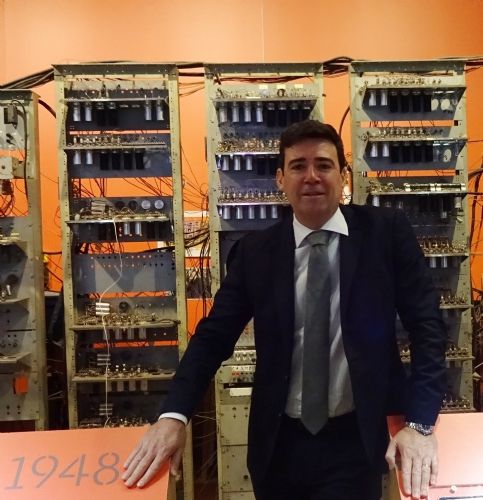
Main photo shows Andy Burnham at the Science and Industry Museum with a working replica of 'Baby', the world's first stored-program computer developed at the University of Manchester in 1948
Update: 5th July – A Salford Council report published today states that there are an estimated 30,000 people who "do not currently have the five basic digital skills", which include sending an email and being able to buy things or bank online - see Salford Star article - click here




.jpg)


.jpg)
.jpg)
(3).jpeg)
.png)
(1).JPG)
