A damning new report has been issued by the National Audit Office on the Tory Government's use of sanctions within the benefit system.
The DWP (Department of Work and Pensions) imposed a massive 400,000 sanctions in 2015 which can be valid for up to 156 weeks, and the report states that the Department is not monitoring the effects, either on the people themselves or on the costs of supporting those people.
"Potential costs of sanctions include direct impacts on people sanctioned" it explains "These sometimes include hunger and depression... and anxiety; financial and emotional impacts such as falling into arrears with rent and bill payments; and worsening relationships with jobcentre staff.
"Several organisations have reported that much use of food banks is because of sanctions" the report understates "but the Department does not collect national data."
It adds that hardship payments are available to those on sanctions... Jobseeker's Allowance hardship payments represent 60% or 80% of benefit but are usually only paid from day 14 of a sanction. Income Support claimants get reductions in benefit rather than hardship payments, and the growing number of those receiving Universal Credit must repay hardship payments...
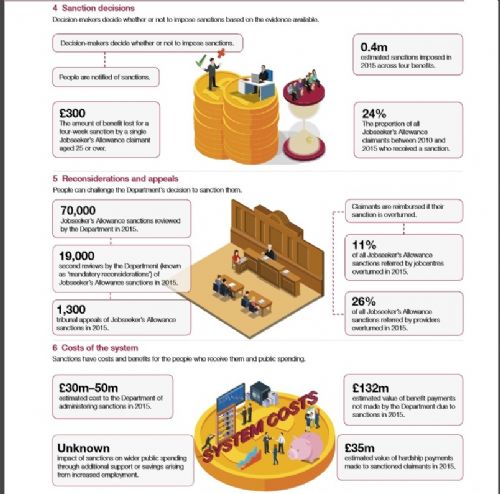
"A typical sanction – a first, four week intermediate Jobseeker's Allowance sanction – means that a claimant aged 25 or over loses around £300 of benefits" the report explains "a typical hardship payment would replace around £90 of this."
Meanwhile the DWP itself spends over £240million a year "administering conditions and sanctions". There's also a wider cost to local authorities in welfare support which "may lead to higher public spending" in helping destitute people.
In terms of direct costs, the report estimates a figure of between £30 and £50million just for administering sanctions, £35million in hardship payments and an `Unknown' figure for the wider impact on public spending. Set against this is an estimated £132million that the DWP has saved by not making benefit payments due to sanctions. It slates the Government for not tracking the costs and benefits of sanctions.
The cost of imposing sanctions might be even more than the amount saved by non-payment of benefits.
There's also a damning indictment of the system that sees the rates of sanctions "vary substantially across jobcentres and providers...Our review of the available evidence suggests the Department's application of sanctions is linked as much to management priorities and local staff discretion as it is to claimant behaviour.
"We found that some Work Programme providers make more than twice as many sanction referrals as other providers supporting similar people in the same area" it adds.
Indeed, in 2015, 26% of all sanctioned Work Programme participants had their sanctions decision overturned, compared to 11% of Job Centre sanctions. The Audit Office cannot show that sanctions work...
"Studies show people who receive sanctions are more likely to get work, but the effect can be short-lived, lead to lower wages and increase the number of people moving off benefits into inactivity" it states.
The report concludes...
"The Department has not used sanctions consistently. Referral rates vary substantially across jobcentres and providers, and have risen and fallen over time in ways that cannot be explained by changes in claimant compliance...
"Our review of the available evidence suggests the Department's use of sanctions is linked as much to management priorities and local staff discretion as it is to claimants' behaviour.
"Until the Department can show greater consistency in its use of sanctions and demonstrate that their effectiveness is proportionate to their costs we cannot conclude that the Department is achieving value for money."
To see the affects of sanctions on Salford people see previous Salford Star article...
Devastating Impact of Benefit Sanctions on Salford People – click here
To read the full Audit Office report – click here




.jpg)


.jpg)
.jpg)
(3).jpeg)
.png)
(1).JPG)
