"with reducing supply of affordable housing and funding being targeted for private sector accommodation, for which significant proportion of households can't access, it is expected that it will become more challenging to meet housing needs."
A new report by Salford City Council shows the dire state of supply of affordable housing, both now and in the future.
The report opens with the cold fact that "the strong demand for affordable housing is indicated by 38 bids made on average for each affordable home advertised"...this despite the fact that thousands of residents have been kicked off the official housing waiting list, thanks to changes in the Council's allocations policy.
A previous Council housing report in 2015 stated that there were 14,194 households on its waiting list and that "most applicants have little chance of ever being re-housed" (see previous Salford Star article – click here). The new report gives a figure of 9,863 on the list in April this year, after the allocation changes. But even for those left on the list, the prospects of an affordable property don't appear to be getting any better.
"It is expected that there will be little new provision of rented affordable housing and a net reduction overall of rented affordable housing stock generated by extension of Right to Buy, RP asset management and disposal activities" the report states.
The term `affordable housing' is now incredibly misleading and covers social rent, the more expensive affordable rent, and `affordable' home ownership.
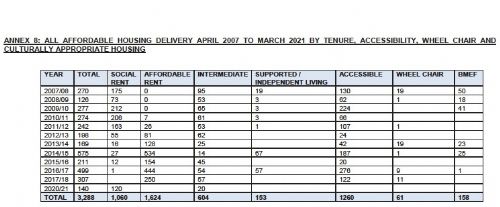
Council figures show a huge move away from social rent, with only one such home being delivered this year, none next year and 120 in 2020/21. During this three year period, 694 affordable rent properties will be built, plus 121 affordable home ownership properties*. Even the so-called `affordable home ownership properties' are out of the reach of around half of Salford's households, the report states.
For those who are elderly or disabled, out of these 946 `affordable properties', only 57 will be for supported/independent living, and only 20 will be wheelchair accessible. However, in April this year there were around 1,460 households on the waiting list with someone who has a medical need (15% of the housing register).
Meanwhile, Tory Government funding is being ploughed into supporting more affluent sectors, with 376 Help to Buy packages and 497 unaffordable private rent properties being backed with public money via Build to Rent during this year and next. The £300million Greater Manchester Housing Fund is also being used to stuff the coffers of developers building unaffordable buy-to-let and private rent properties in Salford (see here).
The report lists Government changes since 2015 that have screwed the provision of affordable housing...
*Increased emphasis upon private sector led development (Help to Buy and Help to Buy ISAs)
*Increased home ownership through extending Right to Buy to Housing Associations, focus of a new affordable housing programmes on shared ownership, `Starter Homes' recognised as an affordable housing product.
*Continued attention on welfare reform with 1% reduction in rents, review of supported housing, shared rates for under 35s and changes to life time tenancies.
City West, which secured supported housing funding for a new Extra Care Scheme has "already paused this development pending the outcome of the review of funding for supported housing", states the report "These policy drivers are having significant impacts upon the nature and scale of affordable housing delivery". It adds that the impacts are fourfold...
"Firstly, due to value for money pressures and national policy drivers and the reduction in grant funding for rented affordable housing, housing providers are required to increasingly look to `cross subsidise' affordable housing development, through delivering homes for market sale/market rent...
"Secondly...the affordable homes delivered will predominantly be shared ownership/ affordable home ownership, not rented affordable housing...Thirdly the Housing and Planning Act means that `Starter Homes' are likely to be required to be prioritised as the affordable housing tenure of choice. This will mean that there are less opportunities for securing rented affordable housing.
"Fourthly, welfare reform changes mean that Housing Providers are looking carefully at not only what, where and how many affordable homes they are seeking to deliver, but also how they manage their existing assets, allocate their homes to meet housing needs, whilst managing the 1% reduction in rent and having a sustainable and viable business."
Meanwhile, developers who are building thousands of unaffordable houses and apartments in the city should also be paying planning fees, or Section 106 payments, for affordable units - but the report shows only 142 such properties earmarked for this purpose over the last few years. The Salford Star has documented over 1,000 affordable properties that have been lost due to developers avoiding or evading such fees (see here).
Many planning applications have also noted that, while developers won't be providing affordable housing as part of their schemes, they would be paying what's called a `commuted sum' for such houses to be built elsewhere. However, the report shows just one such payment received; £635,073 for the Ladywell Point housing estate.
With Government funding being targeted at the already affluent...and with Government policies intent on almost destroying the social housing sector via Right To Buy and reductions in financial support for the poor and vulnerable, plus Salford Council's soft underbelly when it comes to Section 106, it's looking bleak for those who need social housing.
The Greater Manchester Housing Needs Survey in 2015 identified a shortfall of 734 affordable homes per year. And that shortfall doesn't look like being filled any time soon..
"With reducing supply of affordable housing and funding being targeted for private
sector accommodation, for which significant proportion of households can't access, it is expected that it will become more challenging to meet housing needs" the report understates, by one million percent...
* These 946 `affordable properties' are not net additions to Salford housing as many affordable properties have been already been bulldozed, particularly in Pendleton. Interestingly, while the report lists the housing associations delivering social housing, like City West, Great Places etc, Salix Homes isn't mentioned once in the whole report.


.JPG)


.jpg)


.jpg)
.jpg)
(3).jpeg)
.png)
(1).JPG)
