Benny Rothman didn't make a song and dance about his activities, never sought the limelight and never sold out for the sake of his career. Born into poverty in Hightown, Cheetham Hill, 1911, he believed, like many back in the day, that Russia was the model to free the working class from exploitation, and that the countryside provided a huge weekend escape in the meantime...
...So Benny joined the Communist Party of Great Britain (CPGB) and went on cycling and rambling escapades, uniting the social and political as a major participant of the Kinder Scout mass trespass in 1932, for which he was jailed. Ultimately the actions of the Kinder Scout trespassers, including Ewan MacColl, led to the 1949 National Parks and Access to the Countryside Act and, later, the Countryside and Rights of Way Act of 2000.
In a life bursting with activism, Benny Rothman was massively involved in the trade union movement, getting victimised and sacked by various engineering companies around Greater Manchester and, during the Second World War, representing over two thousand workers for the Amalgamated Engineering Union at Metro-Vicks, fighting racism by management on the shop floor and helping women get fair pay. He was also at the forefront of the wave of engineering strikes and occupations around Manchester and Salford in the 70s.
He fought Oswald Mosley's blackshirts at Belle Vue, helped organise support for the Spanish fight against Franco and zillions of other campaigns until his death in 2002.
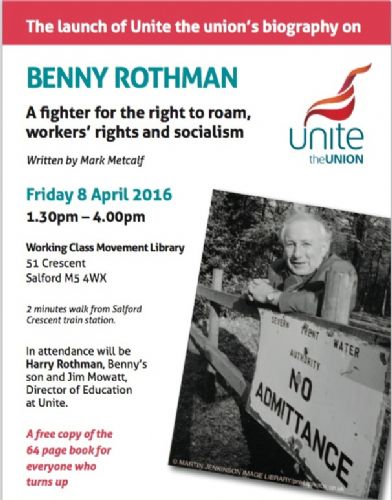
Now Unite the Union has produced an easy to read short biography of Benny Rothman: A fighter for the right to roam, workers' rights and socialism, written by Mark Metcalf, that manages to give a great insight into the socialist's life while providing the historical backdrop in which everything occurred.
"There's an understanding of why the Communist Party grew in the 1930s, as the Soviet Union was seen as a place where poverty, unemployment and exploitation had been removed for working class people" Mark says "Benny and his wife were both working class people who had a permanent struggle at work for decent terms and conditions, particularly in the 20s and 30s when they were brought up and poverty was rife, to put it mildly. So this was seen as a panacea to national and world problems.
"There's also lots of relevance for today, in that working people are under attack with regards to conditions at work, austerity which, in my opinion has been needlessly enforced as a political dogma not an economic objective" he explains "We're again in a position of great doubt and difficulty, and one in which Benny would have undoubtedly said that people need to, not only join unions but to get active within them.
"There's a need for the great community campaigns that he supported around housing and around water, and generally around issues to do with equality" he adds "All of those issues are still important, and if he was still alive he would have been at the forefront, contributing."
The booklet is being launched at the Working Class Movement Library this Friday, April 8th, where Benny Rothman's son, Harry, will be speaking, along with Mark, Roly Smith, Vice President of the Outdoor Writers' and Photographers' Guild, and Jim Mowatt, Director of Education at Unite.
"We are anticipating that there will be a number of people at the event who knew Benny, so it will be an opportunity to bring them together" says Mark.
Everyone who attends the event will get a free hard copy of the booklet, while for those who can't get there, it can be downloaded free from Unite the Union's website – click here. It's well worth reading.
Book Launch
Benny Rothman: A fighter for the right to roam, workers' rights and socialism by Mark Metcalf
Friday 8th April 1:30-4pm
Working Class Movement Library
51 The Crescent M5 4WX
For more details on the Working Class Movement Library and more events see the website – click here
"My dad and mam saw themselves as members of a revolutionary party and my mother talked of `the movement', but where were they going? It was towards a better society, a better world, a world where you did not have to flog your guts out, where you could get proper health treatment, a proper roof over your head, where you could live well. They had an idea of the future, a heaven on earth, utopia. Name anyone who does not want this? The CPGB promised a route to change the world and the members went along with that."
Harry Rothman




.jpg)


.jpg)
.jpg)
(3).jpeg)
.png)
(1).JPG)
