Toxic LOBO, or Lender Option Borrower Option, loans, which many councils took out over ten years ago, have been the subject of a Channel 4 tv documentary and community campaigns, as brokers took huge cuts, while borrowers were tied into big interest rates for up to sixty years.
Salford City Council itself holds £275.2million of LOBO loans, and in 2014/15, it paid interest of £13.668million on them, while making £22million of cuts this year and increasing Council Tax by 3.5%.
The Council has 14 of these loans, borrowed from the Bank of Scotland, Barclays, RBS and lesser known finance houses like DePfa Bank, Dexia and KA Finanz. Interest rates average around 4.75% (RBS is getting 6%) and the Council is tied into them from six to sixty years, despite general interest rates being at their lowest in financial history.
As part of the LOBO deals, lenders have the right to increase interest rates at a few days notice (in most cases every three or four years), and this gives borrowers a chance to escape but none have done so as yet. So, to get out of these deals the Council would have to pay a `breakage' fee which is based upon the gain a bank would expect to make over the course of the deal, and can be higher than 90% of the original loan.
It's absolutely staggering that Salford Council's finance chiefs signed such documents when they were supposed to be safeguarding millions of pounds of Salford people's money. But Joel Benjamin of Debt Resistance UK, which is exposing the banking scam and campaigning against LOBOs, says councils weren't solely to blame...
"What happened was that banks were selling complex products that their own staff understood but council officers didn't" he explains "The councils relied upon companies like Sector, which is part of Capita, and Butlers to give them advice – but they were basically on the take, getting kick backs from brokers. Right along the chain you had these conflicts of interests which resulted in councils borrowing from banks rather than the government's Public Works Loan Board. The rationale behind those decisions needs to be understood and exposed.
"LOBOs were sold on the assumption that interest rates were going up but they are now at an historic low and the councils are locked into them" he says "However, if local councils could re-finance today it would save an extraordinary amount of money; but the Government and banks are preventing them from doing it. What we're saying is that, rather than do cuts, councils should be looking at how to get out of these contracts and re-financing at today's historic low rates.
"Because these LOBOs are linked to rigged LIBOR rates, it gives the councils leverage to say `We wouldn't have taken these loans out if we knew that you were rigging the LIBOR rates'" he adds "What's interesting is that none at the moment are prepared to use it, so we're trying to give them a shove."
This week, Tower Hamlets resident, Angus McNelly, supported by Debt Resistance UK, has submitted a legal objection over £77.5million toxic LOBO loans `mis-sold' to his Council, which is paying over £3.5million a year in interest, while also raising Council Tax and making huge cuts to public services.
Angus has requested a High Court declaration that the bank borrowing was "irrational" and should be declared illegal.
"The debt of Tower Hamlets Council, in the form of LOBO loans, highlights some of the biggest problems of our current financial system" he explains "We have one of the country's poorest boroughs implementing spending cuts of £30 million and council tax hikes; whilst at the same time they are being forced to pay over the odds for debt repayment that is linked through financial instruments to the vicissitudes of the market.
"Not only is a taxpayer funded council being shafted by a bank bailed out by the tax payer (RBS), but both the lenders Barclays and RBS were recently fined for rigging the LIBOR rate on which these loans are benchmarked" he adds "I feel strongly that the good of the people of Tower Hamlets and the Council's financial security has to come before the profits of big banks."
For `Tower Hamlets' read `Salford' and the case becomes clear. There is a precedent for this kind of court action. In 1989, after 137 councils had taken out interest rate swaps from banks, the House of Lords ruled that they were illegal and `stand alone derivatives contracts' were subsequently banned for local government (until the introduction of the 2011 Localism Act).
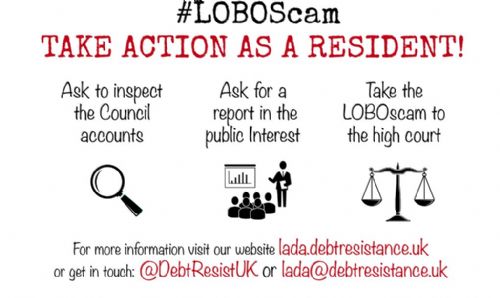
Debt Resistance UK is now calling for citizen-led challenges, like that made by Angus McNelly, in each of the 250 councils affected by LOBO loan mis-selling.
For full details on the current Tower Hamlets case, citizen-led council audits and everything you need to know about LOBO loans and more see the Debt Resistance UK website – click here
LOBO loans are also explained in more detail in this easy-to-read pamphlet - click here


.jpg)


.jpg)


.jpg)
.jpg)
(3).jpeg)
.png)
(1).JPG)
