Wards where hundreds of millions of pounds of public money was spent clearing housing and communities, still remain amongst the most deprived in the city, and the country.
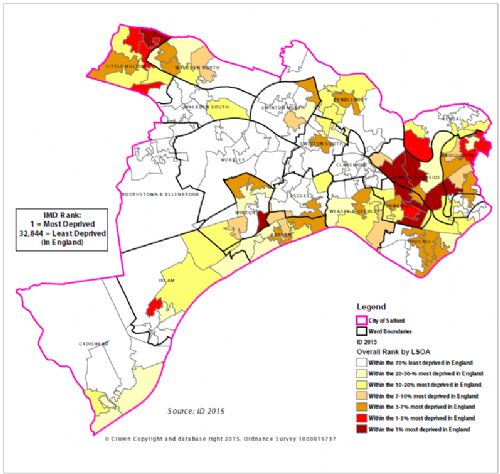
Broughton and Langworthy wards, subject to the Government's Pathfinder scheme which was supposed to improve the areas, remain in the worse three wards in Salford, along with Little Hulton, according to newly released Indices of Multiple Deprivation (IMD) for 2015.
Great swathes of Langworthy figure in the 1% most deprived areas in England, while around 90% of Broughton figures in the 10% most deprived areas (with about one third in the 3% most deprived).
Meanwhile, Lower Kersal, part of the £53million ten year New Deal For Communities (NDC) project (2001-2011) that was supposed to kickstart prosperity, was within the worst performing ward in the city, dropping down five places in the rankings since 2004. Lower Kersal is now in the 1-3% most deprived areas in England, alongside Charlestown, which was also part of the NDC project.
Broughton, Langworthy and Lower Kersal were the absolute focus of Salford Council and Government schemes that were supposed to somehow make life better by bulldozing houses. Indeed, the new statistics show that, while housing has improved slightly, Salford is most deprived with regard to health, employment, and income. Which shows just how hair brained the NDC and Pathfinder projects actually were. Knocking down houses does not create jobs, only attempted social cleansing.
Ordsall ward, which includes the Quays and tons of new expensive housing, unsurprisingly had the biggest improvement in deprivation rankings, moving up six places - although around half the area is still classed within the 3-7% most deprived areas in England. Worsley, Boothstown and Ellenbrook, and Claremont are the least deprived areas in the city.
The massive influx of young professionals to places around Chapel Street, Greengate. Ordsall Waterfront and the Quays has helped dilute and mask Salford's real economic and social problems, and has pushed the city down from 18th most deprived to 22nd most deprived in England, out of 326 local authorities. And, within Greater Manchester, the city is now the third most deprived, compared to second most deprived five years ago. It's no great cause for celebration...




.jpg)


.jpg)
.jpg)
(3).jpeg)
.png)
(1).JPG)
