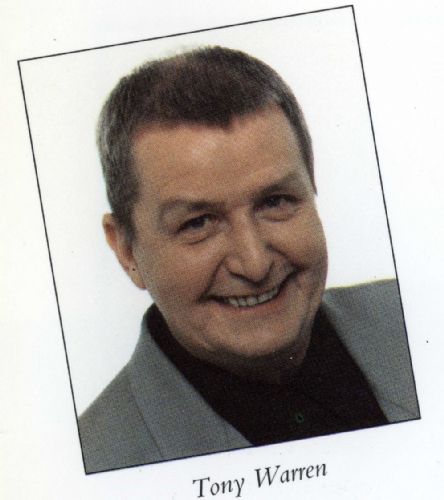
Tony Warren was a true Salfordian in so far as he lived nearly all his life in the city, and even after success retained his residency in a simple but pleasant terraced house overlooking Victoria Park. He never forgot his debt to the people of Salford and always attributed the success of Coronation Street to them.
He used to describe how he came about creating the show. His father was an officer in the intelligence corps and had a small fruit and vegetable import business, so he came from a relatively well-to-do part of town. However, his mother was from old Salford, from the 'Height, and she would take young Tony to visit aunties and cousins, and he would sit under the table listening to all this endless cacophony of women going on about everything from their ailments to, I suppose, how they were going to make ends meet.
These were times when, if men weren't away at work, they were away at war. It was a very matriarchal society during that period and that's why females were the strong element within Coronation Street. Tony would mainly hear women's voices and these voices stayed with him. He picked up what they'd said and the rhythm of how they spoke. The stories of their lives provided the template for these amazing, iconic characters like Ena Sharples, Annie Walker, Elsie Tanner, Vera Duckworth and Hilda Ogden. They were all based on women he'd known during his childhood or been acquainted with.
Added to that was obviously a huge dollop of creativity and a drive which we have to remember wasn't present then.... It was a drive to put the lives of working class people on show in a dramatic situation, and present it in realistic fashion as entertainment. It's something we take totally for granted now but in 1959/60 was almost heresy.
The attitude was `Who wants to know about working class people down a smelly grimy street in a slum city called Salford' – or, for Salford, read Leeds, Liverpool or back street Manchester. It was almost the antipathy of what would make great entertainment. Tony persevered with that and turned that world on its head in form and content – the content being the lives of these working class people, and the very clever format being a street with a pub at one end and a corner shop at the other end so the characters could all interact. It was the template for dozens and dozens of programmes ever since.
I met Tony for the first time in the Granada TV green room in 1983 and, funnily enough, he already knew about me because he'd been to visit my parents' chippy, which we had at the time down the bottom of Pendlebury Road. It wasn't like he was some detached executive. As much as he was an entertainment legend and rubbed shoulders with all sorts of people like Noel Coward, he was also rooted in his own city.
When I left the show I used to go round and have a chat with him. And he'd tell me about his debauched lifestyle during the 60s and 70s and his adventures. Like, once he got a visit from the police saying `We admire what you've done for the city but these new friends of yours are a bit suspect'... Apparently they were mafia who wanted to use him as a smokescreen to get a hold in the city. He had some great stories.
Tony Warren's legacy has probably not been recognised in any shape or form as yet. But whether the Street survives into its centenary in years to come, or whether it fizzles out, the influence his creation made, not just over British but international entertainment ,cannot be overstated. It was phenomenal.
Peyton Place, one of the biggest TV shows in American history, watched by sixty million people at its height, was based on Coronation Street and they admitted that was the format.
He was not the first to give working class people a voice...there were people like Shelagh Delaney, Ewan McColl, Walter Greenwood – and he's up there with them. But Tony Warren was the first to do it on television in any meaningful way. His influence cannot be overstated...
Nigel Pivaro




.jpg)


.jpg)
.jpg)
(3).jpeg)
.png)
(1).JPG)
