While Salford City Mayor, Ian Stewart, rattles on at Council meetings about Salford's "staggering" 8% economic growth that's reaching "China levels", there's whole swathes of Salford people being left behind, with poverty rates also reaching `China levels'.
The 2015 Public Health England profile shows 12,300, or 26.8%, of Salford's children living in poverty, and a life expectancy gap of more than ten years between people living in the most deprived and least deprived wards in the city. Meanwhile, malnutrition rates, particularly for the elderly, have doubled over the last four years (see previous Salford Star article – click here)
Now, a report for the Salford Wellbeing Board reveals latest Government figures showing that over 10,497 of the city's households, or over 10%, are living in fuel poverty – measured using the 'Low Income High Cost' indicator, whereby a household is 'fuel poor' if its members are living below the official poverty line and have higher than average energy costs.
The report also states that Salford has 7,140 homes considered to be a `Health and Housing Safety Rating Systems Category 1 hazard on grounds of Excessive Cold'.
It's a huge issue because, as the report notes, "The death rate rises about 2.8% for every degree Celsius drop in the external temperature for those in the coldest 10% of homes. This compares with a 0.9% rise in deaths for every degree Celsius drop in the warmest 10% of homes (Cold Comfort Joseph Rowntree Foundation)...The health impacts of cold homes and fuel poverty estimated that 'excess winter deaths in the colder quarter of housing were almost three times as high as in the warmest quarter'".
To try to stave off the issue, the National Institute for Health and Care Excellence (NICE) has produced Guidelines on Preventing Excess Winter Deaths and Morbidity and Health Risks with Cold Homes. These include obvious stuff like `Develop a strategy to address the health consequences of cold homes', and `Raise awareness among practitioners and the public about how to keep warm at home', which you would have thought would be in place anyway.
For Council's and health providers, it's all about the bottom line... "Illness brought on by cold homes, have a big impact on the demand for health and other social services" states the report "The problem of delayed discharge from hospital places a burden on the NHS. The cost of just one patient unable to return to their cold home can be as much as £1,750 per week. Preventative steps to improve home insulation and heating will reduce delayed hospital discharge and the demand on services by residents with a cold related illness..."
In other words, we can assume, if there wasn't a cost involved, they would leave them to freeze?
And what is Salford Council and health providers going to do about it all? They are going to commission another report! The `Recommendations for action' conclusion states the Wellbeing Board is "To receive a future report which profiles the problem of fuel poverty and cold homes in Salford and the impact on health. The report will be researched by the NEA and presented to future meeting..."
...By which time, another winter will be in full freeze and those in fuel poverty will still be coping with the dire consequences...
* See also how Salford residents in Pendleton are being subject to new fuel poverty courtesy of the NIBE system being installed into properties - click here
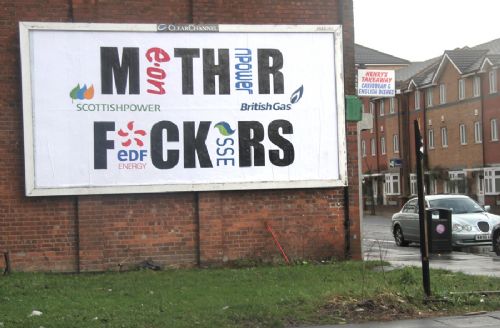
* Photo from Manchester Climate Action Group subvertising campaign - click here




.jpg)


.jpg)
.jpg)
(3).jpeg)
.png)
(1).JPG)
