From the outside, the whole redevelopment of Chapel Street looks like a perfect example of social cleansing. £millions of public money, no affordable housing in the new schemes, official statements designed to attract `young professionals' – and the Vimto brand being dragged into the gutter of secrecy, unaccountability and what is developing into the ingredients for war with the local community.
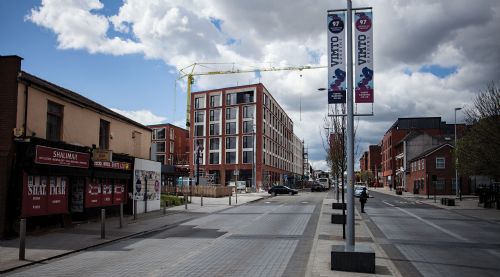
At the centre of it all is Arshad Malik, commonly known as Mo, and his Shalimar convenience store that has served the local community on the Islington Estate for thirty years. Mo's shop has been due for demolition since the 1990s, with Salford City Council wanting to redevelop the area.
A few years ago, a body called English Cities Fund, or ECf, arrived with big plans for the area. The ECf is Muse Developments, Legal and General and the Homes and Communities Agency (HCA), in partnership with Salford City Council. The first scheme put forward by ECf was for what it called Plot E3, which became the Vimto Gardens development on Chapel Street.
It would have town houses and apartments that would "celebrate the brand's personality and its zest for life" and was "expected to be popular with young professionals and families due to their character and close proximity to both Salford and Manchester city centres".
Underneath the development, facing Chapel Street, `independent retailers' would be `encouraged' to take on the retail units. Except that when Mo, the community's longest serving `independent retailer', tried to get a new shop he seems to have been blocked all the way. Mo's shop is a few yards from Vimto, it's due to be demolished but every time he has put in an offer for a new unit it's been rejected.
Vimto Gardens, however, has been stuffed with over £11million support from public money, which should bring with it community benefits. The Government's Homes and Communities Agency has loaned £3.4million; Greater Manchester Combined Authority has loaned £3.4million and cash strapped Salford City Council has loaned £3.8million. The Council has also spent £514,000 tarting up Islington Way for those who would live there or use the retail units underneath the apartments and town houses.
That's over £11million of public money going towards one development which can't even help a community shop get a new unit. Now the community itself is furious and is mobilising to help Mo, with a demonstration outside Vimto Gardens next Monday morning.
"I've known Mo for thirty years, he opened the shop not long after I moved onto the estate when I was 11 and I think it's wrong the way he's been treated" says Sarah Millar who is helping to organise the protest "Mo's been treated as if he doesn't count and he's not allowed to be involved in it but he has the community shop. They can't do this to the local community. It's like it's been privatised, they've got their own people in and they're hoping the Vimto name will bring profits."
This isn't the first fight that Sarah or residents of Islington Estate have had to protect their community. Around fifteen years ago they fought to save the local St Philip's C of E Primary School...
"They wanted to shut it and it was only the community that kept that school open" Sarah explains "If we can save a school we can save our shop. At the end of the day Mo's served us for thirty years and he gets left out as if he's scum, as if he's worthless."
The latest Salford Star print issue has an interview with Mo plus details of all the secrecy and unaccountability that is evident around the whole Chapel Street and New Bailey redevelopment (see print issue pages 24-26 – click here). Since the article was published the Salford Star has been trying to find out who is accountable for the use of public money and the justification for the use of that public money that appears to have no public benefit, only benefit to profit making commercial corporations.
English Cities fund will not talk to the Salford Star. Neither will Salford City Council. We emailed Housing Minister Brandon Lewis and Greg Clark, Minister for Local Government and Communities, as well as the HCA. We asked on what basis the public money was handed out and where the accountability lay for that money.
As yet, no-one has managed to provide an answer but HCA swerved the question*, responding...
"With regards to the ground floor commercial units ECf has offered leases at discounted rents to one existing and one new local business. The development has also contributed directly to local businesses in the form of spend generated by on site workers etc and ECf employing local businesses on the scheme. For example the marketing suite was furnished in part by goods made in Islington Mill and the scheme marketing etc. was procured from a Chapel St based business. Finally, ECf has sponsored numerous local events, notably the Sounds From The Other City event, which generate a large number of visitors to the area.
"On affordable housing, Salford City Council adopted planning guidance and a development framework for Salford Central, to regenerate the whole area, with funds generated by the development of some parts of the area being used to bring forward development on the more challenging sites" the HCA explained "In response to that guidance, ECf suggested a different approach to the section 106 agreement, under which a development trust account would be set up so that funds generated by other developments would be paid into that account and used to deal with issues specific to Salford Central."
Is Mo's shop an `issue specific to Salford Central'? The community, judging by the petitions and upcoming protest would say a big fat `Yes!'
The HCA also added that the fund operates "under scrutiny by the Council, who must approve the amounts paid into the account and approve the amounts proposed to be spent and the matters on which the funds are to be used". In other words, Salford City Council has the power to help Mo, even if English Cities fund thinks he `doesn't count'.
Four years ago, the Salford Star asked ECf about the accountability surrounding Chapel Street's regeneration and it responded that "Specifically in relation to the delivery of the Salford Central scheme, the development agreement with the City Council requires the consent of both parties in all proposals. In addition, it has undertaken a significant amount of consultation with local residents and business groups over plans for the area and meets with them regularly to update them on progress."
The ECf either hasn't done its consultation properly or it has ripped up the results. Meanwhile, residents might well be asking Salford Council how it consented to the Vimto Gardens scheme and threw over £4million at the project without any community benefits.
The protest on Monday is only the start of the community fighting back against what many see as the social cleansing of the area. Vimto Gardens certainly leaves a very nasty taste in the mouth...
Save Mo's Rally
Monday 29th June 9:30am
Vimto Gardens, Chapel Street
Read more about social cleansing, Mo and the Islington Estate in the print issue of Salford Star... Chapel Street Goes Sour - pages 24-26; Social Cleansing - pages 18 and 19; The End of Salford - page 17; Salford's £19million Planning Scandal - pages 27-29; Mary Burns: Euro Jollies for the Islington Estate page 34 - click here
* Update: HCA has since added... "While the HCA obviously invests significant funding into affordable housing – Government investment through the HCA contributed to the building of over 41,000 new affordable homes across England last year – we also have investment that helps stimulate delivery of homes of other tenures (private sale and rent, equity loan such as through Help to Buy) and commercial premises. So a scheme doesn't have to include affordable housing to qualify for HCA support. The loan was made on commercial terms under the Get Britain Building programme, which was designed to provide developers with upfront investment to get construction going on stalled or difficult sites. It has since been repaid meaning no cost to the taxpayer. In order to qualify for the loan, ECf would have had to demonstrate that the scheme met locally identified priorities, that it was deliverable, and that it represented value for money; the same as for any investment by the HCA."
Photos by Steven Speed





.jpg)


.jpg)
.jpg)
(3).jpeg)
.png)
(1).JPG)
