EWAN MACCOLL AND SALFORD
Part 2: Dirty Old Town
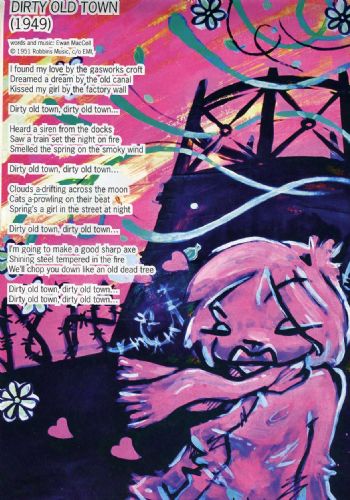
The popular conception is that Salford Council, embarrassed by the perceived negativity of Dirty Old Town, forced Ewan MacColl to change the line from `Smelled the spring on the Salford wind' to `Smelled the spring on the smoky wind'.
The Council certainly had form a decade later when it went all out to denigrate Shelagh Delaney when it couldn't handle A Taste of Honey (see previous Salford Star article – click here). But would such a strong character like Ewan MacColl bend to such authoritarian wishes? The same person who joined a march on Salford councillors' houses after the Battle of Bexley Square?
In 2007 the Salford Star interviewed Ewan MacColl's third wife, Peggy Seeger, who he met seven years after the song was first performed as a set break fill in for a production called Landscape and Chimneys (1949). She confessed to knowing nothing about it... "We only ever sang `smoky wind'" she said "…Salford? Sulphured would be good..." The mystery deepens...
Meanwhile, the missing verse of Dirty Old Town was uncovered a few years ago by Ben Harker, who wrote the now classic biography of MacColl, Class Act... "It's not very good, that's why it was never used" he told the Salford Star. But here it is, the missing verse...
`Moon of steel in the cloudy sky
Silver skin on the roof of mills
Star are sparks from the chimney stacks
Dirty old town, Dirty old town...'
(copyright Jean Newlove/The Estate of Ewan MacColl)
PEGGY SEEGER ON EWAN MACCOLL, SALFORD AND DIRTY OLD TOWN...
Peggy Seeger gave Salford Star an exclusive insight into Ewan MacColl's views on Salford for our printed issue 4. Here we re-print it for the centenary...
"Ewan and I got together literally on our very first meeting in March 1956. We used to travel up to Manchester to work on our weekly programme, The Manchester Ramblers, at Granada Television. Dirty Old Town was one of the theme songs. The first time we went up there he took me to Salford, to Coburg Street in Lower Broughton - his street - and he said `This is the Dirty Old Town'.
I'd been brought up in Washington DC in a very comfortable suburb, I was still green behind the ears and I remember being struck by how dirty and industrialised it was – I'd never been to a street like it in my life. There were tiny, tiny little houses all attached to one another like strings of beads, on a cobbled street. Salford itself made a huge impression on me…It was vital, very vital, one of the cogs that make things run.
Ewan talked a lot in the early days about his upbringing. I don't know if you've ever been devastatingly in love but that's one of the things you do, you want to open yourself totally to the other person and that's what he did…he told me all his secrets and told me about his upbringing; he cried, he wrote poems and I felt it through him because I couldn't grasp being brought up in such a place.
I don't think Dirty Old Town is necessarily negative – it's the same feeling that Ewan had towards Salford all his life, love and hate; that it was a place which was living and breathing, it had a pulse. He was frightened of Salford – he was frightened that he would never get out of the poverty of his childhood, and the exploitation. To him it represented what the whole industrial revolution did to people.
We visited his street several times. He didn't like going back. He felt kind of guilty that he'd escaped the bad parts of it. But when we did go back the conversations with friends and acquaintances who hadn't left were something to be heard, talking about all the people they knew, and he came alive in a very strange way to me. There weren't very many of them left, and they looked on him as their boy who had gone out into the world and done things. And he looked on them as heroes who had stayed there and fought at the base of operations. To me it was fascinating because he was a different person when he was in Salford.
I loved singing Dirty Old Town with him, it's a beautiful, absolutely singable song and we always sang it when we went to Manchester or Salford. I've heard cover versions of it and I've never heard a good one. Especially The Pogues. When we first heard their rendition Ewan started laughing. He said that they didn't understand the loneliness of the song… he wrote to, or phoned up Frank Murphy the manager of The Pogues and said `Look, this isn't what the song is about'. What he didn't say was that the lad can't sing and that the group tried to turn it into a football song. And so Kirsty (MacColl) came along to the Singers Club with Frank, they sat in the audience and Ewan and I sang the song – not that we were the only ones who could sing it but we had the atmosphere you need on it. You need that loneliness. You really need to taste the words, as Ewan used to put it.
Those words are honed, they really are, every line is reminiscent of the boy growing up there and the feeling of what the place really is. I don't know if Shane McGowan has ever been there. Ewan thought you had to go there or be brought up in such a place to sing it properly. Anyway, we sang it and Frank came up to us at the end and he said very quietly `I see what you mean'. But The Pogues still put it out as a single.
Dirty Old Town takes a certain kind of singing. Usually, composers sing their songs in the way they mean them to be done so that the performance and the tune and the words create a unity, and I would like to hear somebody else do Dirty Old Town really well. You have to think about what the composer meant when they made those words. It's more than just words. It requires an imagination that actually graduates into performance so that the performance shows what you are thinking about, rather than just thinking about what instruments are in your band or whether this song is in your range.
There's another of Ewan's songs ... When I first heard Johnny Cash sing The First Time Ever I Saw Your Face I thought it was awful. But then I thought about the man and the loss of his wife, and he's singing this song as an old man with the voice of an old man. It was just different from the way that Ewan meant it which was in the full young flush of love and passion. And it worked. So you can do songs in different ways but you have to think about what the song is about while you sing it. I don't think that The Pogues thought about it.
The last verse of Dirty Old Town –`We'll chop you down like an old dead tree' - the implication to me is that we'll chop you down and build you again the way that you should be, for the people who live there. But I don't know that they will as long as there are `developers' and the idea of `progress' – they want it built more fancy, and the people who live there can't afford it any more. It has to be the people who live there who say how it's going to be.
Ewan was appalled when he saw what they'd done to Coburg Street – we went to look for it once and couldn't find it, it was gone. He hated the things that were put up in its place. He loved and hated the old street but he said the new stuff was unspeakable. It was cheap, it was nasty and had no style. It was nothing but the worst for the working classes, as he put it…
They were very sociable little streets. That's what everybody forgets, keeping the sociability going. It's like the Baedeker Raids during the 2nd World War. Hitler sent his spies to the UK posing as tourists, using these Baedeker Guides which told you where everything historic was in England, the things that England was proud of. They sent home postcards and photos of places like Coventry, London and Manchester, and those were the first places that Hitler bombed - to take away our history, our national identity. And this is what's happening in our cities now. Their sociability and community are disappearing.
The sense of identity is built up with the whole street structure, with the kind of buildings that are on the them. Whatever has happened to the dirty old town of Salford has happened because of industrial rapacity but a lot of the old buildings are very beautiful, and a lot of those string-of-beads terraced houses could be made into wonderful working class homes but they don't do it – because it's expensive but also I think because the developers who come in have no sense of the value of these buildings to the people who live there, people who have been born and brought up there...It's criminal. It's like they're taking away the whole essence of the place.
When I lived in Asheville, North Carolina, they put a motorway practically through the centre of it. The people who lived there objected and objected and objected, they did everything but chain themselves to the bulldozers but the plan was made in a big city 150 miles away and they pushed it through – right though the centre of a very stylish little town.
…I don't sing Dirty Old Town as part of my set. I probably should but I have problems singing some of the songs I sang with Ewan. I keep stopping and waiting for him to do his verses. I'm not sure I could do justice to it...."
See also Ewan MacColl Centenary Part 1: Some background - click here
Part 3: Legacy - click here




.jpg)


.jpg)
.jpg)
(3).jpeg)
.png)
(1).JPG)
