Salford Art Club's Annual Exhibition at Salford Museum and Art Gallery is tilted 1914-2014: A Century of Change, and, this year, is a reflective look on the century that has passed since the horrors of the First World War.
Established in 1953, Salford Art Club has quite a record in providing platforms for genuinely innovative artwork. Boasting famous names such as LS Lowry, Harold Riley, Edith Le Breton and Vera Lowe, Salford Art Club has always been on the cutting edge of artistic exploration from local talent.
Opening the exhibition was Colonel Mike Glover, the Area Regimental Secretary for the Lancashire Fusiliers. He spoke candidly of the enduring impact of the First World War and how we are still unable to full keep up with the true horror.
Mike Glover has much experience running regimental museums and spoke about seeking to redress the central problem of communicating the tragic experiences. His concern was `How can you speak to someone who does not understand?', a question with valid concerns of translating the horrors of such slaughter into something comprehensible to future generations.
Art for him does provide that answer, forming "our duty to enter into the debate on World War 1…Art is challenging and should generate debate, affect your emotion, make you angry." The suitably ambiguous title of the exhibition A Century of Change provides that platform to display a range of perspectives in differing styles.
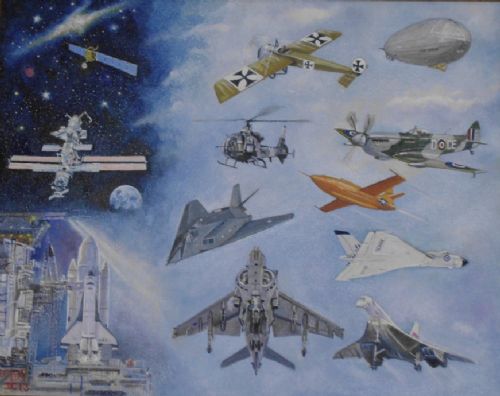
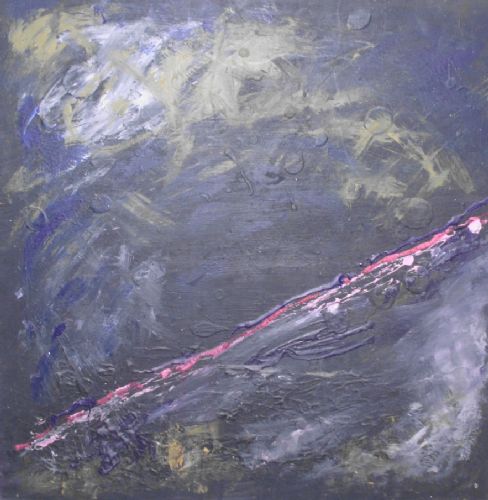
There is a deep melancholy that permeates across the exhibition. A lot of the artists look back onto the last century and question whether things have got better, whether we have made progress. Realist depictions of contemporary life in Salford and Manchester are contrasted with abstract representations of thought.
Underlying all these styles is a political message, sometimes overt, sometimes hidden, but maintaining a frustration that we are still unable to fully learn the lessons of the First World War.
Immediately on the right as you enter the exhibition is Dorothy Pointon's Has Anything Changed?, the winner of the John Clare Award. Her painting depicts a homeless man in contemporary Manchester as city strollers wonder past him uninterrupted. Dressed in green combat pants, the painting addresses a concern for the soldiers who are betrayed upon returning home from conflict, often being abandoned and left to mental trauma and homelessness. The deserved winner of the John Clare Award, this painting is a highlight of the show.
Contemporary concerns remain a theme to enter such historical reflection. George Lee's More Poppies, More Wars depicts a scene of Remembrance Sunday outside the Old Fire Station. The bright green of the grass and red of the brick work is contrasted with the crass black blotches and dead trees that decorate the image. His painting displays a frustration with the repetition of conflict that rings too true today.
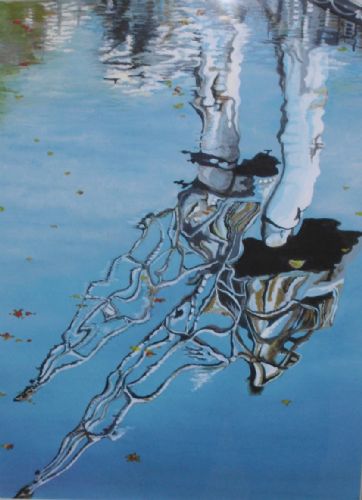
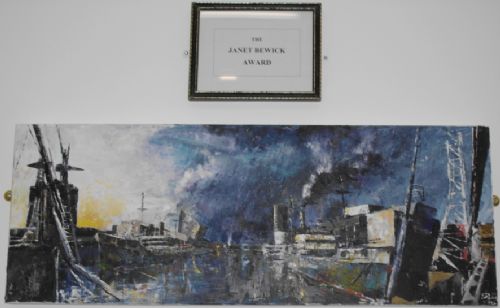
Tom Ward's A Century of Mourning displays a series of poppies surrounded by butterflies with the names of wars and battles that are ongoing. Other scenes contrast the realism with soft scenes of local history. David Coggins' work Silent Cargoes, winner of the Janet Berwich Award, depicts a dilapidated port that is a remnant of the industrial era. Gordon Minton's Deansgate Old and New A Different View contrasts the changes in Deansgate over a century, whilst John Lancaster's Reflections explicitly extends the central theme to local developments, portraying Media City and its reflection in the water below.
The exhibition ends with William Robert's Munitions Factory painted in 1940 and loaned from the Salford Art Gallery. The depiction of the manufacturing weapons echoes the type of industrial slaughter that was so unique to the horrors of the First World War. The working class - too often sacrificed in these conflicts in large numbers and often marginalised in official histories in favour of statesmen and generals - are placed at the centre as a reminder of those truly suffer from these events.
Colonel Mike Glover spoke of the familiar depictions of the First World War being "lions led by donkeys" and how they can be exhausted to the point we deny a real engagement with the impact of the First World War. Artistic challenges seek to expand that, open it up, and rehabilitate it for new generations. This exhibition helps you to discover as well as cultivate your own relationship with this history.
1914-2014: A Century of Change
Salford Art Club
Salford Museum and Art Gallery
Peel Park, The Crescent, Salford
M5 4WU
Phone: 0161 778 0800
until May 2014 free
Opening times...
Monday: Closed
Tuesday: 10:00 am - 4:45 pm
Wednesday: 10:00 am - 4:45 pm
Thursday: 10:00 am - 4:45 pm
Friday: 10:00 am - 4:45 pm
Saturday: 1:00 pm - 5:00 pm
Sunday: 1:00 pm - 5:00 pm
For further details see the website – click here
Words and photos by David Brooke
Main image shows Carol Parkes' Reflections Salford Dock Cranes




.jpg)


.jpg)
.jpg)
(3).jpeg)
.png)
(1).JPG)
