`In respect to older people, Salford's 2020 vision is for a radically changed
health and social care system…Service redesign has to deliver a reduction in costs' Salford Health and Wellbeing Board
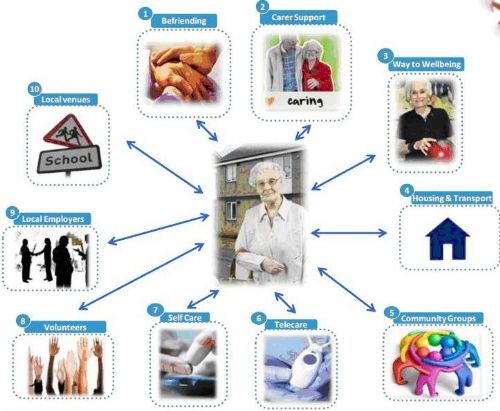
Meet Sally Ford (Sal-ford – get it?). She's 78 years old, retired, divorced and has no children. She rents a council flat in Swinton and is of average health. Sally is a fictional character, or `avatar', dreamed up to be the centre of what is called Salford's `integrated care programme for older people'.
According to Salford Health and Wellbeing Board, people like Sally – and the other 34,500 people aged 65 and over currently living in Salford - are set to "benefit from new ways of working which will improve the health and care they might need".
In reality Sally and co are at the centre of a huge health cuts programme that will see them "deflected" back into their own homes and away from what it calls "unplanned demand for hospital care and expensive packages of social care".
The idea is that elderly people practice Do It Yourself health, where authorities "support older people and communities to care for themselves and manage their own care" so that they are "less dependent on services".
It's about to be sold as giving people more `independence' and `choice' but in the background to the scheme - which might begin as early as April this year - are vicious cuts and the total privatisation of adult social care, with targets and performance related payments for keeping older people out of care and nursing homes and hospitals.
Behind the photos of happy grey haired people that will be published for the public is a very harsh draft document called the Salford Integrated Care Programme (ICP) for Older People Service and Financial Plan (2014/15 – 2017/18). It's waiting to be signed by partners Salford City Council, Salford Clinical Commissioning Group (SCCG), Salford Royal NHS Foundation Trust (SRFT) and Greater Manchester West Mental Health NHS Foundation Trust (GMWFT).
The idea is to pool their services and budgets for older people because "Health and social care services are under unprecedented financial pressure, and it is known that this will increase in coming years." The authorities' answer is not to give more funding to older people's services but to cut them back under the guise of over 65s actually benefiting. The document states, "quality of life should improve for older people and their carers".
Sally Ford does look a bit cynical on the photos of her surrounded by arrows pointing out routes to `self care', `telecare', and voluntary and community groups which are supposed to sort her out. And she's right to be cynical.
Sally is going to have to face the total privatisation of adult social care services which will provide the very minimum of help unless she's dropping on her knees. Or, as the document states; "The strategic direction for Adult Social Care recognises that virtually all services are now commissioned and the new pathways of support for vulnerable adults are more geared to supplying information and advice, building on local assets and networks of support, encouraging reablement, whilst protecting the most vulnerable."
Indeed, life for Sally and co is going to be one of isolation and increasing dependence on family, friends and technology, as the ghost of Dickensian care returns from Christmases past, supercharged for the 21st Century.
Salford City Council minutes from an Audit and Accounts Committee meeting in November on the adult care changes state quite clearly that "The importance of family support and the use of volunteers was recognised."
Meanwhile, the draft Salford Health and Wellbeing Board document states that cuts to adult care have "meant increasingly that people are being asked to consider different types of provision, such as technology rather than people, with some concern and anxiety about this approach".
Stoking up the changes is a bribe from the ConDem Government called, ironically, the Social Care Fund. For 2014/15 Salford Council gets £1.098million to be used to fund the `transition', and for 2015/16 Salford gets £20.161million, of which there will be "a performance related element of £5.250m".
There are targets all over the place to meet this `performance related element' and, while "Failure to achieve the levels of ambition set out in local plans will not result in the withdrawal of performance related funding for 2015/16"..."further consideration is being given to whether this should be introduced in subsequent years".
`Improvement Targets' by 2020 include…
* a 19.7% reduction in `emergency admissions and re-admissions' to hospital – over two thousand people kept away from hospital access.
* a 26% reduction in residential care home admissions – that's estimated at 84 people denied access.
* a 9% increase in people who die at home or in `their preferred place
of dying' [as long as that's not in a care home or hospital eh?] – up from 41% to 50%.
And, ludicrously, there are targets to "increase the proportion of people that* feel supported to manage own condition" and to "increase satisfaction with the care and support provided".
If Salford fails to meet 70% of its target it will have to produce a "recovery plan" to "release the held-back portion of the Fund".
No doubt these targets will be passed onto the private companies who take on the contracts to help Sally Ford and co `benefit from new ways of working'. And they will be under enormous pressure to keep older people out of nursing homes and hospitals, and to prove that older people are `satisfied' with their new lack of care – or they might not get paid, as it's going to be `performance related'. How they are going to do this doesn't bear thinking about.
Meanwhile, to help "support older people and communities to care for themselves and manage their own care" there will be things like a `new contact centre for health and social care' which will give "help, advice and navigation" including the "roll out of telehealth for symptom monitoring and patient education", backed up by the Emergency Duty Team and Care On Call - a 24/7 `rapid response' or `Community Alarm' service' that "could mean individuals are deflected from admission to hospital or an intermediate care unit"…
…Except that Care on Call, we understand, is about to be privatised via a £476,000 cut with the expected loss of thirty jobs. A report from Salford Council's Chief Financial Officer states that Care On Call will have to be "self financing through charges" and that "Levels of charging will be set according to the level of service being purchased by the individual".
Even Salford Council doesn't pretend that its `integrated care programme for older people' is anything but a massive cut to vulnerable older people's services in the city. The Salford Wellbeing Board document coldly states that it's all about "reducing future service demand". However, the changes are already being spun that older people will "benefit from new ways of working which will improve the health and care they might need".
In reality Sally Ford and co will be isolated in their homes, with some inhuman technology and advice leaflets to keep them company, relying on family and friends for any care warmth. Meanwhile, private companies will be stood at older people's doors emptying what's left of their wallets or desperately trying to keep them from going to hospital or care homes to satisfy some performance related clause in their contracts.
From April this year, Salford Council has already stated it will remove social care from adults with `moderate' needs and only look after those with `critical' needs. Over the last three years, Salford Council staff in assessment and care management have been reduced by 18%. For 2014-15, the Adult Care Budget has been slashed by £4.7million.
During 2013/14 there's been an experiment of the `new model' of adult social care with older people in Swinton, Pendlebury, Eccles, Barton and Winton but the results have so far not been published, and, in any case, the trial was done before swingeing cuts have come into force.
From April onwards, if the draft proposals are carried through, any new resources from the Government will be sunk into a Brave New World where `the importance of family support and the use of volunteers is recognised', where there is `technology rather than people, with some concern and anxiety about this approach' and where older people are `deflected' back into their own homes to `avoid expensive packages of social care'.
Something to look forward to in our old age…
• Throughout the document, older people are constantly referred to as `that' rather than `who', giving the impression that the (presumably) health care professionals who (that?) wrote the draft don't see those who they are dealing with as living people - mums, dads and relatives - but as statistics.




.jpg)


.jpg)
.jpg)
(3).jpeg)
.png)
(1).JPG)
