Today the House of Lords is debating regulations under Section 75 of the Health and Social Care Act which deal with 'procurement, patient choice and competition', to open up the NHS to private companies.
"The new Regulations…show clearly that this Government is determined to break up the NHS system that has delivered high quality healthcare at low cost for the last 65 years" says Lucy Reynolds, health policy analyst at the University of London
"Despite clear public support for the NHS, we are being forced down the road to a US system, which places heavy financial burdens on patients, produces worse results than single payer' systems and doesn't even save the taxpayer money" she adds "It is frightening to watch this happen without effective media scrutiny and without the public being properly informed."
The Regulations, if approved, will have a huge impact on Salford because the wealth divide and the health divide are almost geographically the same in the city.
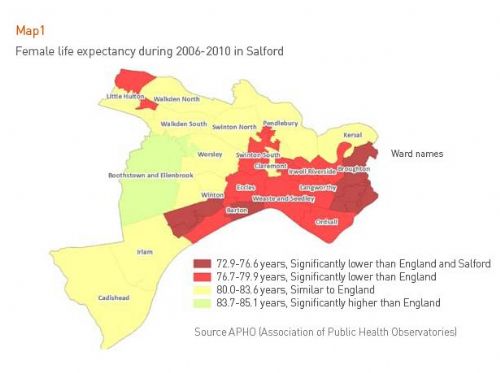
For instance, Salford's latest Public Health Annual Report, which covers the year 2011-12, shows that, if you are female and live in Broughton or Winton your life expectancy is between 72.9 and 76.6 years. If you are a female who lives in Boothstown and Ellenbrook you can expect to live between 83.7 and 85.1 years. That's well over ten years longer.
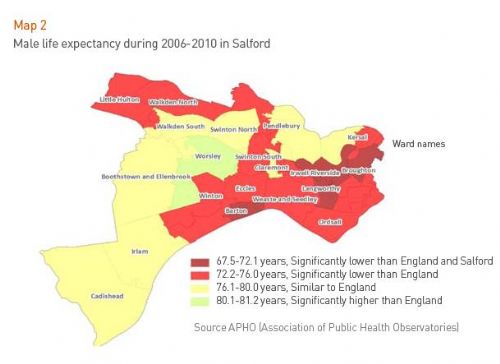
If you're a male living in Broughton, Langworthy, Irwell Riverside or Barton your life expectancy is between 67.5 and 72.1 years. If you're a male living in Worsley you can expect to live between 80.1 and 81.2 years. That's also well over ten years longer.
Campaigners say that if these Regulations go through, instead of benefitting the people who most need the NHS, health services will be geared to those who can afford it – making the health divide in Salford even worse.
"If these Regulations are passed into law, the NHS as we know it will be in grave danger" says Professor Wendy Savage of Keep Our NHS Public "The regulations will put our health service under European competition rules, and it will be almost impossible for commissioning groups to avoid offering `business opportunities' to private companies.
"And there will not be a `managed market', where politicians, hospitals and healthcare professionals can make strategic choices about their priorities" she adds "Rather it will be a US-style market in health. And the impact of austerity policies will make it a two-tier service. There will be a first class service for those who can afford to pay for private health insurance, and at best a basic service, narrowed in the scope of what is offered, for the rest of us."
SOME SALFORD HEALTH STATISTICS*
• While death rates in Salford have been falling since 2009, in line with the North West and England, they are still way above the average for the North West and England.
• Death rates for females in Salford have been rising since 2010, while the rates for England and the North West have been falling.
• Death rates for males in Salford are falling but are still above the average for the North West and England.
• Male deaths from cancer and cardiovascular diseases have been falling but mental and behavioural related deaths are rising.
• Female deaths from cardiovascular diseases and respiratory diseases are falling but deaths from cancer and mental and behavioural related issues are rising. The latter, quite dramatically.
• In Salford the number of new cases of cancer is the second highest in the country. There are 1,200 new cases each year and 600 deaths due to cancer.
• Cancer death rates for under 75 year olds across Greater Manchester show that, in 2009, Salford had the second highest death rate for males, and the highest death rate for females.
• While new cases of HIV are falling, Salford has the fourth highest number of people living with HIV outside London.
• In 2010/11 Salford had the highest number of admissions to hospital for alcohol-related reasons. Salford also has one of the highest rates of liver disease in the country.
• Around 36,500 adults and 6,000 children living in Salford are experiencing poor mental wellbeing. 11,800 adults of working age are likely to have depression, learning problems, mental problems and nervous disorders.
* Statistics taken from Salford Public Health Annual Report 2011-12.
See also previous Salford Star article Ripping The Heart Out of the NHS Protest MediaCityUK – click here



(1).JPG)
.JPG)
(1).JPG)


.jpg)


.jpg)
.jpg)
(3).jpeg)
.png)
(1).JPG)
