"Peel is heavily reliant upon other people's money to fund its enormous ambitions" ExUrbe
In its last statement of public spending over £500, Salford City Council reveals that in just two months (November and December 2012) Peel Holdings was handed almost £2million of public money for projects that are totally obscure to anyone who didn't actually write the cheques.
In November 2012, there were two lots of £560 rent paid to Peel Media Ltd from the Council's Chief Executive's budget. Also paid to Peel Media was just over £45,000 for `service tenancies'. We can guess that these payments are related to rents for The Landing and The Greenhouse at MediaCityUK.
Meanwhile, also in November, Peel Investments (North) Ltd was paid £111,321 in `misc grants' for `capital expenditure'. We know it's something to do with Port Salford but that's about it.
In November and December, a company called Peel Investments (Intermediate) Ltd was paid a total of £1,744,320 in `misc grants' for `capital expenditure' - but for what purpose we have absolutely no idea.
A look at the last accounts for Peel Investments (Intermediate) Ltd reveals nothing about its activities, except that its `principal activities' are "property investment and development and the operation of a golf driving range".
During the year 2012, Peel Investments (Intermediate) Ltd had a turnover of only £654,000 and made an operating loss of over £7million. How and why, we'll never know because its ultimate holding company is Tokenhouse, which is registered offshore in the Isle of Man and controlled by the 1997 Billown Settlement Trust (John Whittaker's private family trust) of which there is no publicly available information.
Yet Salford Council is happy to hand this unaccountable, offshore company £1,744,320. Where are the ethics in that? This example is just the tip of the huge financial, political and moral iceberg that is Peel Holdings.
We in Salford have suffered the Peel Holdings democracy deficit for years (see a zillion Salford Star articles since day one) via MediaCityUK, Port Salford, Burgess Farm, the Barton Renewable Energy Plant, attempted Green Belt destruction in Irlam and Worsley, peat extraction on Barton Moss, issues around the Manchester Ship Canal and Chapel Street, the infamous `Dance With The Devil' tinkering with local elections, and more.
Now Liverpool is getting overwhelmed by the `beast' that is Peel Holdings, related to its massive £10 billion Liverpool Waters and Wirral Waters schemes. An independent Merseyside think tank, ExUrbe, has produced an expose of over 200 pages which pulls no punches. The report concludes, amongst other things… "It is hardly surprising that there is a perception Peel has local governance – if not local authorities themselves – in its pocket"…
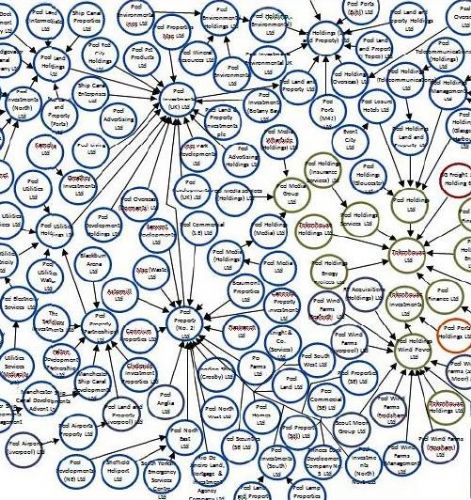
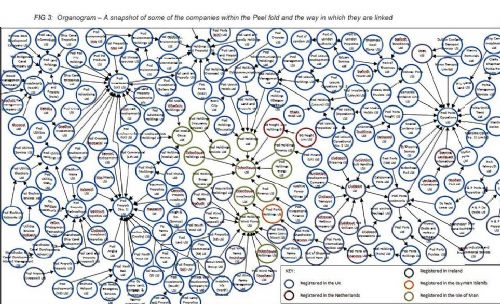
ExUrbe's researchers attempted to map Peel's companies but found "well in excess of 400 individually registered companies, potentially scores and even hundreds more"…
"The lines of governance at Peel – of responsibility and accountability - are nigh on impossible for the lay observer to trace" it adds "We attempted to map out the relationships between the Peel parent and subsidiary or satellite companies but gave up when we could physically fit no more information on the page. Only corporate, legal and financial experts could begin to make sense of the whole."
What the report did manage to decipher is that all Peel's companies, including Tokenhouse Investments (Guernsey) Limited and Peel Ports Holdings (Ci) Limited, which is based in the Cayman Islands, lead to Tokenhouse Limited, registered in the Isle of Man… "At the helm" states the report "sits a tax exile". John Whittaker.
While Peel has reported assets of £18billion, the report questions the conglomerate's financial stability…
"It is nigh on impossible to establish Peel's overall 'worth' or to make any meaningful sense of the way in which it operates financially" it states "That Peel holds valuable assets is a matter of public record. The conglomerate is essentially asset rich, cash poor, however, when it comes to having investment 'readies' to hand.
"For all the public – and by extension, their democratically elected representatives – are able to ascertain, Peel…could be an edifice built almost entirely upon 'virtual' finance."
Indeed, the report states that Peel has "evolved into little more than a brand name for a multi-billion pound investment vehicle concerned first and foremost with cobbling finance deals together piecemeal from a bewildering array of sources, some of them distinctly questionable."
25% of Peel is owned by the Saudi-based Olayan Group, while it has a joint venture deal in Liverpool with a Chinese company, Sam Wa Investments and its distinctly shady President Stella Shiu… "given her reported seniority and influence, there is remarkably little information on record", states the report.
Meanwhile, Peel has been adept at getting millions upon millions of pounds of public money for its schemes, not least in Salford, where MediaCityUK and Port Salford are excruciating examples. Indeed, the report draws on much of the Salford Star's research to illustrate Peel's public money reliance in Salford, while adding that "its projects on Merseyside and elsewhere have received hundreds of millions of pounds worth of EU and UK public subsidy, both in cash and in kind. Little objective analysis has been undertaken to establish the added public value of those historic investments".
"In short" it explains "Peel is heavily reliant upon other people's money to fund its enormous ambitions."
Peel also wields enormous influence amongst public bodies entrusted with funding. In 2010 the Salford Star - watched by John Whittaker, Hazel Blears, John Merry and the Peel Holdings board - actually faced up the then Government Business Secretary Peter Mandelson about the revolving door between the North West Development Agency and Peel Holdings that led to huge public grants for MediaCityUK (see here).
"I'm absolutely delighted that that partnership is working so well here", he responded.
Now Liverpool is experiencing a `Groundhog Day' of the same process, with Peel's Robert Hough, formerly chairman of the North West Development Agency, now chair of the Liverpool City Region Local Enterprise Partnership and sat on Liverpool Mayor, Joe Anderson's 'inner' Mayoral Development Corporation board "the effective decision making structure to develop the Liverpool agenda".
The report notes that "Peel has a presence in every organisation and on every board of note across the city", adding "The power and influence of the conglomerate across the North West generally - and in the Liverpool City Region in particular – has grown remarkably (and disproportionately) over the past few years. It now plays a quasi-political role in the sub-region, so entrenched has its role become in local governance. As a result, it arguably enjoys privileged access to funding streams…"
In another section the report concludes… "The conglomerate's activities have become semi-political, as the lines have blurred between public sector and private sector interests; indeed, public and private interests have been increasingly accepted as one and the same thing, which is patently not the case from a rational, objective viewpoint. What is good for Peel is not necessarily good for the Liverpool City Region populace – and vice versa.
"Given all this, there is little doubt that The Peel Group - a privately owned and privately run concern with an off-shore power base - enjoys unprecedented levels of power and influence across the sub-region generally and in Liverpool, the 'core city', in particular" it adds "This runs counter, surely, to any ideal model of democratic governance?"
And the report goes even further… "By using its vast wealth, actual or perceived, to wield power and influence – and by focusing upon key regeneration and infrastructure projects in often deprived areas - Peel is effectively (if not consciously) holding local and national government to ransom."
But do the schemes actually benefit anyone apart from Peel itself? The report uses MediaCityUK to cast doubt… "The MediaCityUK experience surely raises questions about the guiding principles of a private sector organisation that has been, in this instance at least, so willing to pursue a low-risk strategy by taking public money from several sources but so reluctant to return it to local residents - and prepared to deprive them of both opportunities and rights."
And in a devastating conclusion on Peel's `corporate mentality' the report lists the following traits…
* An indifference to public opinion and a tokenistic approach to public consultation and due democratic process
* Contempt for local government
* A preparedness to enter into any potentially lucrative sector, regardless of experience
* A cavalier attitude to 'soft' (ie: non-commercial) concerns such as public and environmental health
* A similarly cavalier approach to local need and preference
* A readiness to exploit legal loopholes
* A dogged determination, in the face of opposition, to 'win'
* Corporate 'combativeness' – Peel is prepared to fight its corner in the highest courts
* A preparedness to abandon 'sinking ship' projects if and when these prove to be unprofitable
In the Preface to the ExUrbe report, the chair of its Trustees, Peter Kilfoyle writes of Peel…
"That dominance - with no real democratic accountability – makes it necessary to throw a light on the practices, finances and record of Peel. Only with a transparent account of the organisation is it possible to properly assess and judge the nature of the beast to which the Liverpool City Region is now harnessed."
Salford has been harnessed, and is still well harnessed, to the Peel beast, with our elected representatives in the same bed as their Mersey colleagues. It's all very cosy. Until someone scratches the surface. God knows what is going on under the duvet.
The Salford Star recommends that everyone should read this ExUrbe report –click here or go to its website www.exurbe.org.uk and click on Publications, then the report Peel and the Liverpool City Region.




.jpg)


.jpg)
.jpg)
(3).jpeg)
.png)
(1).JPG)
