FRANCES MORRISON: SALFORD'S FIRST FEMINIST
By Michael Herbert
Equal rights for women, relationships based on mutual respect and companionship…and who does the washing up? These radical ideas, usually associated with the Women's Liberation movement of the 1970s, were being debated 180 years ago in Salford by followers of Robert Owen.
Owen was a Manchester mill-owner, who made his fortune in the first heady rush of capitalism in the early 1800s, but then turned against the free-market system, instead advocating, through lectures and pamphlets, a "new moral world" founded on mutual co-operation rather than cut throat competition.
Not surprisingly his ideas were rejected out of hand by his fellow manufacturers and politicians who were quite content with the vast sums of money they were making out of their mills, mines and railways. Owen's ideas on co-operation did, however, take hold amongst groups of working people, who set up co-operative societies and started journals such as the Lancashire and Yorkshire Co-operator and Useful Classes' Advocate, which explained to its readers in the first issue that its object was...
`to expose to the workman's view a real picture of his situation - to awake him to a sense of his powers when in unison with his fellows – to arouse him from his lethargy, like Hercules from slumber; not to deeds of violence, not to take that from others which they have already extracted from him, but to a bold, vigorous, and free enquiry into the causes of his mental and physical degradation, and to an investigation of the nature of the proposed remedy - Co-operation, and the production of a new wealth, hereafter, for his own use and benefit.'
The first Co-operative Congress was held in Manchester in May 1831, convened by the recently formed Manchester Association for the Spread of Co-operative Knowledge, and attended by 65 societies. The Congress issued an address to co-operative societies…
`Co-operation seeks to put the Working Classes in that situation where they shall enjoy the whole produce of their labour, instead of the small part called wages. This can be only done by communities.'
The third Congress was held In London in April 1832, at which the delegate discussed and approved `Articles of Agreement for the Formation of a Community on the principles of Mutual Co-operation'. Article IX read as follows…
Co-operation of Women…
`To secure for the Community the efficient co-operation of one half of its adult members, women; to give them an opportunity of acquiring equal respect and sympathy, by means of equal usefulness, with men: and give them equal facilities with men, of social intercourse and acquiring knowledge; we guarantee to them freedom from the domestic drudgery of cooking, washing, and of heating apartments, which will be performed on scientific principles on a large economical scale, for the whole community.'
The most successful co-operative society in the Manchester district was the First Salford, formed in October 1829. In January 1832 the society set up a Co-operative Sunday School, most of whose teachers had previously worked in Sunday Schools. The Lancashire and Yorkshire Co-operator visited on its second Sunday of opening.
The First Salford has succeeded in obtaining very eligible rooms… `As an instance of their success, we beg to say that we beheld with feelings of unutterable delight…104 male and female adults and children, zealously prosecuting their studies in as attentive, quiet and orderly manner as though the school had been open as many years …Another feature to be admired in this school is, that each Scholar… will be taught that all men are by nature equal…that all mankind are his Brethren; that he should love and be charitable towards those who differ from him in colour, creed or land of birth…'
In 1835 the Salford co-operators opened a Social Institution on Great George Street which could hold up to 600 people. Robert Cooper, one of the teachers at the co-operative school, wrote that the windows "were of stained class, the floors carpeted and the platform neat and elegant, ornamented with mottos in gilt mouldings. Altogether it bore an aspect of comfort and respectability, such as I never saw before or since in connection with an almost purely working class movement."
George Holyoake, historian of the Co-operative movement, visited the Institute in 1838 and recorded his impressions…
`I found my way to the pretty little social institution which I knew existed in Salford, where I knew I should meet some friends familiar with my name as it had been mentioned in The New Moral World read there. James Morrison's widow, a pleasant little person, was mistress of the tea parties at the Salford institute, where I spent the remainder of the day very happily and heard the afternoon and evening lectures.'
Frances Morrison was born in Surrey, the illegitimate daughter of a farm labourer and, aged just 16, ran off with James Morrison, a house-painter tramping the country looking for work. They lived together until she became pregnant, when they got married. They had many children and lived in Birmingham, where Frances ran a newspaper shop and began reading Robert Owen's work. She later wrote to him "Long 'ere I began to think, my reason warred with the absurd forms of society, but from an ill-cultivated and wrong direction given to my mind, I could never get a solid idea until the perusal of your Essays."
In 1833 James, who was an active reformer and trade unionist, became editor of The Pioneer, the newspaper of the Owenite trade union movement, the Grand National Consolidated Trades Union. Frances wrote for the paper under a pseudonym, `A Bondswoman', on issues such as equal pay and the marriage system.
After her husband's death in 1835, Frances became a paid Owenite lecturer and moved to Salford. On 2 September 1838 she gave a public lecture in the Social Institution, Shudehill, entitled `The Influence of the Present Marriage System Upon the Character and Interests of Females Contrasted with That Proposed by Robert Owen Esq'.
She argued for a revolutionary change in the institution of marriage…
"…woman has been made a mere commodity of trade, and the fountain of love has either been choked, or its course directed into the channel of worldly ambition. But in community, money will not be known, neither will the want of it be dreaded, for all that can minister to the comforts of life will be had in abundance; there will, therefore, be no need of this `deadly foe to human weal'.
"If two individuals entertain an affection for each other, there will be no necessity to conceal those pleasing emotions which draw them naturally together, as there will be no distinction in rank, so there will be neither condescension on the one side nor obligation on the other, which ever has, and ever will, constitute a serious drawback on the conjugal felicity of the old immoral world…There will be no marrying for convenience merely (a very cold word), but real affection inspired by real and known worth on both sides. And what surer guarantees can we have for its durability?"
In November 1838 she was in Huddersfield, speaking to large audiences, including many women, on education and on the rights of women, and also performing a ceremony in which she named a child. In July 1839 she spoke at a crowded meeting in New George Street, Shudehill, which was reported in the New Moral World…
`She commenced her lecture with astonishing firmness and composure, and seemed throughout to evince a spirit of devotedness to the cause she advocated which rose superior to the strange position which she, for the first time, occupied.
`The subject of her lecture was confined principally to the feeling and principle which should guide or actuate these who call themselves Socialist. Her manner was peculiarly energetic, her arguments well-arranged, and her remarks judiciously adapted to the occasion, and characterised by remarkable simplicity and delicacy.
`She was listened to with respectful attention and seemed to give general satisfaction. She is the first female in Manchester who had had the nerve to come forward in practical advocacy of our views, and it is hoped that her example will operate as stimulus to others to lend their exertions in promoting the great cause of Socialism, whose interests are so completely identified with their own.'
The Owenites in Salford outgrew the Social Institute and in 1840 put up a new building, which they called the Hall of Science, in Campfield, just off Deansgate. Frederick Engels was a regular visitor during his time in Manchester in the 1840s, for instance. There were regular meetings and educational classes, as well as socials and outings.
The Owenite movement ran out of steam by the end of the 1840s, divided internally, and facing a capitalist society which appeared to be impervious to reform. The Hall of Science was closed and sold to the borough of Manchester to become a free public library; the co-operative societies ceased trading; whilst the small number of Owenite communities that had been established in the countryside folded.
The modern co-operative movement traces its roots back to the Rochdale pioneers of 1844, whose more hard-headed business model was successful, and enabled the movement to prosper and expand. The earlier radical period was largely forgotten. However, the socialist and feminist ideas advocated by the Owenites did not disappear completely, but re-emerged in a variety of social and political movements later in the century.
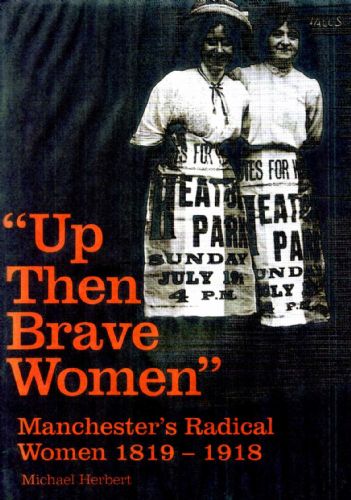
Up Then Brave Women: Manchester's Radical Women 1819-1918
Book Launch: The Black Lion, Chapel Street, Saturday 13 October 6pm.
http://blacklionsalford.tumblr.com/
The book is published by the North West Labour History Society and can purchased from Pat Bowker, NWLHS, 1 Bedford Road Salford M30 9LA for £9.95 p&p. More information; patmbowker@aol.com




.jpg)


.jpg)
.jpg)
(3).jpeg)
.png)
(1).JPG)
