THIS IS HOW SALFORD COUNCIL DOES ITS CONSULTATIONS...
Last week the Salford Star exclusively revealed how Salford Council was about to charge the city's most vulnerable people £3.50 to use its transportation to get to day care centres – click here for the full background story.
In the original Council report it stated that the background papers on the consultation with people who use the transport services were available for public inspection – but despite us requesting to see them, Council officers just wouldn't send them over to us.
Last Friday, the reports finally arrived, a week late, and it's no wonder that the seven Council officers and councillors involved, including the Leader of Salford Council, were dragging their heals…
Eight consultation meetings were held, and 124 people out of the 350 who use the transport service either attended or sent in comments. The people affected have been assessed by Salford Council as "older people, people with learning difficulties, people with complex physical health and or behavioural needs and who can not use other modes or forms of transport".
From what the report states, not one single one of those people (or their carers or families) agreed with the new charge as they raised a massive 27 concerns - ranging from cost, to social isolation, to the possibility of vulnerable people being "subject to bullying on public transportation" - which we print in full below*.
The Report even concludes that 38 vulnerable people currently use the service (10.9%) five days a week which would mean them finding an extra £17.50 a week or £70 per month.
Incredibly the Council report which went from the Assistant Director of Adult Services to the Lead Member Community Health and Social Care, never once mentioned these concerns. The only reference to the consultation in the Report stated… "Through the consultation process people said they wanted a system which…Was easy to use…Fits in with what they do now…Controls the amount taken so they can budget".
No mention of affordability. No mention of isolation. No mention of potential bullying - and all the other 24 concerns.
All the Report seemed interested in was the £123,000 that would be brought into Council coffers following the implementation of the charge, and the best way to implement it.
Indeed, it was only after the decision was made to screw vulnerable people for the £3.50 that the official decision notice stated that the option of "Not charging as people felt they could not afford the charge" was rejected. And… "It is felt that some people may not use the transport because of affordability".
Which all kind of begs the question as to why Salford Council bothered consulting people over the charges in the first place?
The answer to the mad tick box exercise lies in the fact that the Council has to do a `Community Impact Assessment' (CIA), which we also finally got to see.
The CIA states that "The service provides cheap adapted and supported transport to day centres for vulnerable people. Without it some people would not be able to attend". But the Council wants to bring charges in line with those of mainstream bus services, even though it admits that most are on benefits. It adds that "Due to the mobility component of benefits there should be no hardship experienced". But this is not what the user's themselves said in the consultation…
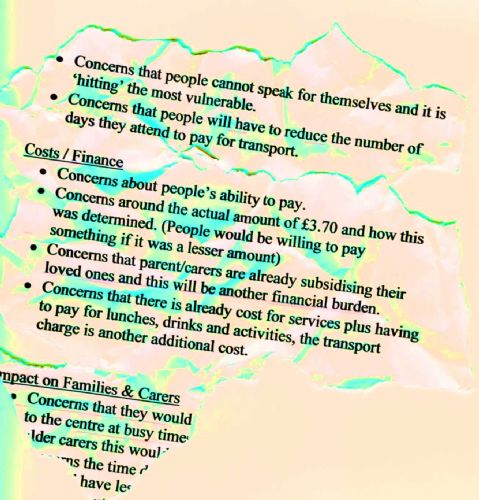
* Here are those 27 concerns…
Service Users
• Concerns about people being socially isolated if they cannot afford to pay the transport charge and will not be able to attend the day centre.
• Concerns that people have a limited income (pensions / benefits) and the additional expenditure will leave people with little or no money left over.
• Concerns that people don't really have a choice if they have to use Social Services transport because of their disability or health needs.
• Concerns that people cannot speak for themselves and it is 'hitting' the most vulnerable.
• Concerns that people will have to reduce the number of days they attend to pay for transport.
Costs / Finance
• Concerns about people's ability to pay.
• Concerns around the actual amount of £3.70 and how this was determined. (People would be willing to pay something if it was a lesser amount)
• Concerns that parent/carers are already subsidising their loved ones and this will be another financial burden.
• Concerns that there is already cost for services plus having to pay for lunches, drinks and activities, the transport charge is another additional cost.
Impact on Families & Carers
• Concerns that they would have to take their son/daughter to the centre at busy times, across the city and for some older carers this would be difficult.
• Concerns the time doing this will infringe on their personal time, and have less time to do other activities, as people have a life outside of their caring role.
• Concerns this responsibility will put extra pressure on families and could result in crisis situations developing.
• Concerns that their son/daughter will not be safe travelling independently and be subject to bullying on public transportation.
Choice & Alternatives
• Concerns there is not an actual choice if people don't have access to a car or cannot use alternative methods of transport.
• Concerns that the alternatives such as Ring & Ride are not reliable and taxis are expensive, Local Link not being available in their areas.
• Concerns that people are currently happy with their transport and if they are not able to use it, they are reliant on their parent/carers for travelling and this is not a choice.
• Concerns that people don't have a choice as to which centre they go to and some have to travel longer distances.
The Future
• Concerns that this is leading to other 'things' happening i.e. centres closing.
• Concerns that this maybe the start of other increases/charges for services received.
• Concerns that people will be moved to a different centre and this may not be based on a decision made by the person.
• Concerns that centres are in the wrong places, and some are on the outskirts of Salford and this makes them difficult to get to.
• Concerns that we are going backwards not forwards.
• Concerns that people may not have enough money in their Personal Budgets.
Application of Charges
• Concerns that the cost is not based on mileage/distance travelled.
• Concerns that there will be a yearly increase.
• Concerns that people may not have the ability to pay.
• Concerns that if people have multiple journeys they will need to pay more than once.
In the CIA one of the sections which the Council has to fill in asks… Can any unfavourable impacts be justified? The Council filled this in `n/a' – or `not applicable'.
Similarly, the Council had to `list any barriers that service users may encounter when accessing services' - `n/a'
…`List any barriers which may prevent people with disabilities from achieving positive outcomes from the service'… `n/a'
The CIA also asks about the findings of the consultation, to which the Council replied…
"Generally people said they would pay the charge as they could not do without the transport. They also said that their preferred method of payment was the post office voucher system. Some people were concerned about their ability to pay and were given the opportunity to have financial re assessment and welfare benefit advice."
`Some people'??? According to our reading of the consultation report it was virtually everyone who voiced an opinion! The strength of feeling against the new charges can be gauged by the fact that, in addition to the consultation, two letters from MPs were also received – and we can assume they weren't in favour of the charges.
For us, this latest sorry episode in Salford Council's recent history shows three things…
1) That Salford Council will put the burden of the cuts on the city's most vulnerable people, while continuing to support `prestige' projects like MediaCityUK and the Salford City Stadium.
2) That the Council does consultations as a pure tick box exercise with no intention of actually changing its path.
3) That when Salford Council is being held up to account for its actions and decisions, it is reluctant to hand over documents that should be in the public domain.




.jpg)


.jpg)
.jpg)
(3).jpeg)
.png)
(1).JPG)
