PART 2
"Salford is now the most studied anthropological tribe since the Amazon!"
Last June at Salford Lads Club in Ordsall, staff from Goldsmiths University of London held an event around the theme of MediaCityUK. Local kids dressed as chefs were serving `light refreshments' and the wine was flowing.
The idea was to bring together people involved in "local media and media training", to show some short films made in Goldsmiths-run workshops with local people, and to have a wider discussion about the "social impacts of MediaCityUK".
After what seemed like hours of short films from around the world, and some from Salford, there were about ten minutes left for the discussion that had interested local community media people. The Goldsmiths staff looked visibly shocked at what they heard…
"We're fed up with big organisations just dropping in and taking all the money" said one bloke who helps some of Salford's most excluded kids get their music to a wider audience "We came here to air our views, not watch a load of films."
Another guy who works on community films stood up and said "This is patronising and condescending – you'd think people in Salford had never heard of the media or something. What we want to know is `Where are the paid jobs for ordinary working class kids around here?'"
He added "There's so many projects around MediaCityUK and the BBC – Salford is now the most studied anthropological tribe since the Amazon!"
The Goldsmiths short film soiree was hastily concluded as Salford people working in "local media and media training" let their opinions rip. What many of those who attended the event or took part in the film workshops didn't know was that they were the community tick box element of a £3.3million project called FIRM - Framework for Innovation and Research in MediaCityUK - financed by UK Research Councils and the North West Development Agency.
FIRM is a "research and innovation partnership" between the University of Salford, Goldsmiths University of London, Lancaster University, University of Cambridge, the BBC, the Massachusetts Institute of Technology and Vision and Media which aims, amongst other things, to "investigate the social impact of MediaCityUK".
Judging by this Salford Lads Club event, the first `social impact of MediaCityUK' was to get the backs up of people in Salford already doing community media work.
The FIRM project has six different `Work Packages' broken into themes. This particular Goldsmiths theme incorporates, "The novelty of the child-like mimetic question 'What is Media City like?'"
Meanwhile, the University of Salford is involved with another FIRM package, part of which is the `Port to Portal' project which entails "the development of an online digital archive which pulls together video and other material, from both professional and user communities, around the main narrative strand telling the story of the area's journey from a world-leading Port to a Portal into the digital age".
This is a remarkably similar project to The Lowry's Unlocking The Quays - "aimed at improving interpretation and increasing access to the history of Salford Quays" - which charts the area's history from, er, port to MediaCityUK portal, with added music, a play, an exhibition and a public art trail for which five artists, none of whom was from Salford, were paid £35,000 each (see here). The Lowry received £464,400 from the Heritage Lottery Fund for this project.
Last year, there was yet another venture "throwing a spotlight on The MediaCityUK Development, its impacts and opportunities for local people and communities". Called New Mornings Old Streets, the idea was for the community to develop "a digital archive and the creation of a film about the changes that are happening around them". This University of Salford led project cost £407,000, including £306,000 from the government's Learning Revolution Fund.
£5000 out of the £407,000 found its way for the Salford Community Media Partnership to produce a magazine, Salford Media Scene. And one feature included interviews with young people in Broughton, only one of whom actually knew what MediaCityUK was (see here). This, despite £320,000 of public money (see below) flooding into `marketing and communications' for MediaCityUK.
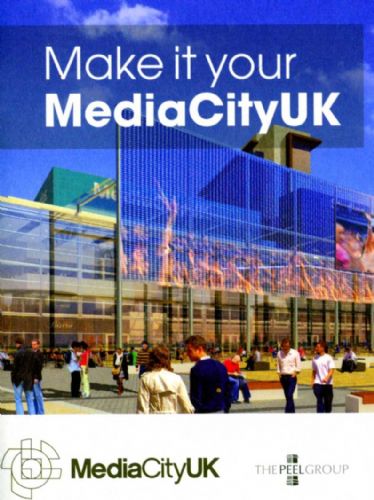
Last year, MediaCityUK PSP or Public Sector Partners - made up of Salford City Council, Central Salford, and the North West Development Agency (NWDA) – also produced a booklet, called Make It Your MediaCityUK. Under a section called `What's In It For Me?', it stated that the partners "are working…on a huge programme that will ensure MediaCityUK has long term benefits for the local area, local businesses and local communities."
The three year PSP Programme was financed by the North West Development Agency with funding of £1,498,500 until March this year. Under the Freedom of Information Act the Salford Star has obtained a breakdown of where that money went, and we can reveal that most of it has been spent on consultants, management, marketing and overheads.
£401,000 was for the `Core' and `Virtual' Programme Teams, including consultants; while £320,000 went on Marketing and Communications, plus £45,000 on Operational Overheads.
A further £732,500 was earmarked for `Research and Consultancy', which included `community engagement' and `new projects'. From this, £102,012 has funded a MediaCityUK Schools Programme (Radiowaves, Supporter to Reporter, Me and My Movies and Higher Futures 4U), and a spokesperson for MediaCityUK Public Sector Partners told us "The majority of activities and projects for local residents to get involved with will come out of our community engagement strategy…which is currently being finalised and looking to start rolling out later this year [2010] and ongoing after MediaCityUK is open."
We now know that the funding set aside for the controversial `community engagement strategy' projects is £161,000 (see here). This makes a total of £263,012. We cannot find any official trace of where the £496,488 remaining part of this £732,500 budget has gone, except under the general heading of `Research and Consultancy'.
If it has gone on `research and consultancy', then added to the other £766,000 that's been spent on management, consultancy, marketing and overheads, this would mean £1,262,488 or 82.5% of the Public Sector Partners Programme's near £1.5million budget is not going anywhere near the community.
Almost six million pounds of public money is currently being hoovered up in researching MediaCityUK, marketing MediaCityUK and `engaging the community' in MediaCityUK.
Meanwhile, Salford's community media groups and artists continue to work for virtually nothing, while having their noses pushed out of the MediaCityUK trough. And Salford Arts Theatre - which puts on affordable events and runs workshops for local kids less than a mile away from MediaCityUK - still has holes in its roof with buckets on the floor catching the rain.
MEDIACITYUK
Public Sector Partners Programme £1.498million: FIRM £3.3million: Unlocking The Quays £464,400 : New Mornings Old Streets £407,000
See also how the BBC didn't bring jobs to Salford (see here)
And how Salford unemployment is rising despite Council claims of 1500 jobs for Salford people at MediaCityUK (see here)
SECRECY AND SCANDAL SURROUNDS ALMOST £6 MILLION OF `COMMUNITY ENGAGEMENT' MONEY FOR MEDIACITYUK: Part 1 (see here)




.jpg)


.jpg)
.jpg)
(3).jpeg)
.png)
(1).JPG)
