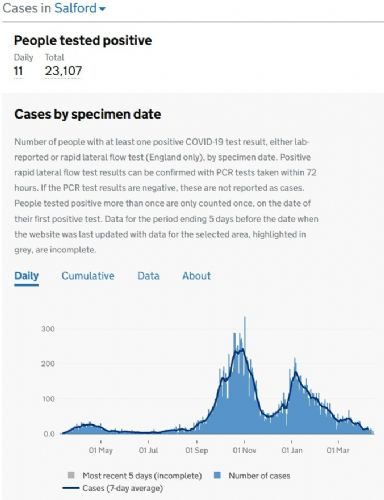
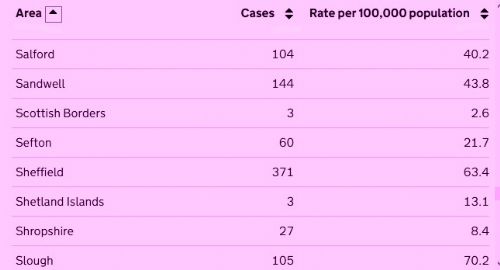
Salford has 11 new coronavirus cases, up from the previous day's 10, which brings the cumulative total of cases to 23,107. The seven day average of cases in Salford is now 104, up from 100, while the seven day rate per 100,000 population now stands at 40.2, up from 38.6.
Elsewhere in Greater Manchester, the seven day average of cases in Bury is 59 (down from 60), with a seven day rate per 100,000 population of 30.9 (down from 31.4); Bolton 140 (up from 126), with a rate of 48.7 (up from 43.8); Manchester 317 (up from 298), with a rate of 57.3 (up from 53.9); and Oldham 144 (down from 151), with a rate of 60.7 (down from 63.7).
Rochdale has a seven day average of cases of 127 (down from 131), with a seven day rate of 57.1 (down from 58.9); Stockport 106 (down from 117), with a rate of 36.1 (down from 39.9); Tameside 77 (down from 80), with a rate of 34 (down from 35.3); Trafford 78 (down from 79), with a rate of 32.9 (down from 33.3); and Wigan 143 (down from 160), with a rate of 43.5 (down from 48.7).
There have been no new virus-related deaths announced by Salford Royal Hospital.
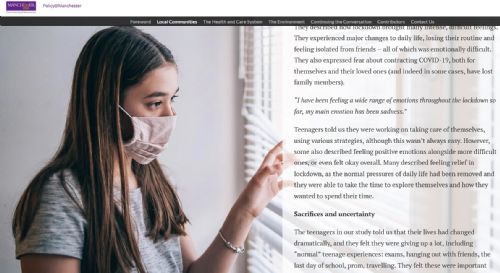
Meanwhile, over the course of the pandemic, academics at the University of Manchester, under the title Policy@Manchester, have been writing blogs on specific research issues which have been pulled together with new recommendations for policy in a report called Lessons from Lockdown.
"Of the blogs we published in the last seven months, three main themes emerged" writes Professor Francesca Gains in the Foreword "Firstly, research insights with relevance to addressing inequalities in both communities of place, and communities of identity, particularly communities who face racial discrimination. Secondly, the consequences and implications for the delivery of healthcare to address health inequalities and to achieve better integration of health and social care. And thirdly, policy messages relating to the social, economic and behavioural implications of new routines for tackling climate change."
The report covers everything from teenage experiences to 'rethinking urban futures with children and young people', to 'developing community-centred interventions'.
To read the full report – click here




.jpg)


.jpg)
.jpg)
(3).jpeg)
.png)
(1).JPG)
